

By Jon Johnson

GRAHAM COUNTY — A local resident is facing potential criminal charges after admitting to grabbing a .410 shotgun and firing at a commercial drone hovering near power lines above his East Sanchez Road property.
According to the Graham County Sheriff’s Office (GCSO) incident report, the Nov. 3 incident caused about $3,000 in damage to the aircraft and prompted a reminder from law enforcement about airspace regulations and the strict illegality of destroying aircraft.
The Incident
GCSO deputies responded Monday afternoon after a resident, identified as Tommy Freestone, called dispatch to report that he had fired a shotgun at an unknown drone hovering roughly 25 feet above his property. Freestone told authorities he believed the drone was spying on or harassing him because its camera appeared to be pointed at him near his house and fence line.
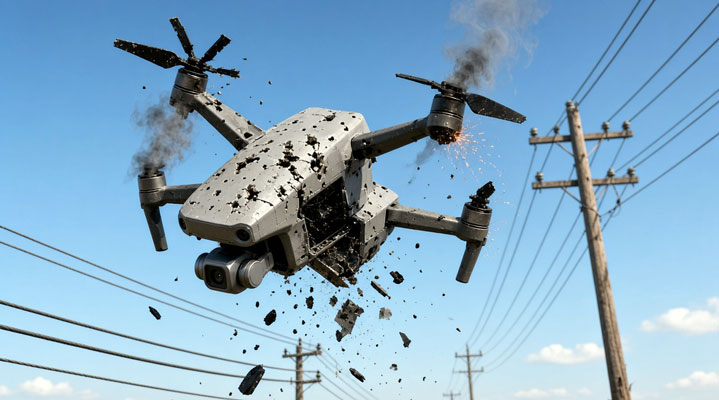
Shortly after, the drone operator of the firm Firmatek arrived at the Sheriff’s Office to report that his equipment had been shot. The drone operator explained that he was contracted by the Graham County Electric Cooperative to survey local power lines and poles. He noted the drone was operating along the roadway and near utility poles when it was struck by birdshot, disabling its controls and causing it to crash and shatter, leaving its camera dangling by wires.
Company representatives said the drone and lost data were valued at around $3,000. While Freestone and his wife expressed a willingness to pay restitution to resolve the matter civilly, GCSO forwarded the case — including a criminal damage charge — to the Graham County Attorney’s Office.
Airspace Legality and the Illegality of Shooting Down Drones
The incident highlights widespread public misunderstandings regarding property rights, airspace, and federal laws governing unmanned aircraft systems (UAS).
- Who Controls the Airspace? Contrary to common belief, property ownership does not extend infinitely upward. Under federal law, the Federal Aviation Administration (FAA) has exclusive authority and jurisdiction over all navigable airspace in the United States, which includes the airspace directly above private residential properties. Commercial operators contracted by utilities may legally fly drones to inspect infrastructure.
- Shooting Down Aircraft is a Federal Crime: Unmanned drones are legally classified as aircraft by the FAA. Tampering with, damaging, or shooting down a drone is a federal crime under 18 U.S. Code § 32 (Destruction of Aircraft or Aircraft Facilities), carrying severe potential penalties, including heavy fines and federal prison time.
- State and Local Consequences: In addition to federal statutes, shooting a firearm at or near a drone can lead to state criminal charges—such as criminal damage, disorderly conduct, or endangerment—depending on the circumstances and proximity to other residences or roadways.
Law enforcement advises residents who spot unauthorized or concerning drones near their homes to avoid discharging firearms, capture photographic or video evidence, and contact the Sheriff’s Office rather than taking matters into their own hands.