

Gila Herald Staff Reports
WASHINGTON, D.C. — In an effort to address a critical flaw in current forest management practices, U.S. Senator Mark Kelly (D-AZ) has teamed up with a bipartisan coalition of lawmakers to introduce legislation aimed at removing the massive piles of debris left behind from forest-thinning operations.

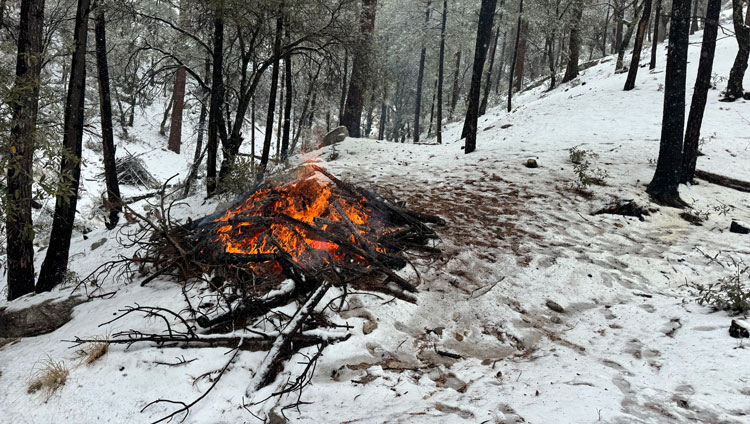
Introduced on Thursday, the Hazardous Fuels Transportation Assistance Act is co-sponsored by Senators Ben Ray Luján (D-NM), Adam Schiff (D-CA), John Curtis (R-UT), and Cindy Hyde-Smith (R-MS). The bill seeks to bridge a financial bottleneck that frequently leaves highly flammable “woody biomass”—such as branches, brush, and small trees—sitting on the forest floor, where it can ironically increase the risk of catastrophic wildfires.
The Cost Barrier of Forest Restoration
Active forest management initiatives, such as Arizona’s Four Forest Restoration Initiative (4FRI), mechanically thin more than 15,000 acres of state forest land annually. However, while chopping down the fuel is the primary objective, transporting the heavy, low-value debris out of remote forest areas to processing or biomass energy facilities is often financially prohibitive for operators.
The problem has intensified recently due to surging diesel prices, with local logging and restoration operators reporting that transport costs spiked by more than a third earlier this year. As a result, the thinned material is routinely left behind in large “slash piles” that remain a severe ignition hazard.
Senator Kelly noted that Arizona communities are all too familiar with the devastating fallout of unmanaged public lands, pointing to last summer’s destructive Dragon Bravo and White Sage fires, which collectively scorched over 200,000 acres on the Grand Canyon’s North Rim and destroyed the historic Grand Canyon Lodge.
“Arizona communities know firsthand the toll of wildfires on natural habitats, the economy, and personal lives,” said Senator Kelly. “Thinning the forest is only half the job. This legislation will help get the material left behind out of the forest to prevent more wildfires and support the jobs, businesses, and forest restoration projects so many Arizona families depend on.”

Overhauling and Codifying Grant Assistance
The new bill seeks to codify and reauthorize the Hazardous Fuels Transportation Assistance program, originally established under the Inflation Reduction Act. By formalizing the program through the U.S. Department of Agriculture (USDA), the legislation would authorize $25 million in annual funding from 2026 through 2030.
Key provisions of the act include:
- Direct Grants: Providing funding to for-profit companies, non-profits, and tribal entities to offset transport costs to processing facilities.
- Infrastructure Support: Covering expenses related to custom wood chipping, loading facilities, scales, and woodyards.
- Equipment and Labor: Allowing up to $250,000 per award to be used to purchase or lease necessary transport equipment, alongside funding workforce training and certifications.
- Funding Caps and Cost-Shares: Capping individual awards at $3 million, with a standard 75% federal cost-share (increasing to a 90% federal cost-share for Native American Tribes).
The program will prioritize projects targeting high-risk “firesheds” and efforts that encourage regional collaboration among industrial, state, local, and tribal partners.
Broad Support Across Arizona and the Southwest
The commonsense approach has drawn widespread praise from conservation groups, logging associations, and state forestry officials who have long struggled with the economics of biomass removal.
“Arizona has already utilized substantial funding from this program to treat hazardous fuels across our state,” said Thomas Torres, Director and State Forester for the Arizona Department of Forestry and Fire Management. “As we scale up forest treatment activities in the coming years, having dedicated transportation assistance for biomass makes the difference between protecting our forests and leaving hazardous fuel on the ground, waiting to ignite.”

Dan Stellar, State Director for The Nature Conservancy in Arizona, echoed those sentiments, calling transportation costs one of the single biggest economic hurdles to executing wildfire mitigation at a meaningful scale.
Locally, the bill has secured the backing of the Eastern Arizona Counties Organization (ECO), as well as national stakeholders such as the National Forest Foundation, the Southwest Loggers Association, the American Biomass Energy Association, and the National Wild Turkey Federation.
By subsidizing hauling costs, proponents note that the bill will not only safeguard rural communities but also supply low-value wood to biomass power plants, using the debris for renewable energy production rather than allowing it to burn uncontrollably on the forest floor.