
By Eileen Mamaghani and Ellis Preston/Cronkite News
WASHINGTON, D.C. – The recent incursion by masked federal agents on Tohono O’odham land didn’t just anger that tribe, which has been trying to block border wall construction along the remote stretch it controls in Arizona.
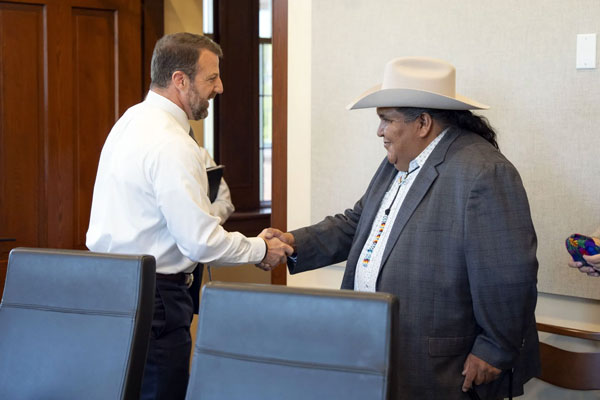
It also infuriated Native Americans who had higher hopes for Homeland Security Secretary Markwayne Mullin, the former Oklahoma senator who is only the second Indigenous cabinet member ever.
“This is especially disappointing when the DHS is headed by … a member of the Cherokee Nation,” said Angelique EagleWoman, director of the Native American Law and Sovereignty Institute at Mitchell Hamline School of Law in Minnesota.

Agents from Customs and Border Protection and the Bureau of Indian Affairs entered the Tohono O’odham Nation at 4 a.m. on Tuesday to prevent tribal authorities from blocking contractors, according to a statement issued that day by the Nation.
Jason Nichols, like Mullin a member of the Cherokee Nation, called the incursion by masked agents a “step backward” in federal-tribal relations – and surprising, given Mullin’s “knowledge on the importance of tribal sovereignty.”
The former mayor of Tahlequah, Oklahoma, was Mullin’s Democratic opponent in 2018 when he won a U.S. House seat. He was dubious about Mullin’s preparation for the homeland security post, he said, but had been relatively impressed with his performance on border policy until this incident.
“What I’m hoping for is that they take a deep breath, you know, take one step back,” Nichols said, referring to Mullin’s department. He called for “substantive consultation with the tribe, because I do think the tribes have proven to be willing and even eager partners.”
Indeed, the Tohono O’odham have long cooperated with the federal government on border security, though the Nation has also strongly opposed wall construction. One all-Native American unit of Immigration and Customs Enforcement called the Shadow Wolves patrols the Sonoran Desert from its base on the Nation.
The Tohono O’odham have members and communities on both sides. Its land spans 62 miles of the border west of Nogales.

In April, a DHS contractor partly destroyed a sacred archaeological site. The Tohono O’odham filed a lawsuit in June to block further construction, and in early August it posted “no trespassing” signs. But on Aug. 14, a federal judge in Washington rejected its request for a temporary pause, despite pleas that construction threatens many other sacred sites.
DHS defended the ongoing construction, though officials deflected questions about the use of force to keep tribal authorities at bay.
“The project will close one of the most dangerous smuggling and trafficking corridors on the Southwest border: remote desert that has facilitated decades of drug loads, migrant deaths, and cartel activity,” CBP commissioner Rodney Scott said in a statement his office provided to Cronkite News. “Congress funded this work, a Federal court has affirmed it, and CBP is carrying it out under the legal authorities that apply.”
According to the Tohono O’odham Nation, contractors engaged in “pre-construction activities” with drilling equipment at three locations. CBP and BIA agents and a SWAT team used a vehicle blockade to prevent their removal by tribal police, who could only monitor the activity from a distance, according to the tribe.
EagleWoman said “the trespassing and covert-style operations” likely violated internal DHS protocols.
Meghan Bishop, director of policy of the National Congress of American Indians, or NCAI, said federal authorities had plenty of better options.
“I don’t think any tribal nation wants to ban people from their lands, but as sovereigns they have the ability and capability to do that,” she said. “The federal government should respect that.”

“From everything that I have seen and understand, the Department of Homeland Security has not engaged in a collaborative, consultative, good fair manner with the nation,” Bishop said.
Another Oklahoman, Joe Deere, a tribal councilor of the Cherokee Nation, also criticized DHS for ignoring the tribe’s objections.
“They have violated treaties before, and they are overstepping the tribal consultation,” said Deere, also a regional vice president at NCAI. “Tribal sovereignty should come first, no matter what protection of the people.”
Aaron Wright, a preservation anthropologist with Archaeology Southwest who advises tribes, noted that Mullin’s experience in Oklahoma is very different from that of someone who grew up on a Nation that spans an international border.
“Obviously, the Cherokee Nation does not share a border with Mexico, and I suspect that there aren’t many, if any, enrolled Cherokee members who live in Mexico and cross that border to visit family and relatives on a semi-regular basis,” he said.
Delvina Charley, an Indigenous activist in Arizona and member of the Navajo Nation, called Mullin a “sellout” who cannot be trusted by fellow Native Americans.
“If this was someone else’s backyard – in Paradise Valley, at the White House – this would be handled differently,” she said.