

Column By Mike Bibb
What do South Carolina, Oklahoma, Mississippi, Utah and Idaho have in common?
They use the firing squad as a means of executing prisoners who have exhausted their appeal processes.
The assassination of Charlie Kirk last September in Orem, Utah, and his alleged shooter’s pretrial hearings have influenced states into instituting the firing squad as a method of execution.
Also, shortages of lethal injection drugs from pharmaceutical companies have contributed to the firing squad solution.

In a previous Gila Herald commentary, I mentioned the option of a state’s use of firing squads and hanging as a lawful alternative to lethal injection — should the chemicals not be available. — “Reignition of an old discussion,” Sept. 23, 2025.
Since hanging and gas chambers are not a favored means of sending a prisoner to his next place of residence, firing squads have gained acceptability in recent years.
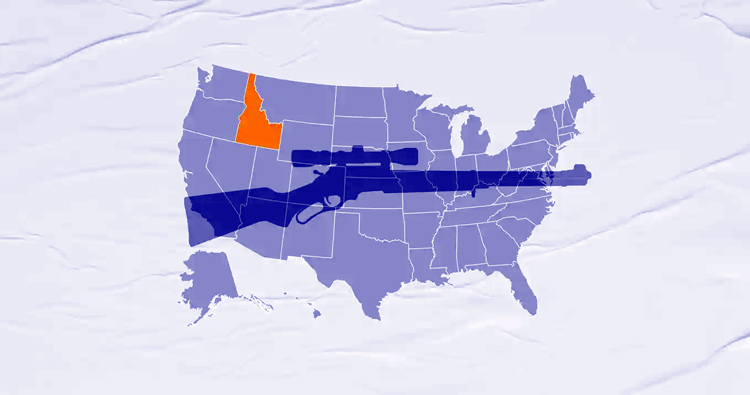
Idaho has become the latest state to join the group of firing-squad enthusiasts.
Reason: It’s a guaranteed conclusion to a years-long legal battle, and no chemical hang-ups can delay completion of the execution.
As reported, “Idaho’s shift to the firing squad stems from repeated difficulties obtaining lethal injection drugs and a botched execution in 2024 involving Thomas Creech, where officials failed to establish an IV line after multiple attempts. Initially, the firing squad was a backup method under House Bill 186 (2023), but House Bill 37, signed by Governor Brad Little on March 12, 2025, made it the primary execution method, with lethal injection as the fallback. The law applies to all executions after July 1, 2026, regardless of when the death sentence was imposed, and grants the Idaho Department of Correction (IDOC) director broad discretion over execution procedures, including squad composition and equipment.” — Copilot Search, July 6, 2026.

This Idaho law went into effect on July 1, 2026. Presently, there are eight people on death row in the “Gem State.”
Of course, there’s a financial price to pay for gearing up a facility to execute convicted felons — “Idaho is spending $1.2 million to retrofit an execution chamber for its new firing squad method, the Idaho Statesman reported.” — “Idaho will soon turn to firing squad executions. Police will pull the trigger.”, Idaho Statesman, June 11, 2026.
A cool $1.2 million to fix an execution chamber seems a bit high. Unless, of course, everything is AI-operated inside a brand new, climatically controlled, state-of-the-art facility.
After all, prison executions are limited to a very small clientele involved in the most serious crimes, and infrequently performed.
Sometimes executions are not carried out for years, due to legal delays, pardons, moratoriums, and other circumstances.
Just because an inmate may be housed inside a death row cell in a state or federal prison does not necessarily mean the execution will actually take place.
Slightly over two dozen states presently have the death penalty as a legal form of punishment. According to “Legal Clarity Team,” April 1, 2026 — “Twenty-seven states currently authorize the death penalty, though only a fraction carry out executions in any given year. Four of those states have governor-imposed moratoriums that pause executions while the statutes remain on the books, and 23 states plus the District of Columbia have abolished capital punishment entirely. In 2025, 47 people were executed across 11 states, and around 2,100 people remain on death row nationwide.”
Obviously, a small percentage of convicts within the entire U.S. prison system are involved in death sentence situations, and a lesser amount is actually carried out.
Arizona is one of the 27 states with the death penalty option.
While all kinds of pro and con, legal and moral arguments are made in death penalty cases, the primary reason for enforcing the sentence is that the crime was proven to be of such a heinous and premeditated nature, and carried out with extreme viciousness, that any chance of rehabilitating the guilty individual is beyond reasonable doubt.
Secondly, what would be the purpose of maintaining a person for life if he/she was convicted of such a wicked crime?
At the cost of thousands of dollars yearly to house, feed, and clothe a prisoner, the financial burden to the taxpayer must also be considered when deciding if it is worth it to allow this particular individual to continue breathing.
What’s the benefit to society to sustain this person until he eventually expires from natural causes in prison?
He/she may be exceptionally talented in a certain academic or mechanical way, but that does not override the fact that he/she committed such a violent crime that no amount of tolerance or extended time in prison could ever undo or compensate for the evil, grief, and sorrow they have inflicted upon a victim’s friends, family, and society.
Whether his/her final moments are ended by lethal injection or firing squad, at least the criminals will have the satisfaction of knowing they received considerably more leniency and legal attention than they permitted their victims.
The media often ignores this fact by excusing the felon’s malicious deeds as the result of socioeconomic disadvantages or racial victimization.
A heart-tugging plea, but it doesn’t override the reality that the crime was intentionally conceived and carried out by an individual with depravity in their motives and murder as their intent.
Then when the time comes for them to “walk their last walk,” reality sets in — no more appeals, no more returning to the safety of a prison cell, no more “I’m sorry” regrets, and no more sunrises.
The lethal injection solution will soon be administered, or the rifle bullet will tear its way into the inmate’s chest.
A final, unhappy ending for everyone involved throughout the procedure.
The opinions expressed in this editorial are those of the author.