
By Elijah Grayson Murray/Cronkite News
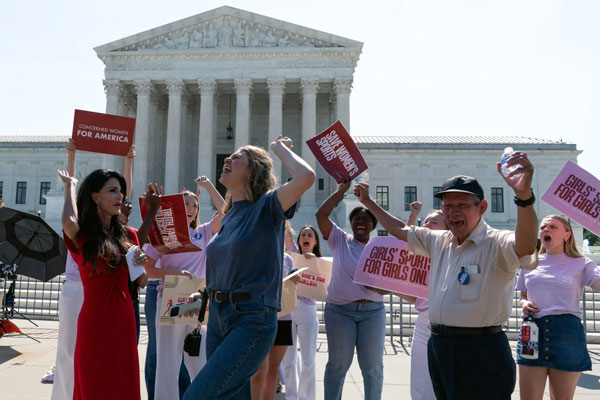
PHOENIX – Arizona lawmakers hailed a U.S. Supreme Court decision on Tuesday that upheld state laws barring transgender girls and women from playing on school athletic teams.
Proponents say the ruling serves as a sought-after validation of efforts by Idaho and West Virginia to enact similar policies, despite attempts from faith leaders, parents and advocacy groups to escalate a lawsuit challenging Arizona’s proposed ballot measure.
Those critics of Arizona’s ballot measure argue that the ruling could not only lead to the harassment, exploitation and bullying of girls, but also distract from underlying issues in the state’s education system.
The ruling in West Virginia v. B.P.J. and Little v. Hecox affirms that states may define athletic eligibility based on biological sex. The Court’s majority wrote that “the States argue – and the Court agrees – that the interests of safety and competitive fairness are important interests for purposes of equal protection analysis.” It also held that “schools may determine eligibility for women’s and girls’ sports based on biological sex.” In another passage, the Court emphasized that Title IX’s regulations require “equal athletic opportunity for members of both sexes.”

Arizona Senate President Warren Petersen, who helped champion the Legislature’s involvement in the case, called the decision “a win for common sense and, more importantly, a win for girls,” in a statement released on Tuesday.
Arizona lawmakers positioned themselves at center of national fight
Petersen and Arizona House Speaker Steve Montenegro filed an amicus brief last year urging the justices to uphold West Virginia’s and Idaho’s Save Women’s Sports Acts. To further advance the states’ support of the two laws, Petersen even traveled to Washington for oral arguments alongside West Virginia Attorney General JB McCuskey and Idaho Attorney General Raúl Labrador.
“Every young woman deserves the opportunity to compete on a level playing field and earn a roster spot, a championship, a record or a scholarship based on her hard work,” Petersen said. “Girls shouldn’t have to lose those opportunities because adults are afraid to acknowledge biological reality. That’s not fairness, and it’s not what Title IX was created to do.”
Petersen further emphasized his support for the cause.
“Arizona has been leading on this issue for years, and we were proud to stand with West Virginia and Idaho before the U.S. Supreme Court to defend girls’ sports. Today’s decision makes it clear that states can continue protecting the integrity of women’s athletics and the opportunities generations of women fought so hard to secure.”

The Court’s ruling, Petersen said, provides “important legal certainty” for Arizona and other states with similar laws.
Arizona’s ballot measure: HCR 2003
The decision arrives as Arizona lawmakers advance HCR 2003, the Protect Girls’ Sports in Arizona Act, a ballot referral that would require K‑12 schools and athletic associations to designate sports teams as male, female or coeducational based on biological sex listed on original birth certificates. As a result, female teams would be closed to biological males.
The House passed the measure 32–25 on Feb. 23. The Senate approved it on June 12, meaning voters will now decide on the proposal on the November general election ballot.
Sponsored by Rep. Selina Bliss, HCR 2003 also includes privacy rules prohibiting schools from allowing students to use restrooms, locker rooms or showers not aligned with their biological sex. If passed, those provisions would take effect Jan. 1, 2027.
Bliss said the measure restores clarity after the Ninth Circuit partially blocked Arizona’s 2022 Save Women’s Sports Act.
“Today the House acted to protect fair competition for girls across Arizona,” Bliss said in February. “Women’s sports were created because biological differences matter. When those differences are ignored, girls lose roster spots, scholarships and opportunities they earned. HCR 2003 gives voters the chance to protect female athletes and establish clear, durable rules for schools.”
She further highlighted what the act entails, and its effects, should voters enact it into law.
“Court rulings have created uncertainty for schools and families,” Bliss said. “This referral allows Arizona voters to decide whether girls’ sports should remain for girls. It protects privacy in locker rooms and showers and restores clarity statewide.”

The measure allows athletes to participate on teams aligned with their biological sex or on coeducational teams. It also prohibits accrediting bodies or athletic associations from penalizing schools that maintain female‑only teams while creating a private cause of action for athletes who lose opportunities or suffer harm due to violations. Furthermore, it protects whistleblowers from retaliation, and it applies to public and qualifying private K‑12 schools.
A split inside Arizona government
Arizona’s Save Women’s Sports Act has been the subject of ongoing litigation, and when the law was challenged in Doe v. Petersen, Arizona Attorney General Kris Mayes declined to defend it. Petersen intervened on behalf of the Arizona State Legislature, and Superintendent of Public Instruction Tom Horne has separately continued defending the law.
Horne said he has spent “education money” to continue the defense after Mayes refused to represent him.
“The newspapers are full of stories about girls who worked really hard hoping to make the team or maybe even get a college scholarship,” Horne said. “And then they come against a biological male who was born with better muscles and better all kinds of physical strength. And they’re devastated. It’s a terrible blow to them. And it’s not fair. It’s completely unfair.”
Arizona Interscholastic Association records show that out of roughly 170,000 high school athletes statewide, they received approximately 16 requests from transgender students to participate between 2017 and 2022. Meanwhile, from a national perspective, NCAA leadership has stated that out of more than 500,000 college student-athletes, fewer than 10 transgender athletes are participating in NCAA sports.
Horne said allowing transgender athletes to compete would defy the purpose of Title IX.
“It’s contrary to Title IX, which was supposed to make it so girls could participate in sports and excel in sports just the same as boys,” Horne told Cronkite News. “When you have biological boys participating, that disappears.”
Horne said biological males have an advantage “even prior to puberty,” citing expert testimony.
“Anybody who’s hung around an elementary school playground knows it,” he said.
He also criticized Mayes for not representing him.
“Two large New York law firms sued us, three of the defendants conceded, and I’m the only one who fought it. The attorney general should have represented me. That was her duty. She refused to do it.”
Faith leaders and Progress Arizona sue to block HCR 2003
On June 22, eight days before the Supreme Court ruling, Valley ministers and the advocacy organization Progress Arizona filed a lawsuit challenging HCR 2003. They argue the measure would harm transgender youth, invite invasive “gender checks” and undermine local control.
“Every kid deserves the chance to learn, play and belong, no matter their race, gender or where they come from,” said Alison Marciniak, executive director of Progress Arizona. “But the same politicians invading students’ privacy with unnecessary gender checks, bullying transgender kids off sports teams, and separating immigrant children from their families are also cutting money from our schools to give breaks to their wealthy friends. Arizonans aren’t fooled.”
Marciniak said the measure distracts from broader education issues.
“We can see when politicians are trying to play us against each other to distract from what they’re really doing,” she said.
The group rallied the same evening of the filing at Title 9 Sports Grill, a bar in Phoenix that prioritizes women’s sports.
Tempe parent Paul Schneider said the measure could lead to harassment of girls.
“We should want more young people to play sports, but a blanket ban on transgender kids would invite anyone to call for a ‘gender check’ on any girl who wants to play sports if they think she is ‘too tall’ or ‘too strong,’” Schneider said. “Local schools and sports associations should be handling this issue, not politicians.”
Rev. Sarah Oglesby‑Dunegan said the measure sends harmful messages to children.
“I’m here as a faith leader and as a parent – as someone who holds the value of each human in our communities as inherently worthy,” she said. “We are facing a moment where we are making decisions that will either expand or limit human flourishing. Our kids are smart. When they see us bully someone, they wonder when they will be next.”
Schneider closed the opposition rally with a call to action for Arizona’s politicians.
“All kids should be able to be on a team without fear of strangers subjecting them to forced inspections,” he said. Let’s call this what it is: bullying. Arizonans aren’t going to let kids be bullied by politicians.”
What the Supreme Court ruling means for Arizona
The ruling does not resolve Arizona’s ongoing litigation, nor does it determine the fate of HCR 2003, but it reshapes the legal landscape in which both will unfold.
Supporters say the decision strengthens the legal footing of Arizona’s proposed ballot measure while opponents say it heightens the urgency of their lawsuit and their campaign to defeat the measure.
Ultimately, the decision is in the hands of Arizona voters to decide whether to adopt the Arizona Legislature’s proposed restrictions, even as litigation continues and national standards evolve.
For more stories from Cronkite News, visit cronkitenews.azpbs.org.