

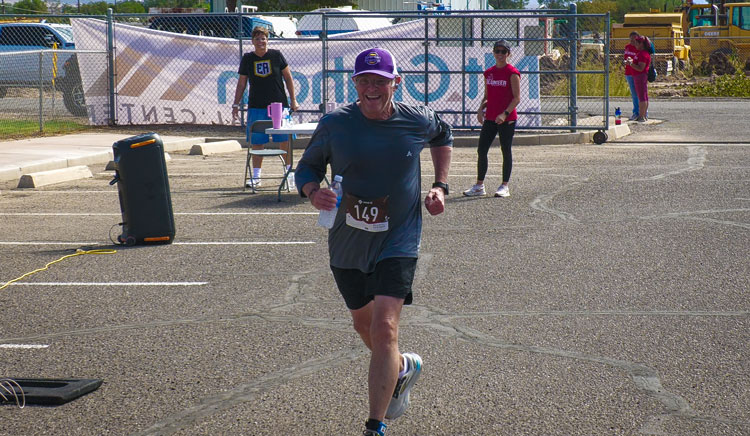
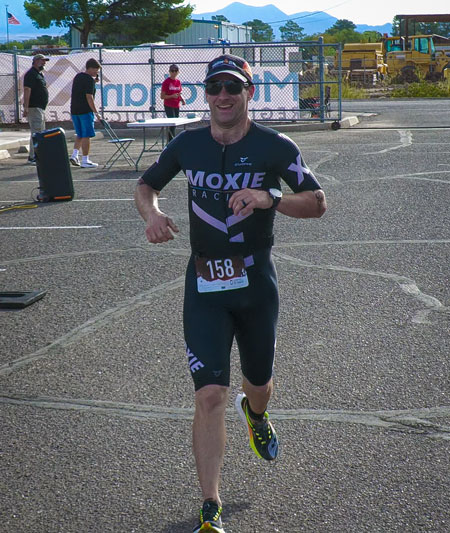
On Sept. 12, Gary Sorensen crossed the finish line of the 16th annual Tri Community Tri in Pima. He was the oldest racer in the field, and according to the Gila Herald’s coverage, he finished with flair. A few minutes earlier, Ross Platt of Florence had won the whole thing. Platt told the paper he tries to come every year and has raced most of the last six.
That second detail is the one race directors should think about. A small-town race lives on the people who come back. Sixteen years of the Tri Community Tri means sixteen Septembers of volunteers on Cottonwood Wash Road and families trying to outrun each other. The race itself remembers all of that. The racers mostly don’t, unless they take something home.
That’s what a medal is for. It isn’t really a prize. It’s the record a race keeps of itself, handed out one piece at a time.
What the swimmers already know

In July, the Safford Pool hosted the summer swim finals for the Safford Bull Sharks, Pima Flippers, Thatcher Rays and Morenci Manta Rays. Pima coach Rebecca Johnson told the Herald that watching her swimmers get a medal or improve their time was what made the season fulfilling.
She put the medal and the time drop side by side, and that’s right. A best time lives on a results sheet. A medal goes home and hangs on a bedpost for years. A kid who swims for the Flippers from age 7 to 14 could end up with a row of them. Whether that row tells a story depends on what’s printed on each one.
Put the year and the number on it
The most common mistake on a local medal is leaving off the details that make it local. A medal that says “Finisher” over a running shoe could come from any race in America. One that says “16th Annual Tri Community Tri, Pima, 2026” can only come from one place and one day.
The edition number matters more than people expect. Regulars start counting. A runner with the 14th, 15th and 16th has a reason to show up for the 17th. Nobody keeps that kind of streak for a generic medal.
Use something the valley owns, too, like Mount Graham on the horizon or the cotton fields along Highway 70. Nobody racing in Phoenix gets that, and it’s the part people point to when they show the medal to someone else.
If you plan to run the event for years, keep one thing the same every year, like the shape or the ribbon colors, and change one thing, like the year or the enamel color. After five years, the medals look like a set instead of five unrelated souvenirs.
What a Tri Community Tri medal could look like
Take the race itself as the example. On the front, the outline of Mount Graham across the top, with three small figures underneath for the swim, the bike, and the run. Around the edge, “16th Annual Tri Community Tri” and “Pima, Arizona 2026.” That’s enough. Small icons get muddy on a medal about 2.5 inches across, and lettering smaller than about a sixteenth of an inch is hard to read once it’s cast in metal.
The back is where most race medals waste space. A plain back can be engraved later with a name and finish time, which matters a lot to a 9-year-old and more than people admit to a 60-year-old. Another option is a simple line drawing of the course, from the Pima Pool out to the hills and back through town. Racers trace it with a thumb and tell the story of where they hit the wall.
The ribbon is the cheapest part to change and the easiest place to thank a sponsor. A local business name printed on the ribbon reads like support, not an ad, and it’s the part the sponsor will actually see in photos.
Who should get one
The Tri Community Tri gave trophies and medals to the top performers. That’s the traditional choice, and it keeps costs down for a nonprofit that puts its registration fees back into local health programs.
But think about who a small race is really for. A fast racer like Ross Platt has other races to win. Gary Sorensen finishing at his age, or a kid beating a parent for the first time, is the moment that race won’t happen again. The math is friendlier than most directors expect. A custom medal needs a mold, and the mold costs the same for 50 medals as for 100. So the price per medal drops fast as the order grows. On the price sheets I work with, 50 enamel medals at 2.5 inches come to about $490. One hundred of the same medal come to about $590. Doubling the order adds roughly $100.
For a race with a hundred finishers, that’s about $6 a person. A director can add that to the entry fee, or ask one local business to cover the whole order in exchange for its name on the ribbon. Either way, the nonprofit isn’t out of pocket, and nobody leaves the finish line with only a banana and a water bottle.
Podium medals can still be different. A larger size or an antique gold finish for the top three separates the winners without leaving everyone else empty-handed.
Order earlier than you think
Custom medals aren’t pulled off a shelf. Someone has to cut a mold from your design before a single medal gets struck. Most makers need a few weeks for that, plus shipping. Directors who order custom race medals two months before race day have time to fix a typo on the proof. Directors who order three weeks out end up paying for rush shipping or handing out medals in the mail.
I run MZIHO, a company that makes medals, so I see the last-minute orders. The ones that go well have the year and the edition number settled before anything else.

There probably isn’t a drawer in Pima yet with Tri Community Tri medals 1 through 16 in it. The 17th could be the first one somebody starts collecting.