
Contributed Article/Courtesy Brando Quinn
SAFFORD – Brando Quinn of Brando’s Fun N’ Sun Travel & Cruise, an Independent Affiliate of Avoya Travel, has returned from an Epic Golden Triangle of India Tour and trekking in Nepal to the Mt. Everest Base Camp at 17,598 feet!
This was “the adventure of a lifetime,” according to Brando Quinn, an Elite Cruise Counselor (ECC) designated at CLIA (Cruise Lines International) and local travel agency owner affiliated with Avoya Travel, a family-owned company in operation for more than 60 years.
I began my journey on April 7, 2026, departing from Phoenix Sky Harbor Airport (America’s friendliest airport) aboard American Airlines, a One World Alliance Partner, which would fly me from Phoenix to New York City (JFK) Airport and then onto New Delhi, India. I was fortunate to be upgraded to first-class seating on the longer flight; the seats fold down into beds, and I was able to get a good night’s sleep before arriving in India.
My choice of Tours was led by Trafalgar Tours, which has been operating since 1947 and has served over five million guests. Trafalgar Tours offers top destinations, iconic sites, and exclusive local experiences, with every detail taken care of! Their 11-Day India Tour from Delhi to Varanasi included the iconic Golden Triangle, spiritual encounter with the Ganges, Jaipur, sacred Varanasi, the rugged wilderness of Ranthambore, and well-known sites such as the Taj Mahal!
I was joined by seven other world travelers from various parts of the world: Australia, Los Angeles, Wisconsin, and elsewhere. Our guide, Abhimanyu Singh, was one of the most knowledgeable I have ever encountered. Having grown up in India, he was ever aware of the mysteries that India exudes throughout the country and offered us personal insights into the inner workings of his homeland throughout the centuries.
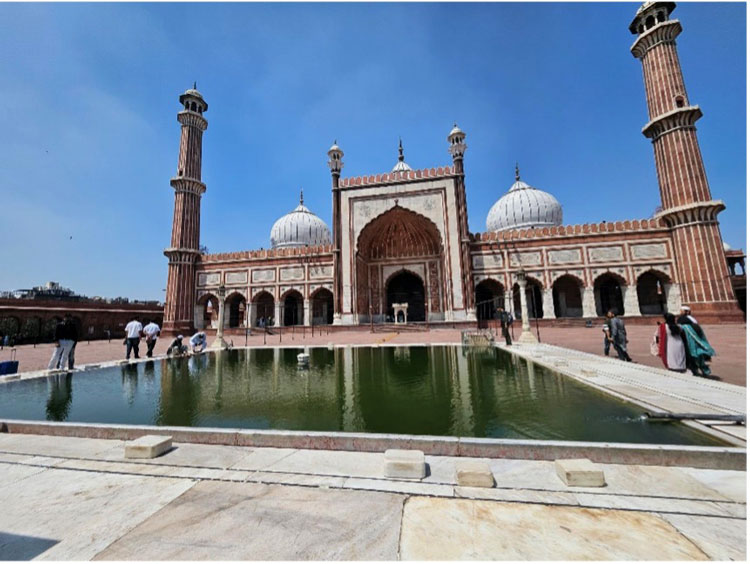
Day one, we settled into our 5-star hotel, the Radisson Blu Towers, and got acquainted with each other. Day two we began our tour through the eclectic city of Old Delhi where we would take an exhilarating rickshaw ride through the busy streets, see the Red Fort a sandstone fortress which once housed the emperors of the Mughal dynasty, and then dove into the culture of the Chandi Chowk market, visit the Jama Masjid, one of the largest mosques in India, and then onto the Raj Ghat a memorial dedicated to Mahatma Gandhi a beloved figurehead who led the campaign for India’s independence from Britain. Our last stop for the day was at the Agrasen Ki Baoli, one of the most noteworthy stepwells in Delhi, hidden amid the cacophony of the streets and business towers rising from the earth’s depths to stand atop 103 stone steps.
On day three, we would embark on a walking tour to the Salaam Baalak Trust experience, a non-profit organization whose sole purpose is to provide a caring environment for street children. We then escaped the noise of New Delhi and ventured to the UNESCO-listed Humayun’s Tomb, an example of the earliest Mughal architecture in India, complete with gardens restored to their former glory, where we could witness firsthand why it served as the inspiration for the design of the famous Taj Mahal.
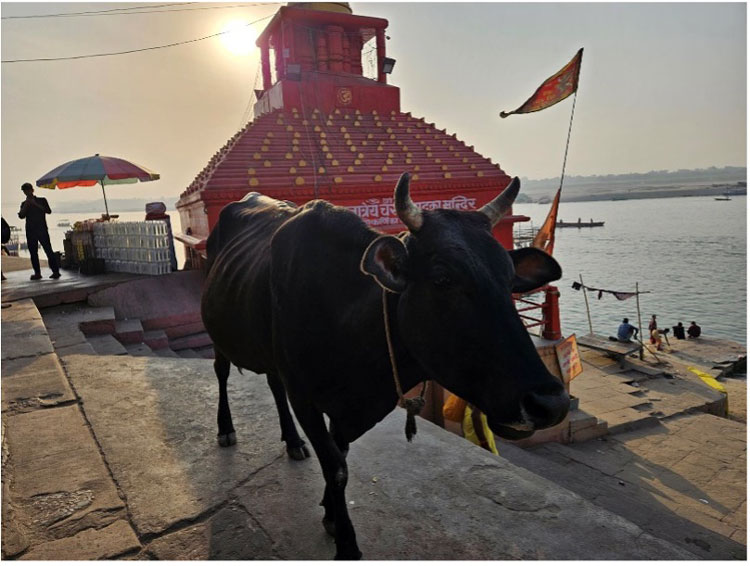
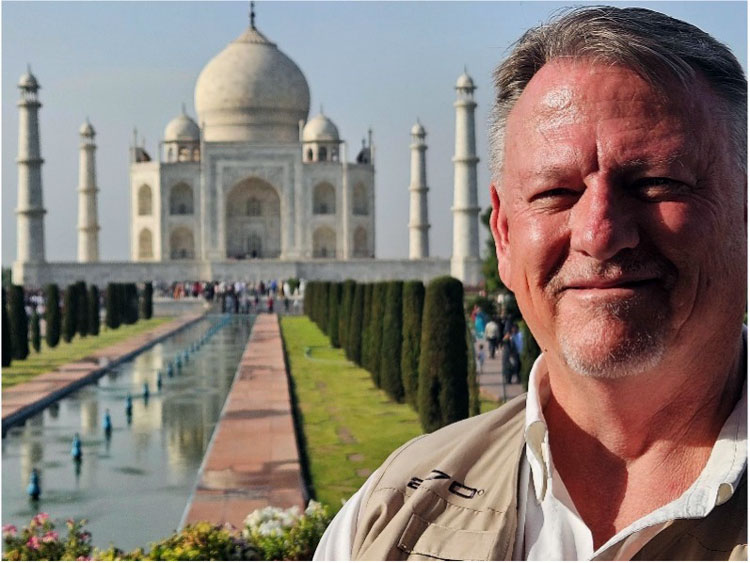
Day four, it was time to leave Delhi behind and head to the Uttar Pradesh city of Agra, home to the “monument of love”, the Taj Mahal. I was spellbound upon first seeing the Taj Mahal with its elegant marble facades awash with sunset’s rose and golden hues. This mausoleum, commissioned in 1632 by Mughal Emperor Shah Jahan to house the tomb of his wife, Mumtaz Mahal, symbolizes eternal devotion, is a UNESCO World Heritage Site, and is considered one of the New 7 Wonders of the World. While in Agra, we also visited the Agra Fort, a 17th-century residence which was once home to the Mughal emperors before the capital moved to Delhi. We explored the Fatehpur Sikri a once grand but now Ghost Town which was built by Emperor Akbar and abandoned soon after.
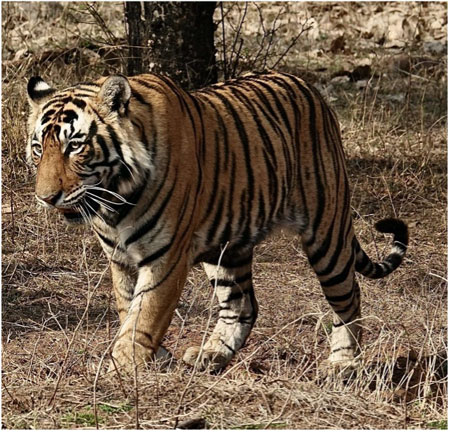
Days five and six, we would then board a train from Agra to Ranthambore to stay at the Shergarh Resort to go looking for India’s elusive tigers in the wilderness of the Rajasthan National Park. Our morning drive to find tigers in the wild was exciting, as we came across a male tiger within 15 minutes of driving into the park. The Bengal tiger ranks among the largest of wild cats and it is estimated that the population of these noble creatures ranges from over 3,167-3,682 as of 2022 estimates. Over the next day, we would locate at least four more tigers roaming freely in the wilderness. Along with tigers, we saw plenty of Sambar deer, chital, nilgai, blackbuck, chinkara, peacocks, lizards, hundreds of bird species, and more!
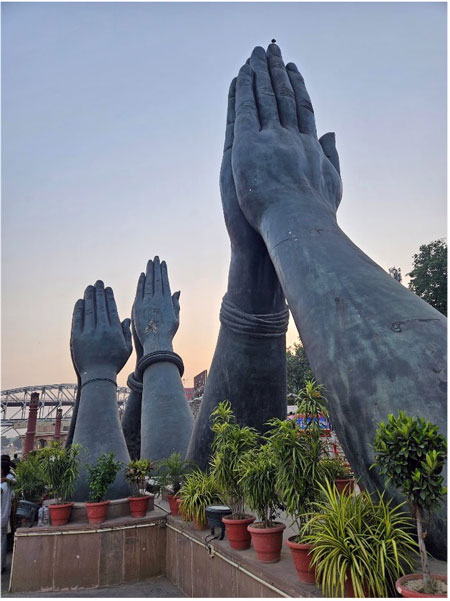
Day seven, our journey took us to Jaipur, known as the “Pink City,” where we would visit a hand-block printing workshop, one of the most famous traditional art forms of Rajasthan, where a local specialist would show us his tricks of the trade as we observed how prints are made using small wooden blocks and indeed were able to hone our own prints using this ancient technique. We visited highly talented local craftspeople who showcased their skills in embroidered textiles, exquisite blue pottery, and plenty of treasures to admire and purchase, if desired. We were then invited to a private home of one of the royal Rajpoot community, where our host shared stories of life in India, served traditional dishes, and gave us a cooking demonstration class, where we all were invited to cook our own daal (lentils) and bati (hard wheat rolls) for a real taste of Jaipur’s culture.
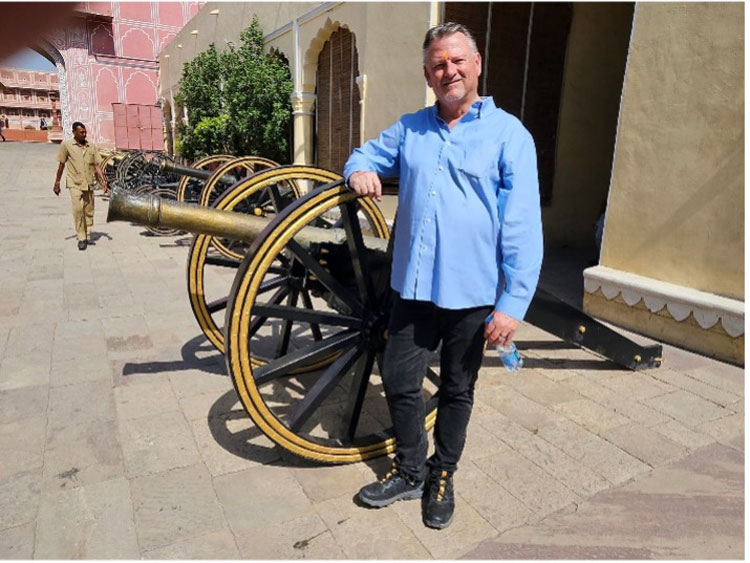
On day eight, we continued exploring Jaipur at the UNESCO-listed Amber Fort and experienced the red-and-pink facades of the Palace of Winds, whose latticed windows once revealed the outside world to the sheltered ladies of the royal household. At the ornate City Palace in the heart of the old city, we would see an impressive complex of buildings and gardens from different eras. We then visited the Jantar Mantar Observatory, another UNESCO-listed site featuring the world’s largest sundial.
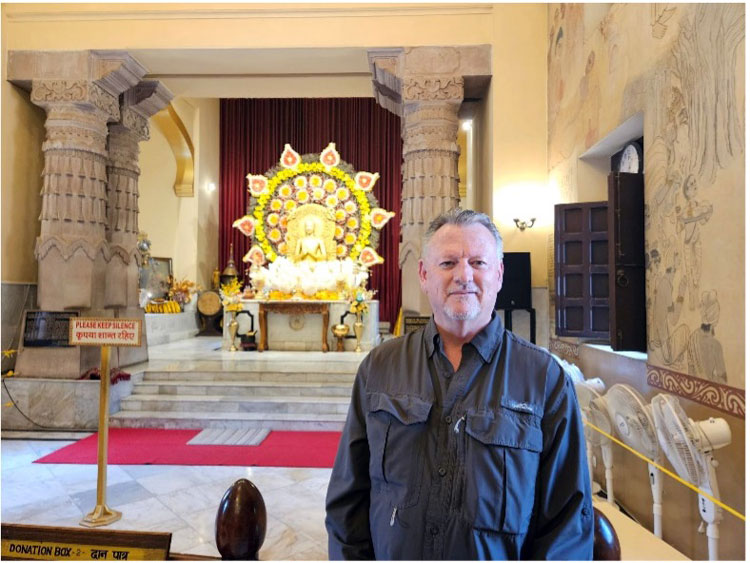
Days nine and 10, we boarded an inter-country flight to Varanasi, the sacred city at the heart of Hinduism, where we would visit the city’s temples, old ghats, and find out why there is such a deep connection to the Ganges River, where daily rituals and centuries of belief have shaped the riverbanks. We witnessed the ritual of Aarti as lamps and flowers are set afloat on the water during an important act of devotion. The following morning, we would rise for an early boat ride along the Ganges, where life was already stirring along the riverbanks, and watch the sunrise over the horizon. A short coach ride to Sarnath took us to one of Buddhism’s most important pilgrimage sites, where we saw sacred monuments and a remarkable collection of artifacts. Sarnath is where Gautama Buddha’s sangha first convened, where he gave his first teaching to his original five disciples, and is known as the site of the “First Turning of the Wheel of Dharma,” which occurred circa 528 BCE, when the Buddha was about 35 years old.
On day 11, the group had a farewell dinner and parted ways. For Brando Quinn, that meant flying from Varanasi to Kathmandu, Nepal, to begin my six-day hiking trek from Lakla, Nepal, to the base camp of Mt. Everest, 17,598 feet in elevation, a journey that would test the limits of my abilities and strength.
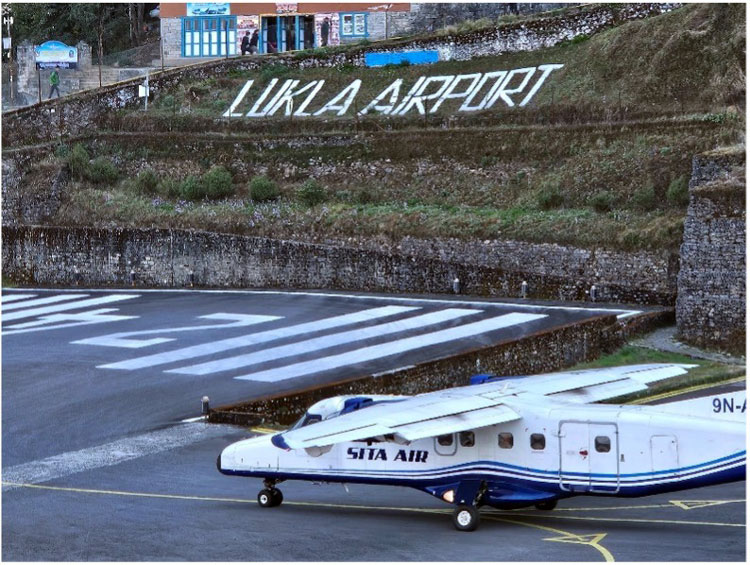
I made my flight on-time from Kathmandu to Lukla Nepal a small town in the Khumbu Pasang Lhamu rural municipality of the Solukhumbu District in the Koshi Province of northeastern Nepal where I would meet my Sherpa Guide and Porter; Mindu Sherpa who has scaled all the way to the top of Mt. Everest in 2014 and has made the trek to the base camp more than 200 times, and his trusty sidekick and my porter Tirtha Man Rai. These two trusted men would be the men whose lives I depended on for the next week to get me from Lukla to the Mt. Everest Base Camp, about 50 miles away over some of the roughest terrain imaginable, scaling from elevations of 2,740 meters to 3,600m to 3,885m, 4,620m, to 5,364m, and finally 5,555m.
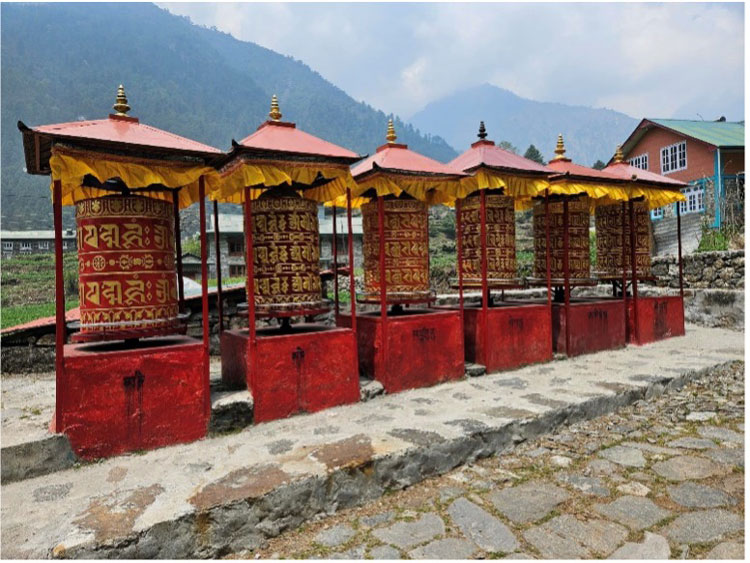
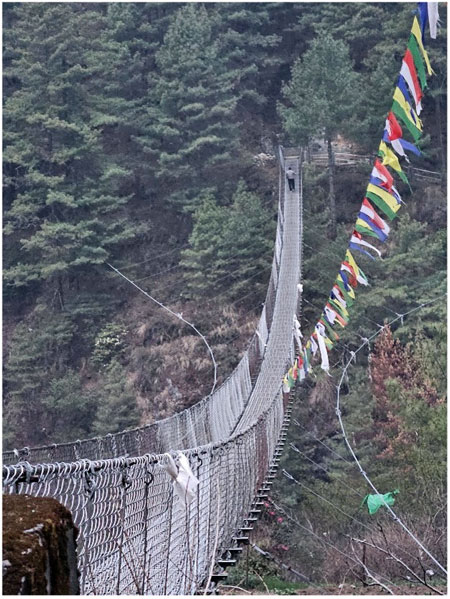
Day one, Lukla to Jorsalle, a trek which takes the best trekker approximately seven to eight hours, covering about 10km, where the trail winds through lush forests, crosses several suspension bridges, and follows the Dudh Koshi River. Along the way, small Sherpa villages offered a glimpse into the local cultures of these amazing mountain dwellers, where everything is brought in by donkey, mule, or cattle, or carried on the backs of the Sherpa people. I made the trek in about 10 hours and was already exhausted; the elevation definitely takes getting used to. We would spend the night at a local teahouse, where food and drink were in abundance, and hunker down for a cold night’s sleep.
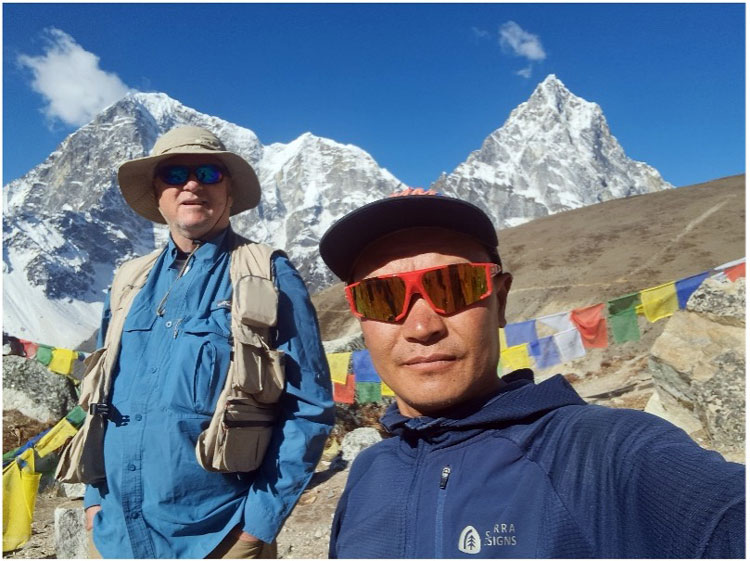
Day two, we begin hiking at 7 a.m. after a solid breakfast of eggs, hash browns, and bacon. Today’s trek is from Jorsalle to Namche Bazaar and then down to Kyanjoma. A trek that typically takes seven to nine hours again took me 10 hours, as every 20-25 minutes, I found myself stopping to catch my breath and hydrate. My guides were very specific on the hydrating aspects of the hike and made sure I always had plenty of water to sip along the route. Today, we will witness stunning panoramic views of Mt. Everest and the other surrounding peaks along the route. There were several steep ascents and crossings of suspension bridges. Once we arrived at Namche Bazaar, we took a short hike to the Everest View Hotel, where the views of Mount Everest were spectacular and motivated me to continue the arduous journey.
Day three, we began hiking from Kyanjoma to Pangboche, a seven-to eight-hour trek that took me another 10 hours. Today would take us on a steady ascent through forests of pine and rhododendron, which were in bloom. Again, offering fantastic views of Everest, Ama Dablam, and other peaks along the way. The trail passed through Tengboche, home of the famous Tengboche Monastery. We made it to Pangboche, where we would again spend the night in a cozy teahouse.
Day four, our trek would take us from Pangboche to Thukla, a six to seven-hour day of trekking that again took me 10 hours. I could feel my energy slowing as the ascent to the higher elevations made each step and each breath increasingly difficult. Nevertheless, I’d made it to the 15,157ft elevation, and even though my pace was slow, it was steady, and I hadn’t experienced any altitude sickness symptoms, so I continued onward. After a gradual ascent along the Khumbu Glacier, we passed through a stone memorial garden dedicated to the climbers who have perished on Everest. A solemn reminder of the beauty of the region, and the deadliness of the trek. After arriving in Thukla, we were treated to magnificent views of the towering peaks of the surrounding valley, with breathtaking mountain vistas that helped prepare me for the final push toward Everest Basecamp.
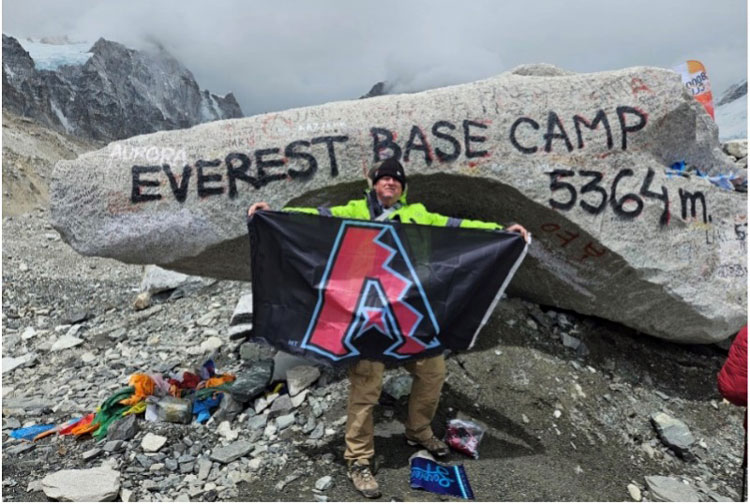
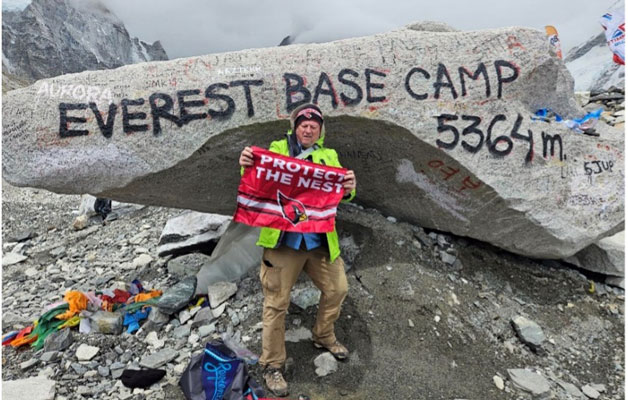
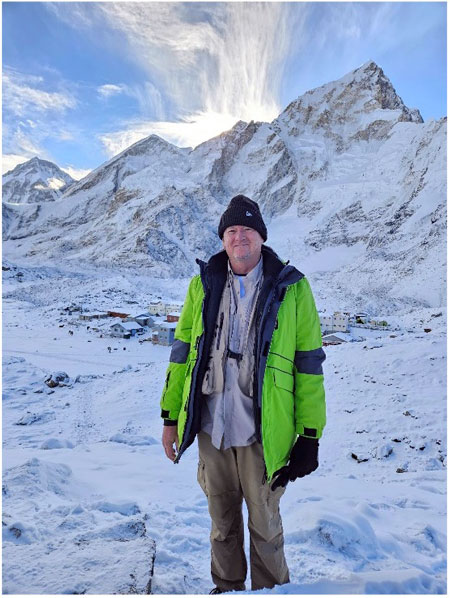
Day five, one of the most exciting days of the trek, promised the arrival at the Mt. Everest Base Camp! The trek took us from Thukla to Gorakshep and Everest Base Camp, normally in seven to nine hours; however, my pace was a steady 10-hour day. From Thukla, we ascended through rocky terrain over the Khumbu Glacier and, after several hours, reached Gorakshep, the last settlement before the base camp, situated at about 5,180m (17,000ft). From here, we continued to Everest Base Camp, the ultimate goal of the trek, at 5,364m (17,598ft). Standing at the base of the World’s highest peak is an experience that can hardly be expressed in words. Before I left Arizona, my Arizona Cardinals ticket representative, Zach Ineson, and the team had given me an Arizona Cardinals Flag to present at the Base Camp, and my Arizona Diamondbacks ticket representative, Baylee Davila, had given me an AZ Diamondbacks Flag to present there as well. My guide delighted in taking my picture holding the team flags. I’ve been a season ticket holder for the Cardinals and DBacks for years and am hoping this hike to the world’s tallest mountain will give them a push towards the Super Bowl and World Series this year.
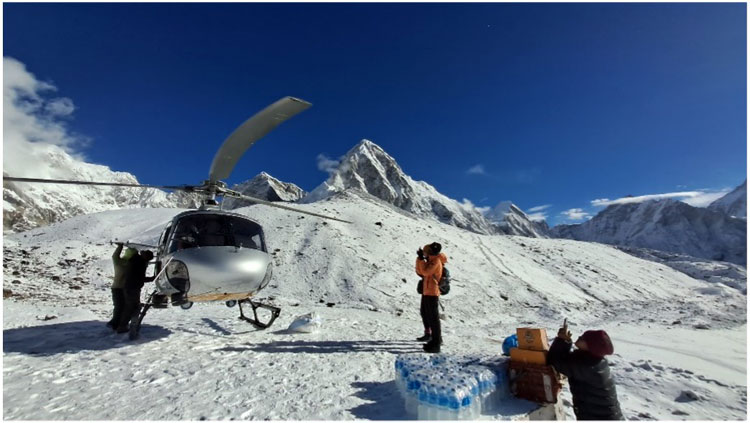
Day six, helicopter ride. After spending another very cold night in Gorakshep, the following morning, the scheduled helicopter picked me up from the landing pad at Gorakshep, flew over the peak of Everest, and headed back to Lukla, where I would board my plane back to Kathmandu, New Delhi, New York City JFK, and arrive in Phoenix about 30 hours later.
This once-in-a-lifetime adventure will forever be in my memory as one of the hardest yet surreal, beautiful, and amazing events I have ever had the opportunity to be a part of. If you or anyone you know is interested in learning more about Trafalgar India Tours, or the Mt. Everest Basecamp adventure, please contact Brando Quinn at Brando’s Fun N’ Sun Travel & Cruise, 513 W Main Street, Safford, AZ 85546, (928) 322-3271, brando.quinn@avoyatravel.com