

By Jon Johnson/Gila Herald
jonjohnsonnews@gmail.com
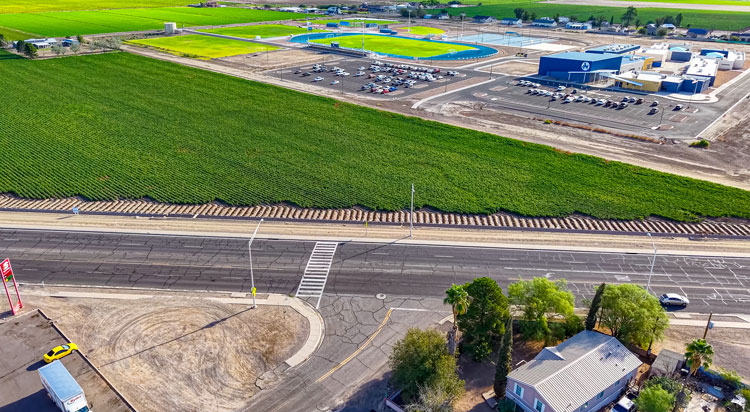
PIMA — Town Manager Vernon Batty provided an updated outlook on the long-awaited Pima High School access road and traffic signal project off Highway 70 and 200 South during the Pima Town Council’s regular meeting on Tuesday, Sept. 8.

While funding streams continue to assemble, community members—including legendary Pima High School basketball coach Stan Smith—raised safety concerns during Call to the Public about high school students speeding through residential neighborhoods because they lack direct highway access.
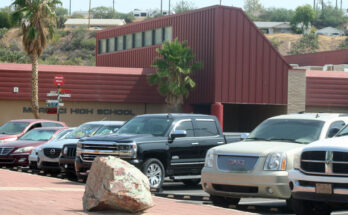
The new $37 million, 67,000-square-foot Pima High School campus opened last fall without a direct entrance from U.S. Highway 70. Instead, traffic has been routed through back roads, including E. Center Street and S. 600 East Street, increasing vehicular volume on local residential streets.
Community Concerns Over Speeding
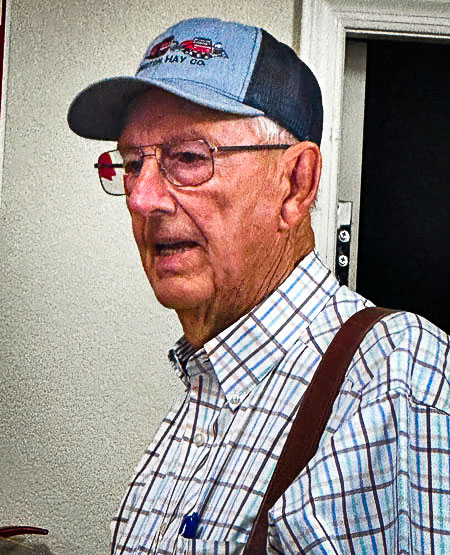
During the Call to the Public, former Pima High School basketball coach Stan Smith—the namesake of one of the school’s gymnasiums who led the Roughriders to six state championships and a 75-game winning streak in the late 1960s and 70s—addressed the council regarding traffic safety near his home.
“I’ll tell you, last year when the kids first started coming down through there, they came down very fast, and the speed I absolutely think it’s picked up this year,” Smith told the council. “I don’t know if we got some new kids, or—and I’m not going to say from which areas they’re coming from—but they come around that corner by the time they hit my house, just before the 25 miles per hour sign.”
Smith, who said he has lived in his neighborhood for 57 years, emphasized his support for local law enforcement while asking the town for help. “It’s just a concern of ours, and if we got that plan, it would help some. I support the local police department… Hopefully, you keep it in mind, and we do something about it.”
Funding Breakdown and Timeline
On the overall status of the project, Batty detailed several secured and potential funding sources to cover construction costs.

“As far as the road goes, we are still working on getting funding,” Batty reported to the council.
Secured and targeted funding sources include:
- $1,000,000 through Rep. Juan Ciscomani’s office via Congressionally Directed Spending / HUD.
- $570,000 via the Transportation Alternatives Program (TAP).
- $337,000 from the Southwest Border Regional Commission (SBRC) through the Arizona Governor’s Office.
- $200,000 (approx.) pending through the Southeastern Arizona Governments Organization (SEAGO).
- $500,000 (potential) requested through Sen. Mark Kelly’s and Sen. Ruben Gallego’s offices for congressional hearing expenses.
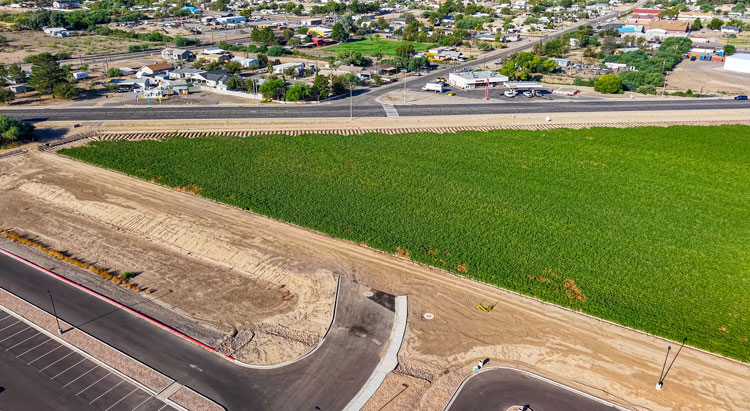
While original total project estimates sat near $2.8 million, Batty said he believes that number may come in lower once engineering plans are complete. Engineering designs are currently sitting at 60 percent.
Batty explained that funds through Ciscomani’s office are administered via the U.S. Department of Housing and Urban Development (HUD), which requires roughly a six-month window before initiating official communications. After reaching that timeframe, Batty has begun receiving initial correspondence to clarify engineering approval workflows.

“Once I have those plans finished to 100 percent, we’ll have a better idea of cost estimate, and we’ll know if we have enough money, or if we even still get enough money,” Batty said. “It’s still my goal, and has been my goal, that we have our funds wrapped up by the end of this calendar year, and then we would be able to go out to bid from there.”
Path to Bidding and ADOT Approval
If funding is finalized by the end of 2026, the town will finalize construction documents for final review. Because Highway 70 falls under state jurisdiction, the project requires final review and approval from the Arizona Department of Transportation (ADOT).
Batty noted that the ADOT approval process typically takes roughly six months once full plans are submitted. If plan approvals and bidding schedules progress smoothly after the turn of the year, construction could follow in 2027, bringing Pima its first full traffic light intersection along the Highway 70 corridor.