


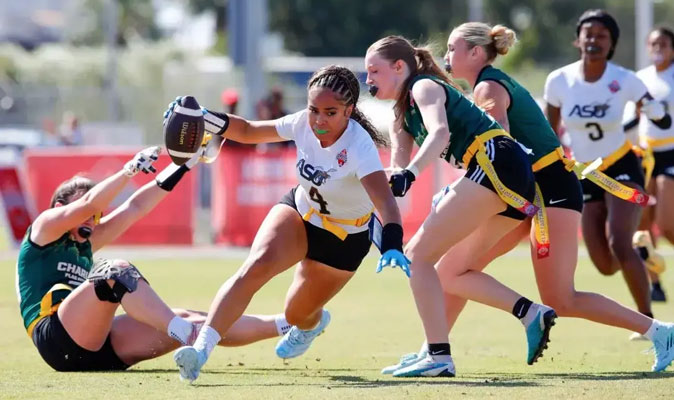
By Shay Moloney/Cronkite News
PHOENIX – Sierra and Sophia Smith, two catalysts behind Arizona State’s new women’s club flag football team, are far from the school’s most recognizable or celebrated female athletes.
That doesn’t mean they won’t end up among the most influential.
“Ten years from now, I think that girls will be able to play from middle school to high school to college to pro,” Sierra Smith said. “That’s what I hope happens.”
For the past few decades, tackle football has ruled America’s sports culture. A counterpart may be emerging on the national stage.
Buried in the news cycle leading up to the NCAA men’s and women’s Final Fours was an important announcement regarding a different collegiate sport – one still in its infancy. Women’s flag football, fresh off achieving “emerging sport” status from the NCAA in January, is now being vetted as a potential sanctioned sport by the Big 12 Conference.

“This effort is really an extension of us doubling down on growing opportunities for women at the collegiate level,” Scott Draper, the Big 12’s Chief Football and Competition Officer, told the Sports Business Journal. “We’re trying to meet the moment.”
The conference’s exploration into flag football’s viability as a collegiate sport is not a solo endeavor. Back in December, the Big 12 revealed a formal partnership with the NFL in order to improve, among many other aspects, referee training, technology developments, and the sport of flag football. This strategic alliance is one of numerous steps the NFL has taken to help launch flag football into the world’s sporting ecosystem, an undertaking that will be on full display in 2028 when it debuts as an Olympic sport in Los Angeles.
“It really helps with their help and focus on the flag,” Draper said of the NFL’s involvement. “With our focus on flag, we’ll be able to really accelerate the growth of the sport, not only at the collegiate level, but at the high school level.”
As is the case with any successful sport, youth and high school participation will be essential to flag football’s long-term survival. Arizona may be paving the way for the rest of the country.

Matt Stone, the flag football coach at Hamilton High School in Chandler, might one day be on the Mount Rushmore of the sport’s most influential figures. In 2007, while teaching at Desert Ridge High School, Stone birthed Arizona high school flag football almost accidentally. Attempting to raise money for his special education program, Stone organized a powder puff football game.
“My initial motivation, just to be really honest, was ‘Oh, I can make a few thousand bucks in a day for my club,’” Stone said of the origins of his event. “Everyone was all in so I started doing my research because if I’m going to put my name on something, I want it to be the very best of that brand.”
Fueled by Stone’s leadership, the game was a massive success.
“I said we’re not going to wear T-shirts, we’re going to get football jerseys. We’re going to help coach the boys up so they can actually learn to coach themselves. We’re going to organize this so it looks like good football,” Stone said of his desire to legitimize the game for the girls wanting to partake. “Through that process, the love of the game was just organically bred into the athletes. It was not a joke. We weren’t going out there to be entertaining and essentially laughed at like so many powder puff games are. They were playing serious football.”
At the end of that night, nearly 20 years ago, a couple of Stone’s students and powder puff players approached him. They wanted to play again, and they wanted to play other schools in Arizona. Stone made it happen, having zero clue what he was in the process of building.
After establishing a flag football team at Desert Ridge to compete informally against other schools in the district, Stone eventually took up a new position at Hamilton in 2014. He wasted no time repeating his efforts.
“Having already started the sport at another school, I wanted to quickly establish a little flag football team here,” Stone said. “We would just kind of play a game here, a game there; each year wasn’t anything resembling a season. And then in 2021, the NFL pledged its money to actually start building the sport in each state. That’s when I went to our district and asked if we could go all in.”

Stone got his wish ahead of the spring of 2022. For the first time in his coaching career, he was tasked with building a team capable of playing an entire flag football season and a full schedule. That’s where the Smith twins came in.
Sierra and Sophia Smith, currently wrapping up their junior year at Arizona State University, were also juniors at Hamilton in 2022. They were natural athletes and already members of the basketball and track teams, so Stone identified the Smiths as potential stars and captains of his flag football team. They went on to become both.
“We had always played sports outside with all of our male neighbors, and loved the game of football. We were like, might as well see what happens and try out,” Sophia Smith said of her and her sister’s decision to give the sport a go. “We went to our first practice, and found out we were really good.”
The twin sisters anchored the Hamilton flag team for two seasons before graduating and enrolling at ASU. The Arizona Interscholastic Association officially sanctioned the sport just a few months later for the fall of 2023. The inaugural season saw 54 high schools compete. Just two years later, that number has grown to 133, and state high school athletic associations across the nation are following Arizona’s lead in sanctioning the sport. Many have even adopted the same rulebook, written by Stone years ago, to help structure the sport.
The Smiths, meanwhile, are now anchoring a new flag football team – Arizona State’s club program – one that did not exist when they first set foot on campus.
“The moment I got to ASU, I took the initiative and started pushing emails out to all of the big dogs on campus. I emailed the AD, and a ton of people in the football realm, to try and figure out how to make this happen,” Sierra Smith said of her relentlessness in getting women’s flag football started. “It’s now our second year being a club team here at ASU, and it’s only going to get bigger and better.”
Sierra worked tirelessly to establish the sport during her first year in school and continued to suit up and take the field with Sophia. The two competed as the only female players on an intramural flag football team during the fall of their freshman year, bringing home the league title at the end of the season.

On April 19, Sierra and Sophia competed for a trophy that carried just a bit more importance, leading their team in the Fiesta Bowl Flag Football Classic, a first-of-its-kind tournament to help put collegiate flag football on the map.
Falling 26-7 in the semifinals to the eventual champions, the University of Central Florida still achieved victory by simply hosting the event. As was the case in founding club flag football at ASU, Sierra Smith was instrumental in ensuring the Fiesta Bowl tournament took place.
“We started having the conversation of what can the Fiesta Bowl do to help ASU, and we started throwing out the idea of a tournament that Fiesta Bowl would put on,” Smith said. “I didn’t really think it was going to go anywhere, but we were really passionate about making it happen. So we did.”
Taking place in Tempe, the Fiesta Bowl Flag Football Classic invited seven other Division I club programs to compete in a two-day tournament, with the semifinals and championship game airing on ESPNU and the ESPN streaming app. It was a monumental first step in the battle for official recognition from the NCAA.
“You grow the sport by putting the biggest names on the biggest stage, and that’s what the Fiesta Bowl did,” Stone, another critical figure in making the tournament happen, said. “I really do believe that what the Fiesta Bowl established is going to spread and inspire other regions of the country to do something similar.”
Stone also noted that the decision to include only Division I club programs, rather than inviting NAIA and other small schools with scholarship teams, was entirely intentional.
“No 16-year-old girl is sitting at home saying, ‘I want to play for Podunk, Tennessee.’ They want to play for Central Florida, they want to play for USC,” Stone said, joking. “It’s the name on the front of the jersey that counts, because in two to three years, those are the best teams in the country.”
After competing in high school flag football, which was not yet a sanctioned sport, the Smith sisters are now living that same reality in college. Despite the fact that they’ll have long since graduated from ASU by the time the Big 12 decides one way or another to authorize it, Sierra is thrilled for the possibility.
“It would honestly take a huge weight off the shoulders of girls like myself. A lot of us founders for these club teams, we’re doing a lot of work behind the scenes that nobody sees,” Smith said of the impact the Big 12 oversight could have. “We’re booking travel, we’re reserving fields, we’re getting the girls to come to practice, we’re trying to figure out our coaches. Having a conference where that weight can be taken off of our shoulders, and we could just be players, it would be huge for us.”
Clearly, a significant amount of momentum and excitement lies within women’s flag football, and the prospect of it one day becoming a sport just like the behemoths of college football and basketball. Outside that community, however, some concerns persist.
One of the main reasons the Big 12 has to “explore” adding the sport, and can’t simply announce the joyous news tomorrow, is that financial and Title IX stipulations exist for its member schools. Money, especially when on the topic of athletic department funding, is the scarcest of commodities. Adding women’s flag football to the directory of sport offerings at a university would likely mean cutting another women’s sport, or at least slashing the funding for other programs significantly.
“You don’t just drop a sport, you also drop the cost of that sport. The scholarships, the travel budget, the facilities, the support staff, all of that goes into this,” Sam Seemes, CEO of the U.S. Track and Field and Cross Country Coaches Association, said of the money side of things.
“You may have noticed recently that tennis programs are being dropped, a fairly low number sport, for sports like acrobatics or rowing where the numbers can be higher. I see flag football as being one of those sports that an administrator will see as bringing to the table qualities that fit their economic and Title IX needs.”
Seemes isn’t just concerned about the number of women’s sports decreasing at the collegiate level – he’s also worried about potential declines in the athlete participation rates within those sports. Multi-sport athletes such as Sierra and Sophia Smith are becoming less common as more and more sports become yearlong commitments.
“People don’t participate in multiple sports the way that they used to, and I think that’s a bad thing for everybody, especially for young kids,” Seemes said of the trend toward sport specialization at the youth and high school levels. “They’re getting told by adults that if they don’t concentrate 100% on this sport, they’re gonna lose out. You’re not going to be able to be on our team, you’re not gonna be able to be in our club, you’re not going to get a scholarship down the line.”
Seemes made sure to add that in no world is women’s flag football at the root of this, but he could see it falling in line with what tackle football has become on the boys’ side. As a leader in America’s track and cross country community, Seemes has to point out these concerns in regard to new sporting developments – but even Sophia Smith, a former high school track and field athlete, sees it the same way.
“I agree completely. We literally have girls on our team right now who were able to get scholarships for track, but instead of pursuing it, now play flag football for ASU,” Smith said. “A lot of girls have transferred over from the sports that they’re used to, to come and try flag football, and they absolutely fell in love with the sport.”
The sport is a tremendous hit with young athletes across the country, with Sophia and Sierra’s story emblematic of the push by athletes and coaches to get it over the collegiate finish line.
Sierra Smith knows that the Big 12 currently holds an important piece of the puzzle for flag football’s future in the United States. Like a growing number of women and girls, Smith hopes the conference uses that piece wisely.
“Hopefully, I’ll be playing for one of those professional leagues, or maybe I’ll be a coach,” she said. “I really don’t care as long as I’m continuing to use my voice to advocate for this game and for this space for young ladies.”