

By George Headley/Cronkite News
PHOENIX – Members of The Church of Jesus Christ of Latter-day Saints have long been staunch Republicans, but this year’s Arizona governor’s race highlights a minority group of churchgoers who don’t feel aligned with the direction their party is going.
Governor Katie Hobbs, a Democrat, selected John Giles as her running mate in the state’s first-ever ticket for governor and lieutenant governor.
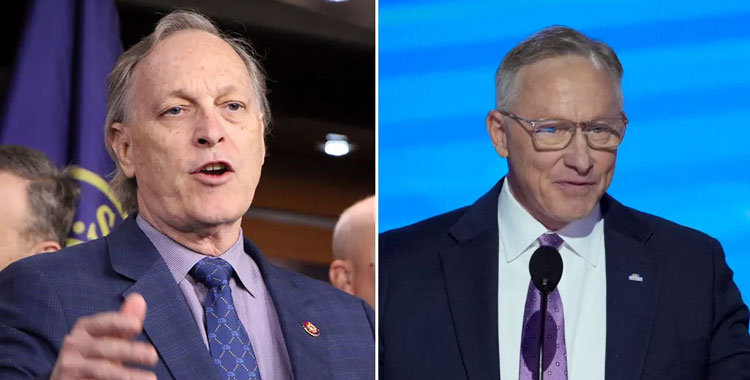
A lifelong Republican, Giles is a member of The Church of Jesus Christ of Latter-day Saints and former mayor of Mesa. In May, he changed his affiliation to “no party preference,” and is running as an independent. The pair is running against U.S. Congressman Andy Biggs of the 5th Congressional District, who is also a member of the Mormon church, a Republican, and a Trump ally, and his lieutenant governor candidate, Sine Kerr, is a former Arizona state senator and a Republican.
Other notable Latter-day Saints members in Arizona who have run for political office have broken away from the Republican Party for their own reasons – and some have faced repercussions for their split – but the divide is coming to a head as the governor’s race has Mormon candidates on both sides of the aisle.
“More and more people, like our neighbors across the street, have had a Trump flag in their yard for 10 years, ever since 2016,” said Julie Spilsbury, former Mesa City Councilwoman and Latter-day Saints member. “In the last two months, it’s now a U.S. flag.”
About 73% of Mormon adults identify as Republican or leaning right, according to the Pew Research Center’s 2023-24 Religious Landscape Study, while 23% identify as Democrat or leaning Democrat. The study showed that Mormons more strongly disapprove of abortion rights and gay rights than Republicans overall, but the reverse on topics like immigration and the strength of diversity in the U.S. The study found that on gay rights, Mormons do appear to be trending less conservative than they have in the past – four in ten now believe gay people should be accepted in society, up from around two in ten in 2007.
Tyler Montague, a Republican political consultant and Latter-day Saints member, said those in the church tend to have a more moderate perspective on immigration because many go on missions to other countries. Last month, the church recorded more than 90,000 missionaries active throughout the world.
“You have people that serve in these other countries, learn these other languages, connect with these other cultures – lots of them in this hemisphere south of our border – to gain empathy,” he said. “That’s a source of friction.”
Another point of contention he’s noticed in the church is how views have changed about President Donald Trump and the MAGA movement.

“Mormons tend to prize humility and servant leadership-type ideals, where leaders don’t view themselves as boastful and don’t exhibit a lot of what you see out of Trump,” he said. “They’re turned off by that.”
Biggs’ past actions, such as election denialism, could directly affect their opinion, but perhaps not the majority of the voting bloc, Montague said.
“He can’t assume loyalty over it, and John Giles on the Hobbs ticket helps give permission to voters that are reluctant to support Biggs, but might feel like they need to,” he said.
Montague also said the Mormon vote can be powerful even though the population makes up only 6% of Arizona, because it’s a very “civically engaged” group.
Jane Andersen, the Arizona director for Mormon Women for Ethical Government, said Latter-day Saints members are encouraged by the church to immerse themselves in the political sphere and be “servant leaders to show up and to turn out.”

She said her organization is focused on engaging Mormon women in civic processes and “advocates for a more peaceful, just and ethical world through advocacy and empowerment.” They are independent from the church, but follow its doctrines as a foundation to their mission.
“We are taught from a very young age that society isn’t something that happens to us,” Andersen said. “That our societal culture is something that we help create.”
Spilsbury, a lifelong Republican, worked closely with Giles when she was a member of the Mesa City Council. In 2024, she joined Giles in speaking out against Trump. The move attracted the attention of Turning Point USA.
The conservative group collected signatures for a recall election of her seat and canvassed against Spilsbury to get her off the council, Politico reported last year. She ultimately lost the recall election.
“We should be supporting leaders who have moral value, moral character, and that are good, decent human beings, and we didn’t see that and recognize that in someone like Donald Trump,” Spilsbury said.
A YouGov analysis, using data from 2007 to 2025 from the Cooperative Election Survey, showed that Republican alignment in the Mormon church dropped by 19%, losing the No. 1 spot to white evangelical Christians.
Giles is not the first independent Mormon member that Biggs has faced in an election. Clint Smith, a longtime Republican, switched his party affiliation and ran as an independent in 2022 for the 5th Congressional District, losing to Biggs. Smith said he’s been in the church for around 50 years and has served in several religious roles, including stake president and mission president.
He said his split from the Republican Party was sparked on Jan. 6, 2021, with the attack on the U.S. Capitol when he noticed his lawmakers’ reactions to the event.
“Not only what Trump and his followers did, but also how the Republicans wouldn’t stand up for what they said they were going to stand up for in the days and hours after the events, including our Congressman Andy Biggs,” Smith said. “I’m still basically conservative, but I can’t be part of this party.”

He said he considers teachings of Mormon faith leaders as an influence in his own choice to turn away from the MAGA movement, taking to heart when the church has emphasized “being peacemakers” and “not voting a totally partisan ticket.”
“Supporting candidates who are honest, good and wise,” he said. “Some people just get so adamant and dogmatic in their beliefs that they don’t hear that stuff, and, in my opinion, there’s not enough of that.”
Latter-day Saints President Dallin H. Oaks has expressed the “peacemaker” message regularly and has spoken at religious gatherings in the past about the need “to moderate and unify.” He also condemned political violence directly after the Jan. 6 insurrection in 2021.
In a speech the year before, he addressed the need to accept election results.
“It means that we obey the current law and use peaceful means to change it,” Oaks said during the October 2020 General Conference. “It also means that we peacefully accept the results of elections. We will not participate in the violence threatened by those disappointed with the outcome.”
While Giles and Smith switched party affiliation to independent, Spilsbury said she is sticking with the Republican label. But she also said it’s at a time when she feels “politically homeless.”
“There’s not really a place for us right now in the Republican Party,” she said. “But there’s a lot of us who are not MAGA, who don’t like what’s happened to our party, and I think John Giles represents that.”