

By Marcus Reichley/Cronkite News
WASHINGTON – Arizona may soon purchase desalinated Pacific Ocean water to help offset shortages in the Colorado River caused by a decades-long drought. The price tag, however, will likely be very steep unless a long-term deal is struck.
A framework signed June 3 by water authorities in Arizona, California, Nevada, and the federal Bureau of Reclamation opens the door for an interstate swap – the first of its kind, according to all parties involved.
“It’s never been done,” said Dan Denham, general manager of the San Diego County Water Authority.
Arizona would cover the costs of desalinated water that San Diego pays for but doesn’t need. In return, California would transfer some of its entitlement to the Colorado River.

With the nearest Pacific beaches nearly 300 miles away, a swap is far more practical than a pipeline to the landlocked Grand Canyon State.
“As a water industry in the West, we’ve contemplated it before, had one-offs of it with Mexico and the basin states, but maybe the urgency wasn’t there. Everything always seemed to just get put on the back burner as hydrology improved,” Denham said.
The water crisis is coming to a head, especially for Arizona.
Negotiations between the three states in the Lower Basin of the Colorado River and four others in the Upper Basin – Colorado, Utah, Wyoming, and New Mexico – are at a stalemate over how to split the declining supply of river water.
Without a resolution soon, the federal government will impose its own plan for dividing the river for the next few years. Arizona faces cuts of up to 77% under a draft released earlier this year.
With that dire outcome looming, Arizona officials have been scrambling.
“As we continue to have our growing issues with the water supply the Colorado River and Mother Nature creates, this is going to become one of the solutions,” said Tom Buschatzke, director of the Arizona Department of Water Resources, “but it will be more expensive than the water that has been delivered from the Colorado River in the past. There’s no doubt that it will.”
Mechanics and cost of a swap
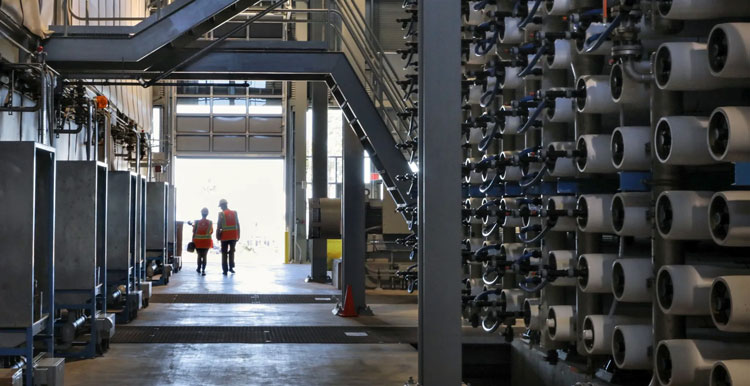
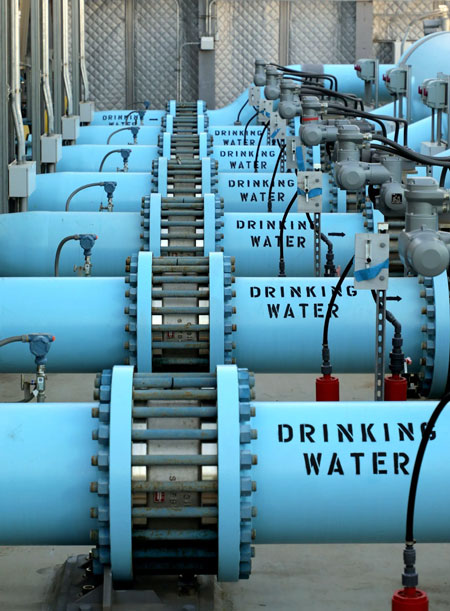
Removing the salt and impurities from ocean water requires tremendous amounts of energy. The San Diego region currently gets about 10% of its water from the Claude “Bud” Lewis Carlsbad Desalination Plant.
“It’s one of their more expensive supplies,” said Leslie Meyers, associate general manager and chief water resources executive for the Salt River Project, which supplies power and water to much of the Phoenix area.
Under a “take or pay” arrangement, the San Diego County Water Authority guarantees payment for a certain amount of water from the plant, whether it uses it or not. In recent years, it has not needed as much as the plant produces.

The surplus would be at the heart of the Arizona-California swap.
The memorandum of understanding between the states sets ground rules for hammering out that sort of deal, though price, quantity, and timing haven’t been negotiated so far.
Even if desalinated water is only a small part of Arizona’s future water portfolio, Meyers said, it provides a real opportunity for Lower Basin states to protect themselves.
“It’s something we all agree on. It’s something we ought to do,” she said.
Buschatzke pointed towards desalination efforts in Mexico as an example of how expensive the process can be. The high costs underscore that agricultural and other major industries would likely not benefit from desalinated water in the short term.
“When we looked at desalination in Mexico, you were talking like $3,000 an acre-foot. … Their profit margin isn’t big enough, unless somebody subsidizes the cost,” he said.
The San Diego County Water Authority currently pays $3,500 per acre-foot to operate the Carlsbad plant. Arizona pays about one-tenth that – $365 per acre-foot – for water delivered by the Central Arizona Project, the state’s main water distributor.
Denham said $3,500 is a ceiling, not a floor, and the final price would hinge on the structure and duration of a deal.
“A one-time spot water transfer, one year, small amount, it’s arguably going to be at the cost of $3,500 an acre-foot,” he said, adding that the price would be lower in a long-term deal.

San Diego has sold $80 million worth of water to neighboring water districts in Southern California, the Eastern Municipal Water District and Western Municipal Water District. The former purchased 30,000 acre-feet for $19 million, or about $633 per acre-foot, according to Denham.
How much water can San Diego sell?
The Carlsbad plant has a capacity of 56,000 acre-feet of water per year, with a possibility of adding another 6,000.
San Diego is currently using roughly 40,000 acre-feet.
About 10,000 acre-feet could be made available for interstate transfer within six months to a year, Denham said. In the long term, the volume could grow substantially.
Factoring in San Diego’s recycled water and reuse projects, which Denham said qualify under the terms of the MOU with Arizona, up to 100,000 acre-feet could be swapped.
That’s enough to supply the city of Phoenix for 3 months.
The San Diego County Water Authority initiated the tentative deal with Arizona. But such a deal requires approval from the Metropolitan Water District of Southern California, and from the federal Bureau of Reclamation, officials said.
The Central Arizona Project, which controls the aqueducts that carry water into Arizona, would also have to sign off.
Sarah Porter, director of the Kyl Center for Water Policy at Arizona State University, is skeptical such a deal would come together because of demand within California.
“It’s a huge hurdle to get Met and the other cities to agree to let San Diego County Water Authority do this deal when potentially that water could benefit them,” she said.
With so many stakeholders on board, Denham said he does not anticipate federal opposition.
An ocean full of opportunity?
Many hydrologists, civil engineers, and policymakers believe that a serious federal investment in desalination can end water scarcity.
Nuclear-powered desalination has been heavily documented as a sustainable method of supplying the immense amount of energy needed to clean ocean water.
Florida and California currently lead the nation in the amount of consumable water produced through desalination. Florida gets almost 10% of its supply from desalination. California gets less than 1%.
Most of Florida’s desalinated water comes from brackish water, which is significantly less salty than ocean water and requires far less energy to process.
Desalination has been widely adopted in parts of the Middle East. Qatar, a Persian Gulf nation that lacks rivers and natural freshwater lakes, gets nearly all of its municipal and industrial water from desalination plants.
Israel, on the Mediterranean Sea, gets 85% to 90% of its water from desalination.
Both largely rely on their natural gas reserves to generate the power needed for water purification.