


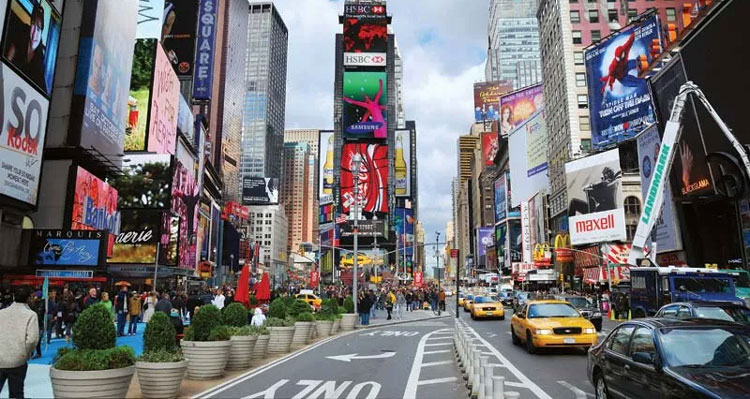
New York City’s streets have long operated at a level of controlled chaos that residents accept as part of daily life. Gridlock on the FDR, buses crawling through Midtown, delivery trucks double-parked on every other block. These are not anomalies. They are the baseline. The real question is whether technology, from toll systems to smart signals to connected infrastructure, can move that baseline in any meaningful direction.
The Scale of the Problem Is Hard to Overstate
Before evaluating solutions, it helps to understand what the city is actually up against. Drivers in NYC lost 102 hours to traffic delays in 2025, and those delays cost the average driver $1,879 while draining the city’s economy of $9.7 billion. That is not just an inconvenience. It is a structural drag on commerce, air quality, and public health that no single fix is going to resolve overnight.
The congestion is also unevenly distributed. Certain corridors, certain hours, and certain boroughs bear a disproportionate share of the burden. Technology works best when it is aimed at those pressure points rather than applied as a blanket solution across an entire metro area.
Congestion Pricing: The Toll Booth Gets Smarter
The most significant technological intervention New York has made in recent years is congestion pricing, which launched in January 2025. The system uses electronic tolling infrastructure to charge vehicles entering Manhattan’s central business district, with the goal of cutting vehicle volume and funding transit improvements.
What the Data Shows So Far
The early results have been notable. Comparing January through mid-March 2025 to the same period in 2024, congestion in the tolled area of Manhattan dropped from 24.7% to 16.9% (according to TomTom traffic data). All told, some 27 million fewer vehicles entered the congestion zone in 2025 than in 2024, per the MTA.

The Ripple Effects Beyond Manhattan
The benefits have not been limited to the toll zone itself. In the Bronx, time lost to traffic jams dropped from 2,384 hours per average weekday before congestion pricing to 1,984 hours per average weekday after it was put in place, a 17 percent reduction. Rush hour delays in the Holland Tunnel are down 65% since congestion pricing began, and MTA express buses in the Lincoln Tunnel are moving nearly 24% faster than in 2024.
The Limits of a Toll-Based Approach
Congestion pricing is not without critics. Suburban commuters who depend on personal vehicles argue the toll is an added financial burden rather than a genuine behavioral incentive. Some traffic has also redistributed to corridors outside the zone rather than vanishing entirely. A pricing mechanism can shift where congestion happens, but it cannot eliminate the underlying demand for road space in a city of eight million people. That demand is not going anywhere.
Adaptive Signal Technology and Smart Infrastructure
Beyond tolling, cities have increasingly turned to adaptive traffic signal systems that adjust timing in real time based on actual vehicle flow. Traditional fixed-signal timing was designed around historical averages, which means it performs poorly during unexpected surges or special events. Adaptive systems use sensors and algorithms to respond on the fly, shortening red lights on backed-up corridors and extending green phases where traffic is moving.
New York has piloted these systems on select corridors. Results tend to be modest but real: faster average speeds, fewer stop-and-go cycles, reduced fuel consumption. But the challenge is scale. Retrofitting thousands of intersections across five boroughs requires capital, coordination between city agencies, and ongoing maintenance. Technology that works well in a controlled pilot does not always translate cleanly to the full complexity of New York’s street grid.
The Pedestrian Safety Dimension
Traffic technology conversations often focus on vehicle throughput, but the people walking those streets have a stake in these systems too. Fewer cars moving faster is not automatically safer for pedestrians. Speed and inattention remain the primary causes of serious pedestrian injuries, and the relationship between traffic volume and pedestrian risk is not straightforward.

When streets become more chaotic, the consequences fall on foot traffic first. Uneven pavement, obstructed sightlines, and rushed intersections create conditions where a pedestrian can be seriously hurt without a vehicle ever being involved. A slip and fall lawyer handling cases in the Bronx will tell you that sidewalk and intersection hazards account for a significant share of injury claims, many tied directly to the physical environment that traffic patterns shape.
Crashes in Manhattan’s Congestion Relief Zone are down 14%, and traffic injuries in the zone are down 15% since congestion pricing launched. That is a meaningful data point. But injury trends in the outer boroughs have been less consistent, and the city’s sidewalk infrastructure remains a separate problem that tolling and signal timing do not address.
Connected Vehicles and the Longer Horizon
The next wave of traffic technology involves vehicle-to-infrastructure communication, where cars and trucks exchange real-time data with traffic management systems. In theory, this allows for much finer coordination: a bus approaching an intersection could trigger a green extension, a delivery truck could be rerouted away from a congested block before it arrives, and emergency vehicles could clear a path automatically.
New York has begun exploring these systems. Widespread deployment, though, is years away. The technology requires both updated infrastructure and a vehicle fleet equipped to communicate with it, two conditions that do not change quickly in a city where fleets turn over slowly and infrastructure projects span decades.
The more near-term opportunity lies in better use of existing data. The city already collects enormous amounts of traffic information from sensors, cameras, and connected transit vehicles. Using that information more effectively to shape signal timing, parking policy, and freight delivery windows could produce real improvements without waiting for the next generation of connected vehicles to arrive.

Where This Is All Heading
Technology is not going to solve New York’s traffic problems on its own. But it is already making measurable differences in specific places. Congestion pricing has cut vehicle volume in Manhattan. Adaptive signals are improving flow on certain corridors. Safety data is getting sharper, which means interventions can be more precisely targeted.
The city’s streets will remain demanding for the foreseeable future. The tools available to manage them, though, are genuinely improving. The bigger challenge is institutional: deploying those tools at scale, maintaining them over time, and making sure the benefits reach every borough, not just the ones that attract the most attention.