
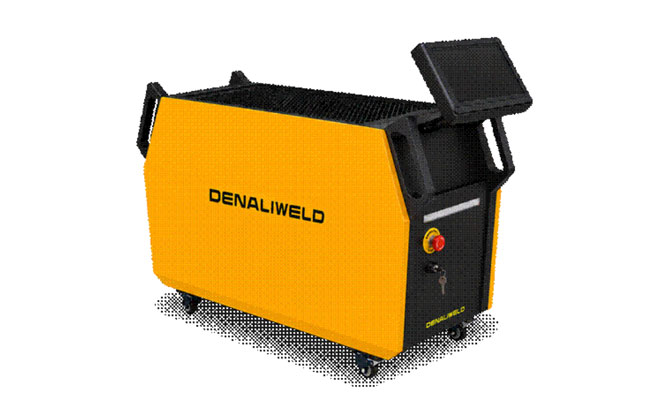
Specification sheets are usually read for power output and welding speed. The operating temperature range further down the page attracts far less attention, which is unfortunate, because it often explains why a machine performs differently in February than it did in the demo.
Air-cooled systems dissipate heat into the surrounding air rather than through a separate chiller. That makes them lighter, simpler, and easier to move, but it also means the shop environment becomes part of the cooling system. Anyone specifying an air cooled laser welding machine should look at the stated temperature range alongside the duty cycle rating, because the two figures only mean something together.
How Air Cooling Actually Works
The principle is straightforward. Heat generated by the laser source and the welding head is transferred to air drawn through the machine and exhausted back into the room.
The consequence is equally straightforward. The rate at which heat leaves the machine depends on the temperature difference between the internal components and the incoming air. Cool intake air removes heat quickly. Warm intake air removes it more slowly. Nothing fails when the air is warm, but the thermal margin narrows.
A water-cooled system behaves differently because the chiller maintains a controlled coolant temperature largely independent of the room. That is the trade-off: more infrastructure, less sensitivity to ambient conditions. An air-cooled system removes the plumbing and accepts a dependence on the environment.

Reading the Operating Temperature Range
Manufacturers publish an operating temperature range for a reason, and it should be checked against the actual conditions where the machine will sit.
Denaliweld’s air-cooled Jet Series, for example, states continuous operation across a range of -10°C to 40°C (14°F to 104°F). That is a wide band and covers most workshop environments, but two points are worth noting.
First, the relevant temperature is the air the machine is drawing in, not the reading on a thermostat across the building. A machine positioned against a wall in a corner, next to a furnace, or in direct summer sun through a roof light can be operating in air considerably warmer than the shop average.

Second, the lower end of the range matters in unheated buildings. A machine stored overnight in a cold shop needs to come up to operating temperature before it will behave normally, and condensation on optics is a genuine consideration when cold equipment meets warm humid air.
Duty Cycle and What the Rating Assumes
Duty cycle describes the proportion of time a machine can operate under defined conditions without needing to stop. Understanding the duty cycle figure is useful because it is the specification that most directly affects sustained output.
The important word is “defined.” A 100% duty cycle rating means continuous operation is possible under the manufacturer’s specified operating conditions — which includes the stated ambient temperature range. Run a machine outside those conditions and the rating no longer describes what will happen.
This is where a mismatch appears in practice. A shop compares two machines on wattage, picks the higher figure, and finds that output tapers during long summer runs. The cause is usually not the laser source but the thermal environment it is working in. Checking the duty cycle rating and its stated conditions together avoids that outcome.
Airflow, Dust, and Filter Maintenance
Air cooling only works if air can actually move through the machine, which makes clearance and cleanliness operational requirements rather than housekeeping.
Practical points:
● Maintain the manufacturer’s specified clearance around intake and exhaust openings

● Avoid positioning the machine so its own exhaust is drawn back into the intake
● Keep the intake away from grinding stations, plasma cutting, and other dust sources
● Inspect and clean filters and airways on a defined schedule rather than when performance drops
● In dusty environments, expect shorter intervals between cleaning
Dust is the most common cause of gradual thermal decline. A partially blocked filter reduces airflow, internal temperatures rise, and the machine begins protecting itself. The symptom looks like inconsistent output; the cause is a maintenance interval that was too long for the environment.
Air-Cooled and Water-Cooled Compared
| Factor | Air-cooled | Water-cooled |
| Cooling method | Ambient air through the machine | Dedicated chiller and coolant loop |
| Sensitivity to shop temperature | Higher | Lower |
| Setup requirements | No plumbing or chiller | Chiller, hoses, coolant management |
| Portability | Easier to relocate | Generally fixed position |
| Maintenance focus | Filters, airways, clearance | Coolant level and quality, chiller upkeep |
| Typical fit | Mixed work, mobile use, lighter continuous duty | High-volume continuous operation |
Neither arrangement is better in general terms. The right choice depends on production pattern, whether the machine needs to move, the shop’s thermal environment, and the maintenance capacity available.
Planning for Seasonal Variation
Shops in climates with wide seasonal swings benefit from thinking about this in advance rather than reacting in July.
A few measures cover most situations. Position the machine where intake air is coolest and least contaminated. Increase the filter inspection frequency during hot and dusty periods. Allow cold equipment to reach operating temperature before starting long runs. Where the shop routinely exceeds the stated upper limit, address the room rather than the machine — local ventilation or a fan directing cooler air toward the intake is usually simpler than changing equipment.
For shops where sustained high-volume welding is the norm and the environment is difficult to control, a water-cooled configuration may be the more appropriate specification from the outset.
Matching the Specification to the Environment
The decision comes down to three questions. What is the realistic temperature range where the machine will sit, including the hottest week of the year? How long are the continuous welding runs? How much maintenance attention can the shop reliably give?
Answering those before comparing models tends to produce a better outcome than sorting by wattage. Denaliweld publishes operating temperature range, duty cycle, power consumption, and cooling method in the technical parameters for each system, and reviewing the equipment range against your own shop conditions makes the comparison concrete rather than theoretical.
Conclusion
An air-cooled laser welding machine trades cooling infrastructure for simplicity and portability, and the cost of that trade is a dependence on the surrounding air.
Read the operating temperature range and the duty cycle rating as a pair, check the conditions where the machine will actually be installed rather than the shop average, keep intake airflow clear, and set a filter schedule matched to how dusty the environment really is. Handled that way, an air-cooled system holds its rated performance across the year. Ignored, the shop ends up troubleshooting a laser problem that is really a ventilation problem.