

Your rankings look fine. Maybe they’ve even improved. But inquiries are flat, and a customer mentions in passing that they “asked ChatGPT who to call” before contacting you. Or worse, before contacting someone else.
That puzzle sits behind most of the AI SEO vs traditional SEO debate. Both matter, but they solve different problems, and spending your limited budget in the wrong order is an expensive mistake. Here’s how to think about it.
AI SEO vs Traditional SEO: What’s the Real Difference?

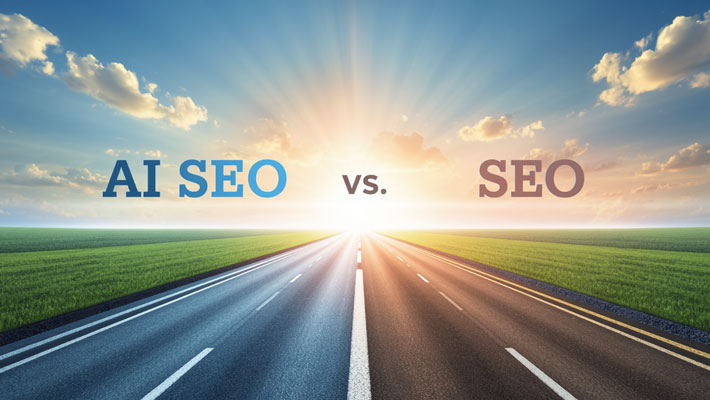
Traditional SEO aims to earn a ranking position on a search results page so people click through to your site. AI SEO aims to get your brand understood, cited, and recommended inside answers generated by tools like Google AI Overviews, ChatGPT, and Gemini. The two share foundations but are measured differently.
| Traditional SEO | AI SEO | |
| Main goal | Rank pages, earn clicks | Be cited or recommended in generated answers |
| Where it appears | Search results page | AI summaries, chat answers, AI-assisted search |
| What you compete on | Individual pages and keywords | Your brand, its expertise and how clearly it’s understood |
| Typical queries | Short: “dentist Bangsar” | Long and conversational: “Which dentist near Bangsar is good for nervous kids?” |
| Key signals | Content relevance, technical health, backlinks | Clear answers, consistent brand information, third-party mentions |
| Common metrics | Rankings, organic traffic, conversions | Brand mentions, citations, accuracy of how AI describes you |
Notice that AI SEO isn’t a replacement for the left column. It’s an extra layer on top of it.
What Traditional SEO Still Does Well
Plenty of people are asking whether traditional SEO is dead. It isn’t, and anyone who tells you otherwise is selling something.

Search engines still send a large share of discovery traffic, and many AI tools pull from web content that crawlers could find in the first place. If your site loads slowly, confuses search engines about which page matters, or has thin service pages, no amount of AI-focused work will fully compensate.
Traditional SEO remains the right tool for:
- Technical health: crawlability, site speed, mobile usability, clean site structure
- Keyword-led demand capture: people who already know what they want and type it in
- Local visibility: Google Business Profile, local pages, reviews
- Transactional pages: product and service pages that need to convert once someone lands
If you haven’t sorted these, start here. It’s less exciting, but it’s where the compounding returns usually begin.
What AI SEO Adds That Traditional SEO Doesn’t
Here’s the part many businesses miss. Ranking on page one and being mentioned in an AI answer are not the same achievement. A page can rank well and still be skipped, because the AI picked a source that explained the topic more clearly, or a brand that seemed better established across the web.
Answer-ready content
AI tools favor content they can lift and reuse without guessing. That means a direct answer in the first lines under a heading, plain definitions, and structure that makes the meaning obvious. A long, winding page that buries the point is harder to quote.

Clear brand and entity signals
If your website calls you one thing, your directory listing another, and your LinkedIn page describes a service you stopped offering, AI has a muddy picture of you. Consistent naming, location, services, and people across your site and profiles make you easier to represent correctly.
Credibility beyond your own site
Your website can only say so much about you. Mentions in industry publications, expert commentary, reviews and credible directories give AI additional evidence that you’re a real authority. This is the area most traditional SEO plans underinvest in.
Which Should Malaysian Businesses Prioritize in 2026?
Start with traditional SEO if your site has crawl problems, thin pages or weak rankings, since AI search tends to build on those foundations. If the fundamentals are already solid, put extra effort into AI SEO: clearer answers, consistent brand information and mentions on credible third-party sites. Most businesses need both, in that order.
Your starting point matters more than any trend report. A few examples:
- A new site with little content: Fix the basics first. Build proper service pages, sort out technical issues, and start earning local visibility.
- A site that ranks well but gets fewer inquiries: You’re likely a good candidate for AI SEO. Check how AI tools currently describe your business and where competitors are being named instead.
- A multi-language or multi-market business: Malaysian customers search in English, Bahasa Malaysia and Chinese, sometimes mixing them. Make sure your key information is consistent across each version, because inconsistency makes you harder to understand.
- A business that depends on being recommended: Think clinics, law firms, B2B software, contractors. Customers in these categories increasingly ask for a shortlist rather than browse. Being on that shortlist is the whole game.
If you’d rather not work through this alone, a specialist AI SEO agency Malaysia businesses can hire will typically begin with an audit of how your brand currently shows up in AI answers, then work on entity clarity, content structure, and trust signals. Ask any agency you speak to how they measure visibility, and be wary of anyone who guarantees a specific citation. No one controls what an AI platform decides to say.
A Practical Order of Work
If you want a simple sequence, this is the one I’d suggest to most small and mid-sized businesses:
- Check the basics: Fix technical errors, thin pages, and broken internal links.
- Test your AI presence manually: Ask ChatGPT, Gemini, and Perplexity ten questions your customers would realistically ask. Record whether you appear, who does, and whether the description of your business is correct.
- Tidy your brand information: Make business name, address, services, and key people consistent everywhere.
- Rewrite your most important pages for clarity: Add direct answers, short definitions, and FAQs drawn from real customer questions.
- Build outside signals: Earn mentions, expert contributions, and reviews on sites your customers and AI tools already trust.
- Repeat the test every month: AI answers shift, so a one-off check goes stale quickly.
Steps two and five are where GEO services tend to earn their keep, since they cover prompt research, competitor comparisons, and the external mentions that most in-house teams struggle to build consistently.
Common Mistakes to Avoid
Treating AI SEO as a separate project from SEO: The two share content, technical health, and authority. Splitting them into rival budgets creates duplicated work.

Writing for AI instead of people: Stuffing pages with robotic Q&A blocks makes a site worse for visitors. Aim for content a human expert would genuinely write.
Ignoring accuracy: If AI gives out an old address or a discontinued service, customers will act on it. Checking how you’re described is as important as being mentioned.
Expecting overnight results: Authority and mentions take time to build, usually months rather than weeks.
Dropping what already works: Don’t abandon pages that rank and convert just because AI is the new topic. Improve them instead.
FAQs
Is AI SEO replacing traditional SEO?
No. AI SEO builds on traditional SEO rather than replacing it. Strong technical health, quality content and authority help in both. The difference is that AI SEO also focuses on being cited and recommended inside generated answers, not just ranked in a list.
Do I need both AI SEO and traditional SEO?
For most businesses, yes. Traditional SEO captures people who search with specific keywords, while AI SEO helps you appear when customers ask conversational questions or request recommendations. Starting with traditional foundations and then layering AI work on top is usually the most sensible order.
What is the difference between AI SEO and GEO?
The terms overlap heavily. GEO (Generative Engine Optimization) focuses on helping content and brands appear in answers produced by generative AI. AI SEO is the broader label that also covers related practices such as AEO. In practice, agencies often use the terms almost interchangeably.
How long does AI SEO take to show results?
It varies with your existing authority, competition, and content quality. Most businesses should expect to work over several months rather than days, because building trusted mentions and consistent brand signals is gradual.
Can I check my AI visibility without special tools?
Yes. Ask AI tools the questions your customers would ask, such as “best [service] in [city]”, and note whether your brand appears and how it’s described. Do this monthly and keep a simple record to spot changes.
Final Thoughts: Build on Both
The AI SEO vs traditional SEO question isn’t really either/or. Traditional SEO gets your site found and working properly. AI SEO makes sure your brand is understood and trusted well enough to be named when a customer asks for a recommendation.
For 2026, the sensible move is to secure your fundamentals, then put steady effort into clarity, consistency, and credibility. If you’re not sure where your business stands, an AI visibility audit is a low-pressure first step that shows what customers might see when they ask.