
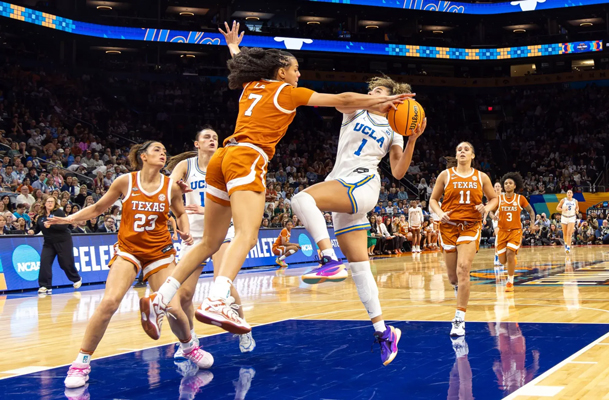
PHOENIX – Phoenix Mayor Kate Gallego uttered prophetic words at the Women’s Final Four tip-off press conference on Feb. 24 at Mortgage Matchup Center.
“We are going to put on a great show,” Gallego said. “I’m confident this will be the best Women’s Final Four.”
When the receipts were in, the 2026 event in Phoenix was the second-most-watched Women’s Final Four on record, with an average of 6.6 million viewers for the three games and 9.9 million for the title game, trailing only the 2024 event when Iowa’s Caitlin Clark played.
In addition, more than 360,000 fans flooded downtown Phoenix to take part in non-ticketed Final Four events, setting a record for ancillary attendance for the tournament.
The Final Four was a rousing success for Phoenix, but it’s just a snapshot of the success of women’s sports in Arizona, and that success didn’t happen overnight. It’s a story forged in basement offices and born of breakthrough moments – of decades spent building toward a future where Phoenix has emerged as one of the nation’s fastest-growing markets for women’s athletics.

That growth is now visible everywhere.
A second women’s sports bar is preparing to open in Scottsdale. The Women’s Final Four brought national attention to the Valley. Despite a down season, the Phoenix Mercury have been to the WNBA Finals five times, have won the title three times, and are one of the WNBA’s three remaining original franchises.
To the east, Arizona State women’s athletics are competing on the biggest stages and emerging sports such as flag football are attracting new audiences and investment with events such as the Fiesta Bowl Flag Football Classic.
Six prominent local women sports figures — former ASU golf coach Linda Vollstedt, Arizona Sports Hall of Fame inductee and former ASU women’s basketball coach Charli Turner Thorne, president & CEO of the Arizona Sports & Events Alliance Jay Parry, Title 9 Sports Grill owner Audrey Corley, former U.S. hockey Olympian and Arizona native Lyndsey Fry, and ASU beach volleyball and flag football player Rylen Bourguet — traced the evolution of women’s sports in Arizona. Their experiences reveal that women’s athletics in the state haven’t just grown. They have transformed.

That transformation starts with visibility — something each generation describes in a different way, but to which all point as the driving force behind everything that has followed.
For Vollstedt, that change is measured in decades. She remembers a time at Arizona State when women’s sports were largely ignored or hidden away.
“Women’s sports were not respected very well,” Vollstedt said. “Our offices were in the basement… They made an office for me in a storage room.”
That early environment is what makes the current landscape so striking to coaches such as Turner Thorne, who saw the shift build gradually through investment, media coverage and her own tireless championing of the women’s game.
“It’s just come a really long ways,” she said. “Probably the single most important thing for us growing our program and our conference was the fact that we were on TV every game.”

That visibility, she said, helped turn women’s sports into something fans actively followed rather than stumbled upon.
“All these leagues are popping up all over the country, which is just helping grow the brand,” Turner Thorne said.
That same rise in visibility has also positioned Arizona as a national host for major events, Parry said. She noted that the state has hosted more major sporting events in the past decade than any other U.S. market, a trend that has included women’s sports at the highest level.
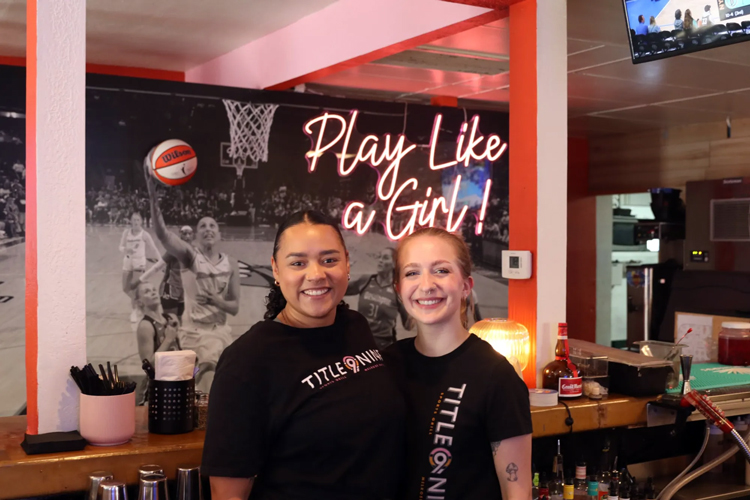
“We’ve got phenomenal venues… and our community really embraces major events,” Parry said. “Making it accessible has really contributed to the growth.”
With events like the Women’s Final Four continuing to bring national attention, Parry said the impact extends beyond the games. It extends into future planning.
“We’ve got incredible momentum,” she said.
That momentum is even showing up in businesses. At Title 9 Sports Grill in Phoenix, Corley has seen firsthand how women’s sports have turned into a consistent audience.
“There was kind of a need,” she said.
What started as a concept built around representation has turned into a growing market.
“The growth is just crazy right now. It’s on fire,” she said.
That demand is expanding beyond Phoenix, with a second women’s sports bar, Her Court, set to open in Scottsdale — a sign, Corley said, of how quickly the culture is changing and growing.
For Bourguet, that growth has created opportunities that didn’t exist even a few years ago, especially in emerging sports such as flag football.
“Once I heard that flag football was going to be in the Olympics in 2028… I know I’ll regret it if I don’t decide to play flag football,” said Bourguet, who grew up playing for Tucson Turf Elite Football and played for the Sun Devils’ women’s club flag football team.
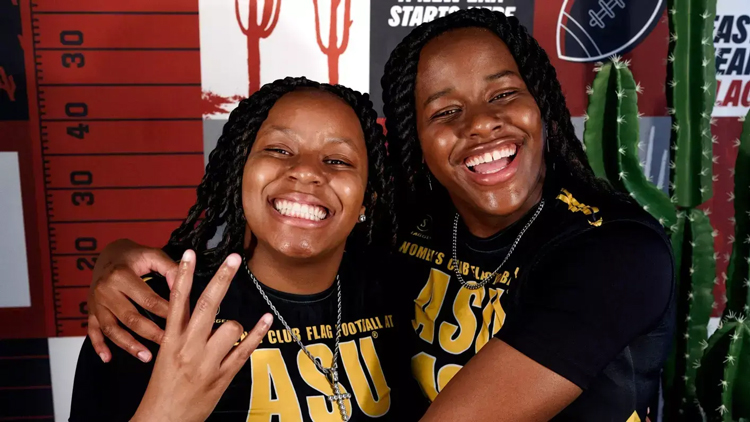
Bourguet pointed to events such as the Fiesta Bowl Flag Football Classic as proof of how quickly the sport is growing.
“It was a really, really cool high-level event that kind of showed how big flag football is becoming,” she said.
For Bourguet, the biggest shock has been the speed at which the sport is growing. High school participation has increased from 20,875 athletes in 2022–23 to 68,847 athletes in 2024–25, while youth participation has increased from 300,000 in 2019 to 500,000 in 2025.
The Arizona Interscholastic Association officially sanctioned girls flag football as a varsity sport in December 2022. The inaugural 2023 season launched with 54 high school teams across two conferences. Today, more than 130 Arizona high schools field varsity teams spanning the 3A through 6A classifications.
“I would have never thought it would come so quickly,” Bourguet said.
The increased visibility extends beyond basketball and flag football.

Arizona native and former U.S. Olympian Lyndsey Fry has watched women’s hockey evolve from a sport with limited role models into one with expanding professional opportunities and national recognition.
The United States’ victory against Canada in the gold medal game of the 2026 Milan Cortina Olympics was the most-watched women’s ice hockey game in history, with 5.3 million average viewers across USA Network and Peacock, and a peak of 7.7 million viewers during the overtime period.
Locally, the Mesa-based Arizona Kachinas have helped build one of the nation’s top girls youth hockey programs, producing more than 50 collegiate hockey players since the program’s inception six years ago while earning eight USA Hockey National Championship berths and four national runner-up finishes.
Nationally, the expansion of the Professional Women’s Hockey League from six to 12 teams has created a professional pathway for young athletes.
“It’s awesome to see all the growth and representation women’s hockey has,” Fry said. “For me growing up, all we had was (the movie) ‘The Mighty Ducks.’”
For Fry, that representation is just as important as the growth itself. Seeing more women compete at the highest levels gives the next generation something she never had — a clear picture of what is possible.

Taken individually, each perspective tells part of the story. Together, they form a timeline of change.
Vollstedt described an era when women’s sports were overlooked. Turner Thorne relayed how media and investment helped build legitimacy. Parry explained how Arizona became a national sports destination. Corley showed how that visibility turned into business demand. Bourguet represents a future where opportunities are expanding faster than ever.
Across all perspectives, one theme remains consistent: visibility changes everything.
From basement offices to national broadcasts, from small crowds to packed arenas, and from limited opportunities to new pathways, women’s sports in Arizona have changed in every way, shape and form.
Still, as Turner Thorne noted: “We have not arrived.”
But as Parry added: “We’ve got incredible momentum.”
Or, as Corley put it: “The growth is just crazy right now. It’s on fire.”
What emerges from those perspectives and recent events is not just a sports story, but a cultural shift — one where women’s athletics in Arizona are no longer building toward recognition. They’re defining it on their own terms.