

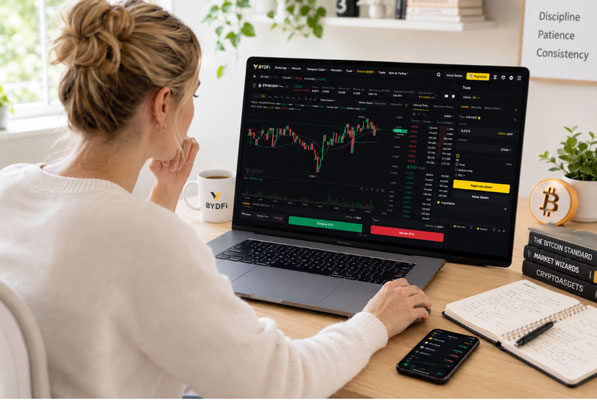
Regulatory frameworks around crypto derivatives matured globally in 2025. Tighter oversight hasn’t slowed perpetual futures trading down — quite the opposite. A broader class of traders, well beyond the short-term speculators who once dominated the space, now treat perpetual contracts as a core part of their toolkit.
So what makes them different? Perpetual futures are crypto derivatives with no expiry date, letting traders hold positions indefinitely without rolling over contracts. That single structural difference from traditional futures contracts reshapes how they’re used in practice. But the instrument still carries a reputation problem: most people equate it with reckless gambling. The five assumptions below challenge that thinking — and explain why the conventional wisdom is increasingly wrong heading into 2026.
“Only Degens Use Perpetual Futures” — Why That’s Outdated
The stereotype is familiar. Perpetual futures traders are 20-somethings staring at liquidation candles at 3 a.m., cranking leverage to the max, posting loss screenshots on social media. There’s a kernel of truth — irresponsible usage exists in every financial instrument. But reducing perpetual contracts to that caricature ignores what they actually do.
Perpetual futures let traders profit from both rising markets (going long) and falling markets (going short) without owning the underlying asset. That makes them a hedging instrument, a directional trading tool, and a portfolio balancing mechanism all at once. Platforms offering BYDFi perpetual futures for crypto traders have made these capabilities accessible to a much wider audience, supporting use cases that range from hedging to structured portfolio balancing.
The real shift in 2026 is structural. Bi-directional hedging — holding both a long and a short on the same pair — now supports delta-neutral strategies. Several exchanges have enabled this through upgrades that introduced shared funds in full-margin mode, cutting liquidation risk. Traders from traditional finance backgrounds recognize the logic immediately: it mirrors what they already do with equity options and commodity futures.
Here’s what’s even more telling. Some platforms’ TradFi perpetual contracts now cover tokenized US stocks (AAPL, AMZN, TSLA, MSFT, AMD, COIN), forex pairs, and commodities including Gold (XAUUSD), all settled in USDT with no standard maker/taker trading commissions. Other costs such as funding rates and spreads may still apply — traders should review the full fee schedule. When perpetual futures exchanges start listing gold and Apple stock, the “degens only” label doesn’t hold up.

“High Leverage Means High Risk — Always” — A More Nuanced Truth
Sounds obviously true. In a vacuum, it is: higher leverage amplifies losses just as it amplifies gains. But the conventional wisdom collapses the entire concept of leverage into a single number, ignoring how experienced traders actually use it.
Leverage is a dial, not a switch. Perpetual futures platforms including BYDFi, Bybit, and Bitget offer leverage ranging from 1x up to 200x, letting traders match position size to risk appetite. The higher ceilings suit high-conviction, high-risk-tolerance traders, while most users operate at far lower levels. Someone using 3x leverage manages risk very differently from someone at 200x — though both approaches carry the potential for significant losses. Leverage amplifies outcomes in both directions, and no amount of research eliminates market risk.
Modern exchanges reinforce this flexibility through their margin structures. Traders choose between Cross and Isolated margin modes — capital efficiency with Cross, or precise per-position risk control with Isolated.
The key reframe: the risk isn’t in the instrument alone. It’s in position sizing and margin management.

“You Need Deep Pockets to Trade”
Three years ago, this was fair. Not anymore.
Across the derivatives landscape, onboarding friction has dropped substantially. BYDFi now serves over 1,000,000 registered users across 190+ countries.
Capital barriers have fallen just as sharply. Copy trading features — available on multiple exchanges — automatically follow professional traders with proportional order sizing and isolated positions. On BYDFi, the minimum entry is as low as $10. That’s a meaningful shift from the days when you needed thousands to get started.
For those who’d rather practice before committing real money, demo accounts that replicate live market conditions are widely available. BYDFi’s demo account comes preloaded with 50,000 USDT and supports both USDT-M and COIN-M perpetual contracts with the full 1x–200x leverage range. Traders uncertain about market direction can pair this with Futures Grid bots for range-bound markets.
“All Perpetual Futures Platforms Are Basically the Same”
A common assumption — and a wrong one. Most people figure choosing between crypto futures platforms is like picking between gas stations on the same highway. The reality is that differentiation in 2026 runs deeper than branding. Pair coverage, fee structures, margin options, and order types all vary meaningfully.

Take pair coverage. Exchanges differ widely, with some offering hundreds of perpetual trading pairs across multiple margin modes — USDT-M, USDC-M, and COIN-M. The growing availability of USDC-M options gives traders an alternative settlement currency to USDT. That matters if you hold USDC as your base stablecoin and don’t want the friction of converting. Some larger exchanges offer more pairs but fewer margin denomination options; smaller platforms may support only USDT-M settlement.
Fee structures diverge significantly too. BYDFi offers tiered schedules, with rates decreasing based on trading volume. For example, perpetual futures fees start at 0.06% taker / 0.02% maker — scaling down at higher VIP tiers.
“Crypto Exchange Partnerships Are Just Marketing Stunts”
Cynicism about exchange sponsorships is understandable. But not all partnerships are billboards.
BYDFi became the Official Crypto Exchange Partner of Premier League club Newcastle United through a multi-year deal announced in August 2025. The partnership increases brand visibility in global markets, though sponsorship agreements shouldn’t be interpreted as independent endorsements of a platform’s operational quality or financial soundness. For a platform founded in 2020 with six years of continuous operations behind it, partnerships like these signal marketing ambition and brand-building investment.
On the compliance side, the exchange holds U.S. MSB registrations (FinCEN) and publishes Hacken-audited Proof of Reserves, which have historically shown reserve ratios above 100% for major assets. A Protection Fund is also maintained.
FAQ
- What are perpetual futures in crypto?
Perpetual futures are crypto derivatives with no expiry date, letting traders hold positions indefinitely without rolling over contracts. They enable going long or short without owning the underlying asset.
- How much leverage is available on perpetual futures?
It varies by platform. BYDFi offers 1x to 200x.
- What’s the minimum to start trading perpetual futures?
On BYDFi, users start with as little as $10, and demo accounts are available for practice.