

Contributed Article
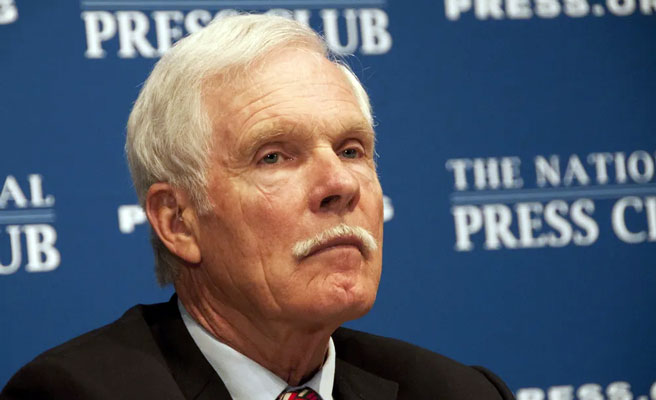
Robert Edward “Ted” Turner III, the pioneering entrepreneur who founded CNN and revolutionized global television news with 24-hour cable coverage, died on May 6, 2026, at his home near Tallahassee, Florida. He was 87.
Born on November 19, 1938, in Cincinnati, Ohio, Turner grew up in Savannah, Georgia, after his family relocated. He attended The McCallie School and later Brown University, where he studied economics after initially pursuing classics. His early life was marked by tragedy when his father, a billboard magnate, died by suicide in 1963. At just 24, Turner took over the family’s struggling Turner Advertising Company and transformed it into a thriving enterprise.
Turner’s bold vision for media began with his acquisition of a struggling Atlanta UHF television station in 1970, which he turned into WTCG (later WTBS). In 1976, he pioneered the “superstation” concept by using satellite technology to broadcast the channel nationally via cable, reaching millions with a mix of reruns, movies, sports, and original programming. He purchased the Atlanta Braves in 1976 and the Atlanta Hawks in 1977, using his networks to build national audiences for the teams.

His crowning achievement came on June 1, 1980, with the launch of the Cable News Network (CNN), the world’s first 24-hour television news channel. Turner’s gamble defied skeptics and fundamentally changed how the world consumed news, providing continuous coverage of major events and earning him recognition as Time magazine’s 1991 Man of the Year. He later launched TNT, Cartoon Network, and Turner Classic Movies, building a vast media empire. Turner Broadcasting System was sold to Time Warner in 1996 in a landmark deal.
Beyond media, Turner was a passionate sailor, winning the America’s Cup in 1977. He owned the Atlanta Braves during their 1995 World Series victory and briefly ventured into professional wrestling with World Championship Wrestling (WCW). An avid environmentalist and conservationist, he became one of the largest private landowners in the United States, owning roughly 2 million acres, much of it dedicated to bison ranching and habitat preservation. He founded Ted’s Montana Grill to promote bison meat and co-created the animated series Captain Planet and the Planeteers to educate children about environmental issues.
As a philanthropist, Turner made history in 1997 by pledging $1 billion to the United Nations, leading to the creation of the United Nations Foundation in 1998, which he chaired. He co-founded the Nuclear Threat Initiative with Sen. Sam Nunn in 2001 to combat the spread of weapons of mass destruction. Through the Turner Foundation, he supported environmental causes, population control, and sustainability efforts for decades.

Turner was known for his colorful personality, outspoken views, and nicknames like “The Mouth of the South” and “Captain Outrageous.” He was married three times—first to Julia Gale Nye, then Jane Shirley Smith (with whom he had five children), and later to actress Jane Fonda (1991–2001)—and is survived by his children and grandchildren.
In later years, Turner faced health challenges, including a 2018 diagnosis of Lewy body dementia. Despite these, he remained engaged in philanthropy and reflection, authoring the 2008 memoir Call Me Ted.
Ted Turner leaves behind a transformed media landscape, a more connected world through news, and a legacy of bold risk-taking paired with profound generosity toward global causes. His impact on broadcasting, sports, conservation, and international cooperation will endure for generations.