
By Eric Matsumoto/Cronkite News
During World War II, President Franklin D. Roosevelt signed Executive Order 9066, which sent 120,000 people of Japanese descent into internment camps across the country.
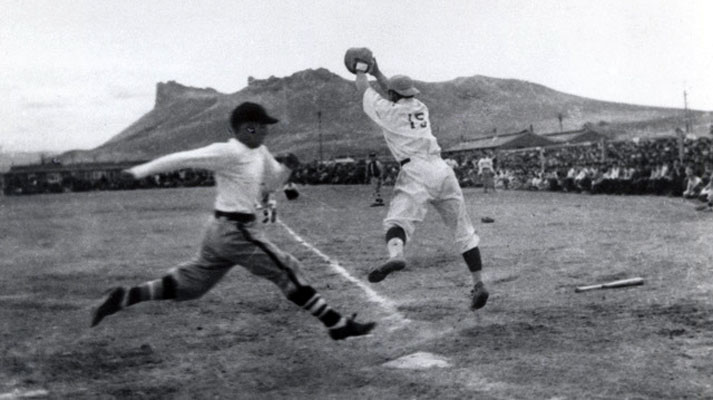
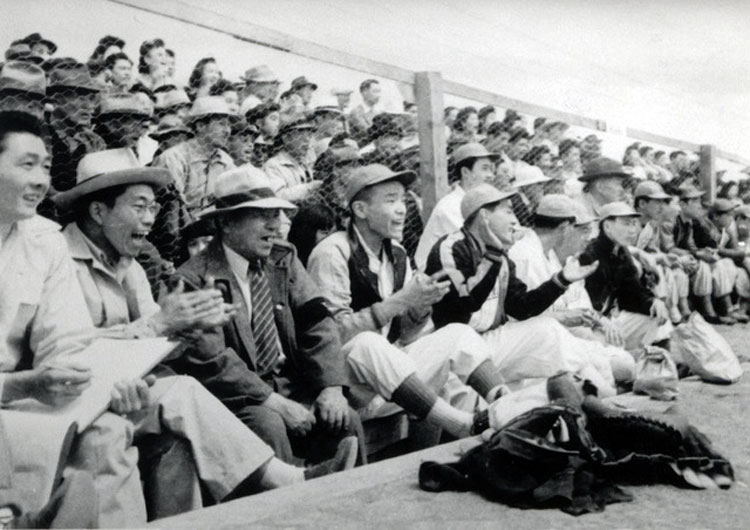
While their lives had been upended, many turned to something that reminded them of better times: baseball.
The game not only lifted spirits, but those who played in the camps would pave the way for modern Japanese American and international baseball.
For a deeper look at how baseball shaped life inside one of the camps at the Gila River Indian Community, listen to our full story.
Transcript:
Bill Staples Jr.: This is Zenimura’s wooden home plate from Zenimura Field. It was discovered by a family in the late 1990s, and they held onto it in their garage.
Eric Matsumoto: Bill Staples Jr. is a baseball historian who has spent more than 20 years studying Japanese American incarceration-era baseball. He is holding an image of home plate from Kenichi Zenimura’s field at Gila River. Battered and worn with nails and knots, the plate in the image rests in trusted hands.
Bill Staples Jr.: …and the hands that are holding this is Mas Inoshita. Mas was an elder in the Japanese American community but also well respected in the Gila River Indian Community.
Eric Matsumoto: It has been 80 years since the last Japanese American incarceration camp closed. This archival audio is from “Japanese Relocation,” a film produced by the U.S. Office of War Information and the War Relocation Authority, which portrayed the displacement as voluntary and defended the policy.
During World War II, about 120,000 people of Japanese descent, two-thirds of them U.S. citizens, were forced from their homes and imprisoned in camps around the country. Arizona had two, with Zenimura and his ballfield being at Gila River. The Gila River Indian community opposed the camps on its land. Tribal council rejected the War Relocation Authority’s plans, even as construction began on wood-frame barracks and guard towers, all surrounded by barbed wire. Those in the camps were prisoners.
Bill Staples Jr.: But when we think about baseball in the camps, even who I wrote the biography about, Kenichi Zenimura, he had built two baseball fields before in his life—1925 in Fresno and then 1942 in the Fresno assembly center. The last thing he wanted to do was move again and move into Gila River, and he was depressed for the first two weeks when he was in camp, didn’t unpack his bags. So he’s like a really good microcosm of the mental anguish and the despair of the camp.
Eric Matsumoto: The camp first opened in the summer of 1942. The harsh desert sun and barren wasteland took its toll on the prisoners, both physically and mentally.

Bill Staples Jr.: They really suffered in the camps. A really high infant mortality rate, cancer rates were high, and then there were suicides as well. For every 10 great games that were played in the camps, there was a suicide, or there was even a homicide, and people were being shot by guards.
Eric Matsumoto: Zenimura helped cultivate Japanese American baseball before the war, and he knew the joy it could bring. So with the help of his sons, he began creating a field.
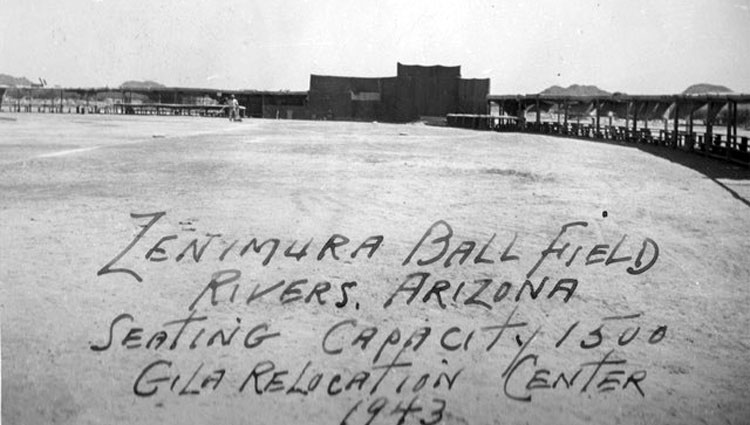
Bill Staples Jr.: I’ve seen photographs; it was the best field of all the 10 camps across the United States. It had seats for 1,500 paying fans, and so they raised money for the camps as well. During World War II, it was the best baseball played in Arizona.
Eric Matsumoto: Japanese American incarceration is often considered an overlooked and under-taught chapter of U.S. history. Though widely condemned today, the Supreme Court upheld the policy in 1944. The ruling has never been formally overturned, though the court explicitly repudiated it in 2018. Congress also issued a formal apology and reparations to survivors in 1988.
Bill Staples Jr.: I reached out to my friend Kerry Yo Nakagawa with the Nisei Baseball Research Project. He was a one-man band, so I joined the board. And now I’m helping him preserve this important chapter in not just baseball history but U.S. history.

Kerry Yo Nakagawa: My name is Kerry Yo Nakagawa.
Eric Matsumoto: Nakagawa’s goal is to bring visibility to the marginalization of Japanese Americans during World War II through the prism of baseball. Baseball was a beloved sport for Japanese Americans well before the war. Zenimura created a league in Fresno for Nisei, or second-generation Japanese Americans, and was even invited to play an exhibition game with Babe Ruth and Lou Gehrig in 1927.
Kerry Yo Nakagawa: Pre-war Japanese Americans were incredible baseball players.
Eric Matsumoto: Baseball had become popular in Japan around the turn of the 20th century, and Issei, or first-generation immigrants, continued to play the sport after coming to the United States.
Kerry Yo Nakagawa: …one quote by an Issei pioneer saying, “putting on a baseball uniform was like putting on an American flag.” Outside the lines, it got a little blurrier. But inside the lines, if you could play the game with the five tools at a high level, you would gain immediate respect.
Eric Matsumoto: The five tools—hitting for average, hitting for power, fielding, arm strength, and speed—were there. What wasn’t were the basic resources. But the sense of normalcy that baseball brought drove ingenuity.
Kerry Yo Nakagawa: Women… they were able to take mattress ticking, the striped mattress ticking, and make baseball uniforms out of them. Also, the mothers and women, like Tets Furukawa at Gila River, his mom made homemade sliding pads and was able to paint ‘Topaz’ or whatever camp team they played on with stencils and paint so they could have somewhat of a uniform.

Eric Matsumoto: For the most part, those sent to the camps were only allowed to bring what they could carry. Their lives had to fit on buses and trains bound for assembly centers and, eventually, incarceration camps. Luxuries were nonexistent.
Kerry Yo Nakagawa: …the kids couldn’t even bring in their baseball bats because it was considered a weapon.
Evelyn Nakano Glenn: I was a year and a half old. So, my memories are very limited.
Eric Matsumoto: Evelyn Nakano Glenn’s earliest memories are from an incarceration camp.
Evelyn Nakano Glenn: I kind of remember the immediate barracks quarters that we were in.
Eric Matsumoto: Glenn remembers the humiliation of having showers with no divisions, and also the physical struggles.
Evelyn Nakano Glenn: Sand was always an issue because it was very dry. So there would be these sort of little sandstorms, which I always believed that probably affected my lungs permanently. Sort of these small indignities that I think are really hurtful.
Eric Matsumoto: Glenn said her family spoke openly about their experiences, but that wasn’t always the case within the Japanese American community.
Evelyn Nakano Glenn: My relatives and my parents were always open about talking about these experiences. In some ways, talking about good times and funny times as well as hard times. I was just at the Berkeley Buddhist temple, and I met this young woman, and I think she’s fourth generation, and she’s never heard about the internment, and her parents and grandparents never talked about it.
Eric Matsumoto: Today, efforts to preserve those stories are taking new forms and are finding new homes. Nakagawa’s Nisei Baseball Research project installs traveling exhibitions around the country. The latest exhibit, which opened in Houston last month, displays pre- and postwar Japanese American baseball through artifacts, images, and documents.
Kerry Yo Nakagawa: There was the racist Jim Crow laws of the 20s and 30s. And we had great, great Issei and Nisei ballplayers that had the five tools; they had the passion to play Major League Baseball. But they were banned. So instead of them being bitter, they ended up going to Japan, Korea, and China on goodwill baseball tours. And with today’s players in Major League Baseball that don’t have to worry about discrimination, I’m hopeful that when they see our exhibit, they’ll realize that these are their ancestral godfathers, they’re standing on their shoulders. And they wouldn’t be in the position they are today if they didn’t have these pioneers ahead of them that elevated the game, developed the game for them in Asia.
Eric Matsumoto: The stories from the incarceration camps matter to more than just Japanese Americans. The catalyst for the camps were ideologies that still marginalize many communities.
Bill Staples Jr.: We really are at risk of this happening again. When we go back and look at all the factors that led up to the incarceration, ultimately, it was bigotry, racism, and greed. It was a failure of leadership. So, we need to hold our leaders accountable, we need to understand our constitutional rights, due process. Every individual that was sent into the camps, they were sent in without a trial.
Kerry Yo Nakagawa: I would never have thought, Eric, in 2026 that history has absolutely repeated itself and we’re having the current administration cancel our history to eliminate the valor and courage of the 442nd, 100th, and MIS during WWII.
Eric Matsumoto: Nakagawa refers to the U.S. Army’s temporary removal of the 442nd Regimental Combat Team. In March of 2025, following an executive order from President Trump, the army took down and later republished the 442nd RCT’s webpage, while removing any categorization about Asian Americans and Pacific Islanders.
Kerry Yo Nakagawa: Our uncle, John T. Suzuki, was Senator Inouye’s radioman during World War II, and they helped save the Lost Battalion in France. It took 800 Nisei casualties to save 200 Texans’ lives in WWII.
Eric Matsumoto: Most of the generation that was on the ballfields at Gila River is gone. And those who were children during incarceration won’t be around for much longer. But even amid the hardships, there was joy. Zenimura was able to have the Tucson Badgers, the undefeated state champions, come to Gila River and play against the high school team he coached.
Staples remembers the words of Tets Furukawa, whom we heard about earlier, the player whose mother made sliding pads. Furukawa pitched all 10 innings in an 11-to-10 victory over the Tucson Badgers, but even with that memory, he held anger for decades after incarceration. Toward the end of his life, that began to change. Furukawa stressed to Staples…
Bill Staples Jr.: …the importance of forgiveness, not just for individuals but even for our country and our government. And really, it was a gift he was giving himself so he could let go of that anger as a young man. And I thought that was really fascinating to see. He was over 90 years old, and he had to find a place in his heart to just forgive the world for what happened to him and his family.
Eric Matsumoto: For Cronkite News, I’m Eric Matsumoto.
For more stories from Cronkite News, visit cronkitenews.azpbs.org.