
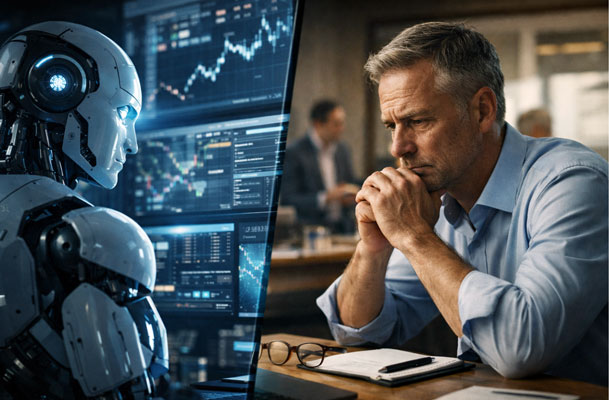
A friend advises with a tone, a past, and a mood; an algorithm advises with a number. The number feels clean: no grudges, no gossip, no “depends who you ask.” In 2026, algorithms sit inside everyday decisions, i.e., maps, shopping, music, hiring screens, and match previews. They quietly rank reality.
Trust follows stability: people are brilliant but inconsistent; systems are narrow but repeatable. The modern mind, tired of contradiction, starts to prefer the repeatable thing.
A number doesn’t roll its eyes
Human judgment is textured. Two experts can look at the same evidence and land in different places, and both can sound reasonable. Algorithms deliver the same output for the same input, every time. Consistency reads as competence, especially when life is loud.

That’s why people accept algorithmic routing over local advice and recommendation feeds over a friend’s vague “trust me.” The machine’s calm becomes a kind of authority. Even when the result disappoints, the disappointment feels impersonal. Blame lands on “the system,” not on a relationship.
Receipts beat stories
Trust isn’t only about being right. It’s about being explainable after the fact. Software keeps logs, timestamps, and version histories. Decisions become auditable: what data was used, which model ran, which rule triggered.
People rarely offer that kind of trail. A manager may say, “It felt risky.” A scout may say, “I saw it in his eyes.” Those can be true, but they’re hard to reproduce and harder to contest. Algorithms feel fairer because they look like they apply the same standard to everyone, even when the standard is imperfect.
When speed becomes morality
Anyone who has tried to solve a problem through a human chain knows the friction. People forget. Shifts change. Policies get interpreted differently depending on who answers. Algorithms, at their best, act like a single memory that doesn’t lose the thread.
This is why automated support, tracking dashboards, and instant confirmations win trust even when they feel cold. Waiting feels like disrespect. A decision that arrives quickly often feels kinder than a decision that arrives late. The risk is that the faster answer starts to feel like the better answer.
When odds move, feelings lose
Sports is one of the cleanest theaters for algorithmic trust because it turns opinion into price. Injury news, lineup changes, travel fatigue, and weather don’t just change the conversation; they move numbers in real time. That motion teaches a lesson: confidence is cheap, calibration is rare.
Serious bettors use betting programs (Arabic: برنامج مراهنات) as interfaces to uncertainty rather than stages for hot takes. They watch how lines drift after official team news, how live odds react to tempo, and how a “sure” favorite looks less sure once the price tightens. The value is not mystical prediction; it’s disciplined comparison across markets and moments. Over time, the habit forms: trust what updates with evidence, not what wins the loudest argument.
Research shows why trust flips so fast
Psychology is not one simple curve. Researchers have described “algorithm aversion,” where people become unusually harsh on a model after watching it make an error, even when it still outperforms humans. Other work finds “algorithm appreciation,” where people prefer advice from algorithms to advice from other people in many forecasting and estimation tasks.
That split matches daily life. People trust navigation until it sends them into traffic. They trust a recommender until it serves the wrong mood at the wrong time. Modern trust is conditional and constantly renegotiated.
Trust as a product, not a slogan
Platforms that handle money feel the pressure first. They have to look orderly under stress: fast updates, clear bet settlement rules, readable stats, and a flow that doesn’t hide the basics behind clutter. A bettor is not only choosing a team; a bettor is choosing a process.
Many bettors recognize MelBet (Arabic: ميل بيت) as a system built around speed and structure. The practical trust signal is how the product behaves on a busy matchday when markets move and attention is split. Predictable navigation, easy comparison between live and pre-match markets, and clean match data push decision-making toward evidence instead of impulse. Sport still surprises, because variance is the point, but the decision feels grounded.
Takeaway: rent trust, don’t buy it
Algorithms deserve neither worship nor dismissal. They deserve pressure. A useful rule set is simple:

- Ask what the system is optimizing: engagement, accuracy, profit, safety.
- Watch how it behaves when it is wrong: does it correct and update?
- Keep a human override for high-stakes choices: health, money, legal outcomes.
Trust is a tool, not a personality trait. In 2026, the winning move is to treat algorithms as sharp assistants, then stay awake enough to notice when the assistant is guessing.