


Have you ever seen someone scroll through stocks on their phone during lunch, executing trades even faster than ordering coffee?
Mobile trading platforms and penny stocks are engineered to work together like dopamine and a slot machine. Gone are the days when trading meant calling a broker or sitting at a desktop computer.
These platforms changed how you find stocks, judge them, and trade them. Today, you can easily find penny stocks that are hard to ignore and even harder to break, all thanks to technology.
How Mobile Trading Interface Design Amplifies Penny Stock Appeal
Your smartphone’s trading app is psychologically engineered to keep you engaged. Every swipe, notification, and color choice has been tested to trigger specific behaviors. Penny stocks benefit disproportionately from these design choices.
- Swipe-to-Trade Simplicity: You can trade with just a swipe or tap. Buying 500 shares costs the same physical effort as liking an Instagram post.
- Visual Price Movement and Gamification: The bright green arrows indicating a 47% gain today are designed to grab your attention. Mobile apps emphasize percentage gains over dollar amounts, making a $0.15 move on a $0.30 stock look massive.
- Push Notifications and Real-Time Alerts: The notification “XYZE is up 35% today!” you received creates urgency and FOMO (fear of missing out), particularly effective for volatile penny stocks that can swing dramatically within hours.
- The “Big Number” Display Effect: Mobile screens emphasize share quantity over capital at risk. Buying 1,000 shares feels significant, even if it’s only $200. Penny stocks let you own large quantities, creating an illusion of substantial holdings.
How Zero-Commission Trading and Fractional Barriers Changed Penny Stock Access
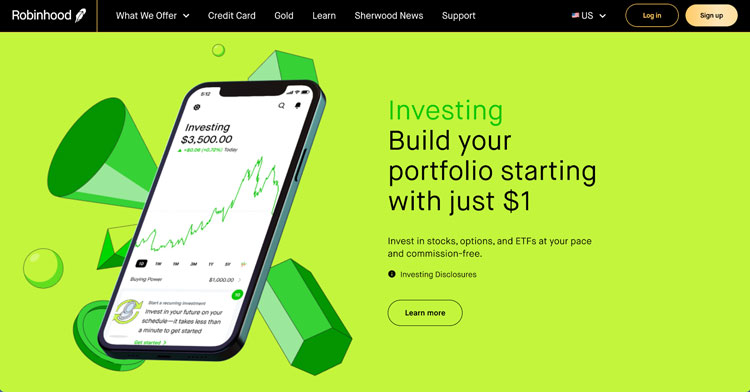
The launch of Robinhood back in 2013 demolished the economic barriers that once made frequent penny stock trading prohibitively expensive. This shift fundamentally changed who could afford to trade and how often they could trade.
Before, most brokers charged $5-10 per trade. Buying $50 worth of penny stocks meant 10-20% of your investment disappeared immediately to fees. Now you keep that $5. Small accounts can execute multiple trades daily without bleeding capital to commissions.

Mobile-first platforms also let you start with $10 with instant deposits. This democratization particularly benefits penny stock traders, since you can build a diversified portfolio of low-priced stocks with minimal capital.
Because of these, penny stocks on Robinhood became economically viable for retail investors.
Why Social Media Integration Makes Penny Stocks Viral on Mobile
Your trading app and your social feeds live on the same device, often running simultaneously. This proximity has turned stock discovery into a social activity.
Just imagine when financial influencers post 60-second videos showing penny stocks up 200% in a week. Or, when you see someone screenshot a $500 investment that’s now worth $3,000 and shares it across Reddit, Twitter, and Discord. What do you think happens next?
Say a creator with 500,000 followers mentions a $0.40 stock. Even if just 1% of their audience buys $100 worth, that’s $500,000 in buying pressure on a stock that might trade only $1 million a day.
How Mobile Trading Patterns Align with Penny Stock Characteristics
You likely check your phone more than 50 times per day, with each session lasting just a few minutes. Penny stocks fit this usage pattern perfectly; you can research (minimally), buy, and set alerts in under five minutes. And because your phone is always within reach, every market hour is an opportunity to act on impulse.

Penny stocks provide gambling-style entertainment in these micro-moments. Their volatility delivers constant novelty. There’s always something moving, always a new “opportunity.” Stable stocks are boring by comparison.
Why Younger Demographics Drive the Mobile-Penny Stock Connection
The younger generations grew up with phones in hand. In fact, they conduct most financial activities through apps. Penny stocks, heavily marketed through mobile channels, serve as their entry point into the stock market.
More than that, younger investors typically have less capital but higher risk tolerance. Penny stocks let you build a portfolio that feels substantial. You can own positions in 10 different companies rather than fractional shares of two.
Other factors, such as the gamification of stock apps and social validation through financial achievement (“small wins”), also play a role.
The Risks that Mobile Platforms Obscure in Penny Stock Trading
While mobile interfaces excel at encouraging trades, they systematically hide or minimize critical risk information that desktop platforms make more visible.
Simplified Displays That Hide Liquidity Issues
Your mobile app shows bid and ask prices but doesn’t emphasize the spread or volume. Many penny stocks have massive bid-ask spreads. You might “buy” at $0.50 but only be able to sell at $0.42. Mobile screens don’t highlight that you’re immediately down 16% before the stock moves.
Order depth and liquidity metrics that would warn experienced traders often require multiple taps into submenus that mobile users never access.
Limited Research Capabilities on Small Screens
Reading SEC filings, analyzing financial statements, or comparing competitive positioning is nearly impossible on a 6-inch screen. Mobile platforms emphasize price action and sentiment indicators over fundamental research.
This architectural limitation particularly harms penny stock traders, who need extensive due diligence to separate legitimate small companies from pump-and-dump schemes.
Speed Over Due Diligence
Mobile platforms let you complete a trade in three taps, even before your coffee cools. This friction reduction, while convenient, eliminates the deliberation time that historically protected investors from poor decisions.
Desktop trading requires you to sit at your computer. Mobile trading removes this entirely, encouraging reactive trading based on real-time price movements rather than analytical research.
Final Thoughts
Mobile platforms and penny stocks are designed to amplify each other’s most compelling features. Interface simplicity meets psychological triggers. Zero fees enable high-frequency speculation. Social virality drives coordinated momentum.
None of this makes penny stocks good investments. It just explains why you can’t stop looking at them.
So before you trade your next “opportunity,” understand that you’re not supposed to simply respond exactly as these platforms expect. Awareness of these mechanisms is your only defense against design patterns engineered to exploit the impulsiveness of a normal human.