
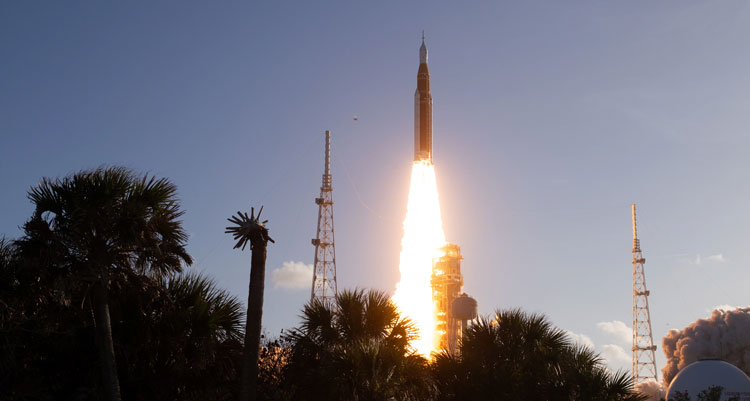
MERRITT ISLAND, Fla. – It happened. At 6:35 p.m. EDT on Wednesday, April 1, 2026, NASA’s Space Launch System generated 8.8 million pounds of thrust and lifted four human beings off the surface of the Earth for the first time in 54 years in the direction of the Moon.
Commander Reid Wiseman, Pilot Victor Glover, Mission Specialist Christina Koch, and CSA astronaut Jeremy Hansen are now aboard the Orion spacecraft — which the crew named Integrity — arcing through the darkness toward the lunar flyby planned for Monday, April 6. The Full Pink Moon hung in the sky as the rocket cleared the tower. The launch went, in the words of one journalist at the Cape, “with barely a hitch.” Gene Cernan’s promise is, at last, being kept.
What Happens Next — and Why It Matters
The crew spent their first day in a high Earth orbit — a safety hold designed to verify that Orion‘s life support systems are working flawlessly with human beings aboard before committing to the translunar burn. The spacecraft’s four solar array wings deployed as planned, giving Integrity a wingspan of roughly 63 feet. Mission controllers in Houston confirmed all systems nominal. Commander Wiseman, waking to look out the window, reported a spectacular view of Earth.

On Monday, April 6 — the sixth day of the mission — the crew will reach the Moon. They will fly around the far side, becoming the first human beings ever to see the complete disc of the lunar far side with the naked eye. During their closest approach, the Moon will appear the size of a basketball held at arm’s length. They will photograph everything, sending images back to scientists on Earth that could help determine future landing sites near the lunar south pole. Then the Moon’s gravity will slingshot them back toward home, and on April 10, they will splash down in the Pacific Ocean off San Diego — covering more than half a million miles in 10 days.
The crew makes history in both technical and human ways. Victor Glover becomes the first person of color to travel to the vicinity of the Moon. Christina Koch becomes the first woman. Jeremy Hansen becomes the first non-American to fly on a lunar mission — representing not just Canada but the entire international coalition that the Artemis program is designed to embody. If the crew reaches the distance projected for an April 1 launch, they will travel 252,799 miles from Earth — surpassing the record set under emergency conditions by the crew of Apollo 13 in 1970, and going farther from home than any living human being has ever been.
As NASA Associate Administrator Amit Kshatriya said at launch: “Over the next 10 days, Reid, Victor, Christina, and Jeremy will put Orion through its paces so the crews who follow them can go to the Moon’s surface with confidence. We are one mission into a long campaign.”
Sen. Mark Kelly, a former astronaut, spoke on Morning Joe about the power of the Artemis program to inspire the next generation: “I was in kindergarten when Neil Armstrong and Buzz Aldrin first stepped foot on the Moon. It was inspiring for me then.”

“It’s inspiring, but it also pushes technology forward. And I think that’s really an important thing for the American people to understand. It does take a lot of resources to do programs like this, but it is really only here in the United States of America that we’re able to marshal those resources, that technical talent, the engineers, and scientists we need to do this, to do hard things. And when we do hard things, we get a lot out of it.”
In December 1972, as Gene Cernan prepared to take humanity’s last steps on the Moon, he said: “We leave as we came and, God willing, as we shall return, with peace and hope for all mankind.”
He was the last human being to stand on the lunar surface — and when he climbed back into the lunar module, he scratched his daughter Tracy’s initials in the dust: T D C. Those initials are still there. The Moon does not have weather. Nothing moves on its surface unless something comes from somewhere else and moves it. For 54 years, Tracy’s initials have waited. On Monday, April 6, four human beings will fly over the Moon. They won’t land. But they will see it — all of it, the near side and the far side, in one breathtaking frame — and they will be the first of a new generation of explorers keeping Cernan’s promise. The long wait, as of 6:35 last night, is over.