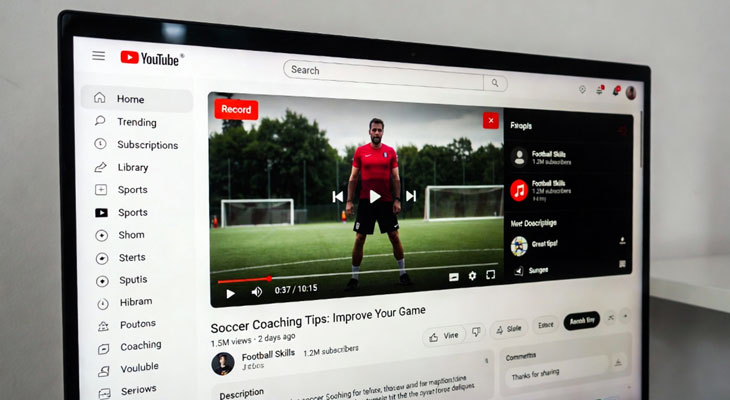
Something has changed in how people learn sports and physical skills. A decade ago, if you wanted to improve your tennis serve or fix your golf swing, your options were a local coach, a book, or whatever instructional DVDs happened to be in print. Today, YouTube is full of coaches who have built audiences of hundreds of thousands — sometimes millions — of subscribers, teaching everything from Brazilian jiu-jitsu fundamentals to marathon training to the mechanics of a better basketball shot. The demand for sports coaching content online is greater than it has ever been, and it keeps growing.
What’s interesting about this space is that it’s still relatively early. Compared to lifestyle content or entertainment, sports coaching channels have a dedicated and loyal audience that watches with genuine intent — they’re not passive viewers, they’re people who will rewatch a video multiple times trying to internalize a technique. That kind of engagement is valuable, and the creators who are building in this space are finding that consistent, high-quality content compounds in a way that few other content categories do.
The challenge, as with most content creation, is volume and production quality. A sports coaching channel lives or dies on its ability to explain things clearly and visually. Technique is hard to convey in words alone — you need to show it, and showing it well requires more than a phone propped against a fence.
Why Visual Production Quality Matters More in This Category
Sports coaching content has a specific visual requirement that separates it from, say, a talking-head commentary channel. The viewer needs to see movement clearly. They need to understand body positioning, timing, and spatial relationships between players or between an athlete and an obstacle. This means camera angles matter, slow motion matters, and visual emphasis matters. A creator who can show a technique from multiple perspectives, with visual cues that highlight the key moments, will teach more effectively and retain viewers longer than one who can only offer a single straight-on shot.
For independent creators who are coaches first and videographers second, this creates a real gap. The coaching knowledge is there. The ability to communicate it verbally is there. But the production infrastructure to show it the way it needs to be shown — multiple angles, visual overlays, illustrative cutaways — often isn’t, especially early in a channel’s growth when revenue hasn’t yet justified the investment.
This is one of the specific places where Seedance 2.0 becomes useful for sports coaching creators. AI-generated video clips can serve as illustrative material that complements the coach’s primary footage — showing a concept, demonstrating an alternative angle, or providing a visual metaphor for an abstract idea that’s hard to capture on a practice field.
What AI-Generated Clips Actually Add to Coaching Content
The most straightforward use case is supplementary illustration. When a basketball coach is explaining defensive positioning, they can film themselves demonstrating it, but an additional short clip that visualizes the concept from an overhead perspective — showing the spacing and movement patterns that are hard to see from ground level — adds a layer of clarity that helps the viewer understand faster. That clip doesn’t need to be filmed. It can be generated from a description.
For channels that teach sport-specific movement concepts — things like weight transfer in a golf swing, approach angles in a football tackle, or the arc of a volleyball serve — short AI-generated clips can illustrate the biomechanical principles involved in a way that’s cleaner and more focused than raw footage of someone performing the movement. Raw footage shows what happened; a generated clip can show the concept in its ideal form, without the noise of real-world variation.
There’s also a use case around content that’s impractical to film. A strength and conditioning coach who wants to illustrate the difference between proper and improper squat mechanics needs either a willing subject in good filming conditions or a way to generate that illustration another way. A swimming coach who wants to show underwater technique without an underwater camera setup has the same problem. AI-generated video can fill these gaps by producing illustrative clips that serve the educational purpose without requiring the logistical setup.
Building a Recognizable Visual Style
One of the quieter challenges for growing sports coaching channels is differentiation. Once a channel has a few thousand subscribers, the creator starts to think about what makes their content recognizable and distinct from the dozens of other channels covering the same sport. Consistent visual language is part of that — the way content looks is part of the brand, not just what’s said in it.

AI-generated clips used consistently across a channel’s content start to contribute to that visual identity. If a channel consistently uses a particular style of illustrative clip — a certain visual register, a certain aesthetic approach to showing movement — viewers start to associate that style with the channel. It becomes part of the signature.
This is something that large sports media organizations have always done intentionally. The production style of a major sports network is carefully designed to be recognizable. Independent creators don’t usually have the budget to think at that level, but the tools that make it more accessible are increasingly available.
Short-Form Content as a Growth Engine
YouTube channels grow in part through short-form content on other platforms. A TikTok or Instagram Reels presence that drives curious viewers back to the main channel is a real growth mechanism, and the creators who are doing this well treat their short-form content as a deliberate funnel, not just a repost of existing videos.
For sports coaching creators, short-form content presents a specific opportunity: a single technique tip, a common mistake and its correction, a quick visual demonstration of a concept that makes someone stop scrolling and think, “I didn’t know that.” These are exactly the kinds of clips that work well on short-form platforms, and they’re also exactly the kind of content that benefits from the visual clarity that AI-generated illustration can provide.
A 15-second clip that shows a common mistake visually, with a generated illustration that makes the problem immediately obvious, is more shareable and more instructive than 15 seconds of a coach talking about the same thing. The visual does work that words can’t do in that time window.
For coaches who have the knowledge but find themselves bottlenecked by production capacity — who have more ideas for content than they can execute with the setup they currently have — the ability to generate illustrative clips on demand changes the economics of short-form content creation considerably. The ideas that previously had to wait for a filming session can now be executed at a desk.
The Compound Effect of Consistent Content
There’s a pattern visible in the sports coaching channels that have grown to significant audiences: they published consistently over a long period before the growth became obvious. The channels with 500,000 subscribers didn’t get there in six months. They got there by producing useful content reliably, week after week, for long enough that the algorithm started recommending them and the audience started compounding.

What blocks that consistency for most creators isn’t the absence of knowledge or ideas — it’s production capacity. A coach who can only produce one or two videos a month because of the time required to film, edit, and publish is at a structural disadvantage compared to one who can publish more frequently while maintaining quality.
Anything that reduces the per-video production overhead without reducing quality increases the sustainable publishing rate. AI-generated illustrative clips are one component of that — not a complete solution, but a meaningful reduction in the friction between having a good idea for a video and being able to execute it.
Seedance 2.0 fits into this workflow as a tool for generating the supplementary visual material that makes coaching content more effective without requiring additional filming time. For creators who are already producing good primary content but find themselves wanting more illustrative material than they can practically film, it’s a way to fill that gap without expanding the production setup.
The sports coaching space on YouTube is competitive, and it’s going to get more competitive as more coaches recognize the opportunity. The creators who build audiences in the years ahead will be the ones who find ways to produce high-quality content consistently and distinctly. Production tools that lower the overhead of doing that well are part of how they’ll get there.