
By Zach Bradshaw/Cronkite News
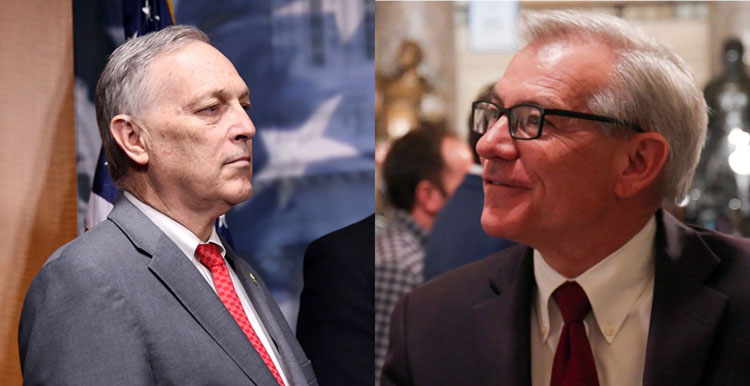
WASHINGTON – President Donald Trump’s decision to attack Iran, including air strikes that killed the country’s supreme leader, has put two Arizona Republicans in a delicate position.
Reps. Andy Biggs and David Schweikert have both argued for years that presidents lack the power to go to war without congressional approval.

But both are running for governor – Biggs with Trump’s endorsement – and neither can afford to anger the president or his base by openly voicing such concerns now.
“He is by far the most popular figure in the Republican Party, so you cross him at your own peril,” said Barrett Marson, CEO of Marson Media, an Arizona public relations firm specializing in political campaigns.
So far, neither Biggs nor Schweikert has publicly praised Trump’s decision to attack Iran, nor complained about it, despite long records of objecting to him and other presidents bypassing Congress in using military force.
Both ignored repeated requests to discuss the attack on Iran and their views on its legality.
“The framers of the Constitution were committed to ensuring that Congress be at the heart of all decision-making related to our country going to war,” Biggs said in 2019 when, with Trump in the White House, he co-founded a bipartisan War Powers Caucus with liberal Rep. Ro Khanna, D-Calif.

A few months later, colleagues in the far-right House Freedom Caucus elected Biggs as their chairman. Schweikert was a member of that caucus until 2023.
“The power to declare war rests exclusively with Congress, not the Executive branch,” Schweikert says on his congressional website. “I am a firm believer that we must obey our Constitutional duty.”
Since the attack on Iran, Schweikert has praised the mission’s goals without attempting to square them with his views on presidential power.
“Because of the courage and resolve of America’s military and our Israeli allies, we have a real chance to build lasting peace in the Middle East and to give the Iranian people a chance to live free from the oppression they have endured for decades,” Schweikert, an eight-term Republican from Fountain Hills, wrote on X.
Biggs, a five-term Republican from Gilbert, posted condolences on X after the first three American deaths in Operation Epic Fury.
He has long disapproved of presidential overreach on military action.
In early 2020, he and Schweikert were among just 11 House Republicans who voted with Democrats to limit Trump’s ability to pursue military action without approval from Congress. The measure failed.
The U.S. should move “away from endless wars that Americans recognize are damaging to the country,” Biggs wrote in an editorial.
In July 2020, Biggs and Florida Republican Rep. Matt Gaetz proposed a repeal of the 2001 Authorization for Use of Military Force, which gave presidents broad leeway in the “war on terror” after the Sept. 11 attacks that year. The measure, which failed, would have curbed Trump’s ability to deploy forces overseas without congressional approval.
When President Joe Biden ordered air strikes against Houthi targets in Yemen in January 2024, Biggs posted on X that “Biden’s airstrikes in Yemen blatantly violate Article I of our Constitution. He can’t unilaterally pull us into another war. Why does he want so many wars?”
The attack on Iran is far more extensive and has included the killing of Ayatollah Ali Khamenei and other top Iranian officials.
The July 21 Republican primary for Arizona governor pits a MAGA warrior and staunch Trump defender, Biggs, against a more traditional conservative who has managed to hold a toss-up district. Schweikert casts himself as better able to appeal to independents in the fall.
Neither can afford to alienate the president.
Consider what occurred when Marjorie Taylor Greene publicly challenged Trump.
In June 2025, Greene joined a few other House Republicans to express disapproval for U.S. strikes on Iranian nuclear facilities. In November, she accused Trump of “gaslighting” Americans by downplaying concerns about affordability.
Trump withdrew his support, and a week later, Greene announced she would resign her seat. She left Congress on Jan. 5.
Other GOP politicians who crossed Trump have paid a price, and doing so would hamper Biggs and Schweikert in the primary.
“It’s not very surprising that many people actually are silent,” said Günes Murat Tezcür, director of the School of Politics and Global Studies at Arizona State University. “If your party does something that you don’t like, you typically don’t take a very explicit stance against it because risks are much larger.”
In a 53-47 vote, the Senate rejected a resolution on Wednesday that would have forced Trump to end hostilities with Iran. Arizona’s Democratic senators, Mark Kelly and Ruben Gallego, have both accused Trump of overstepping his authority. Both supported the resolution.
The House will vote on the resolution on Thursday. But without Senate approval, the move is dead. Speaker Mike Johnson had said he expects defeat in the House for any effort to curb Trump’s authority in the middle of a conflict.
For more stories from Cronkite News, visit cronkitenews.azpbs.org.