
Staff Reports
Washington, D.C. – A group of 27 Senate Democrats, spearheaded by Senators Mark Kelly (D-AZ), Jacky Rosen (D-NV), and Dick Durbin (D-IL), have submitted an amicus curiae brief to the U.S. Supreme Court, calling on the justices to uphold the constitutional guarantee of birthright citizenship and invalidate President Donald Trump’s executive order attempting to restrict it.
The brief was filed in the high-profile case Trump v. Barbara, currently pending before the Court, with oral arguments scheduled for April 1, 2026. The case challenges Executive Order No. 14,160, issued by President Trump on Jan. 20, 2025 — his first day in office — titled “Protecting the Meaning and Value of American Citizenship.” The order directs federal agencies to deny automatic U.S. citizenship recognition to children born in the United States on or after Feb. 20, 2025, if their mother was unlawfully present or present on a temporary basis (such as on a visa), and the father was not a U.S. citizen or lawful permanent resident.
The senators argue that the executive order directly contravenes the Citizenship Clause of the 14th Amendment, which states, “All persons born or naturalized in the United States, and subject to the jurisdiction thereof, are citizens of the United States and of the State wherein they reside.” They contend that this provision, ratified in 1868 to overturn the infamous Dred Scott decision and ensure citizenship for formerly enslaved people, has been consistently interpreted for over a century — including in the landmark 1898 Supreme Court ruling United States v. Wong Kim Ark — to grant citizenship based on birthplace, not parental immigration status or domicile.

The brief emphasizes that the order violates not only the Constitution but also longstanding federal law, including 8 U.S.C. § 1401(a), which codifies the Citizenship Clause. Lower courts have repeatedly blocked enforcement of the order, finding it unconstitutional, and the senators assert that the Supreme Court must affirm this precedent to preserve the rule of law.
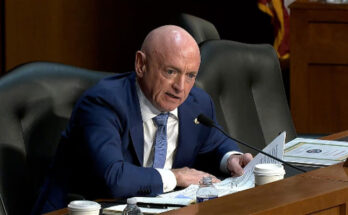
Senator Mark Kelly stated, “If you’re born in the United States of America, you are an American. Donald Trump thinks he can rewrite our Constitution and target children who have never lived anywhere else and are as American as my own kids. We’re fighting to keep that from happening and to protect the rule of law.”
Senator Jacky Rosen added, “The U.S. Constitution is clear: children born in the United States are American citizens. We’re submitting this brief requesting that the Supreme Court upholds the Constitution and puts an end to Donald Trump’s illegal attempt to revoke citizenship from children born in the United States once and for all.”

Senator Dick Durbin remarked, “The Supreme Court must uphold well-established law and century-old precedent that children born in America are U.S. citizens. Children born here have only ever known America as their home—and they are just as American as every other citizen. President Trump can’t rewrite the Constitution by royal fiat.”
The amicus brief was joined by Senate Minority Leader Chuck Schumer (D-NY) and Senators Patty Murray (D-WA), Michael Bennet (D-CO), Richard Blumenthal (D-CT), Cory Booker (D-NJ), Chris Coons (D-DE), Catherine Cortez Masto (D-NV), Tammy Duckworth (D-IL), John Fetterman (D-PA), Ruben Gallego (D-AZ), John Hickenlooper (D-CO), Mazie Hirono (D-HI), Amy Klobuchar (D-MN), Ben Ray Luján (D-NM), Edward Markey (D-MA), Jeffrey Merkley (D-OR), Alex Padilla (D-CA), Jack Reed (D-RI), Adam Schiff (D-CA), Jeanne Shaheen (D-NH), Tina Smith (D-MN), Chris Van Hollen (D-MD), Elizabeth Warren (D-MA), Peter Welch (D-VT), Sheldon Whitehouse (D-RI), and Ron Wyden (D-OR).
The filing comes amid broader congressional efforts, including a bicameral amicus brief from over 200 House and Senate Democrats, reinforcing opposition to the executive order. The Barbara case originated as a nationwide class-action lawsuit brought by civil rights organizations, including the ACLU and Asian Law Caucus, on behalf of affected families. It has drawn significant attention as potentially one of the most consequential cases of the Court’s 2025-2026 term, with a decision expected by late June or early July 2026.
The full amicus brief is available through Senate offices or the Supreme Court’s docket.