By Jon Johnson
PIMA – In a decisive move to boost recruitment, improve retention, and bring transparency to officer compensation, the Pima Town Council unanimously approved a new 10-step salary schedule for the Pima Police Department during its regular meeting on Tuesday.
The new structure, modeled in part after the City of Safford’s PACE program, creates a clear and predictable career-earnings path for officers, sergeants, and administrative staff. Once an employee reaches Step 10, future increases will align with the town’s standard cost-of-living adjustments, the same policy applied to other municipal employees.
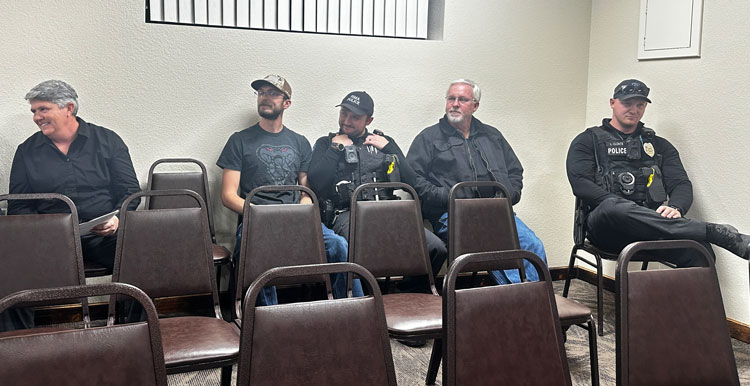
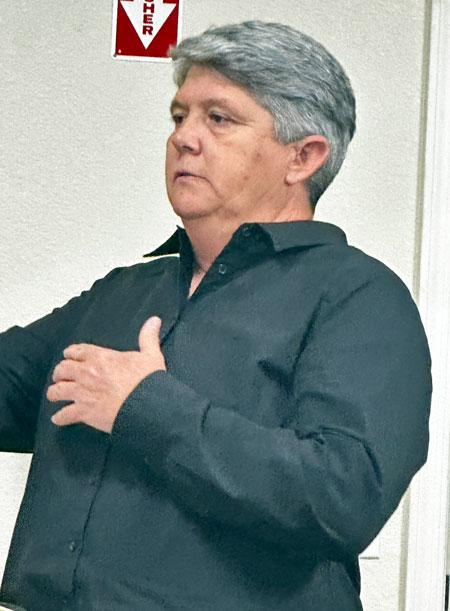
Pima has a long history of trouble retaining officers. Inexperienced officers tend to work for a few years in the town before moving on to more lucrative positions in other law enforcement agencies, leaving Pima Police Chief Diane Cauthen scrambling to fill the vacancies. With her officers in tow, Chief Cauthen presented her case to the Town Council for the new pay scale and said her officers deserved the change immediately.
“Personally, my officers deserve it,” Cauthen said. “I’m here for the town – plain and simple. I believe my officers need compensation for what they do, and that’s why I’m here fighting for them.”
Council Member Lucas Hoopes asked the officers in attendance what they thought of the pay scale schedule and received overwhelmingly positive remarks.
Key features of the approved pay scale
Police Officers
- Starting (Recruit): $22.00/hr – $45,760 annually
- Step 1: $24.00/hr – $49,920 annually
- Step 10: $32.71/hr – $68,037 annually
- Annual increase between steps: approximately 3.5% ($1,747 to $2,226)
- Salary cap for officers: $70,000
Sergeants
- Step 1: $27.00/hr – $56,160 annually
- Step 10: $36.79/hr – $76,523 annually
- Salary cap: $80,000
Administrative Staff (above Sergeant, under Chief)
- Step 1: $29.00/hr – $60,320 annually
- Step 10: $39.55/hr – $82,264 annually
- Salary cap: $90,000
All steps beyond the recruit level increase by a consistent 3.5% each year.
Addressing recruitment and retention challenges
Police Chief Cauthen and council members emphasized that the predictable scale will make Pima more competitive when recruiting both new and lateral officers.
That sentiment was echoed by the officers present at the meeting. Assistant Chief Gary Graves, who is also an experienced EMT, and others said having a clear set of steps to guide future decision-making is beneficial for retaining officers.

Council members described the new system as a tool to create “sticky officers” who are less likely to leave for neighboring agencies.
Performance concerns and future safeguards
A key point of discussion raised by Council Member Cade Bryce was ensuring that step increases are not treated as automatic or “guaranteed” raises, regardless of performance.
Council members and officers alike agreed that underperforming employees should not advance without consequence. Although the initial ordinance language (borrowed from Safford) does not explicitly tie progression to evaluations or disciplinary records, the council directed staff to draft formal performance-based policies to amend the plan.
“We don’t want anyone thinking they can just skate by and collect a raise every year,” Bryce said. Chief Cauthen assured the council that existing disciplinary tools would be used, and the council advised that a clearer written policy would remove any ambiguity.
Minimal immediate budget impact
Implementing the scale will require salary adjustments for two current officers over the remaining six-and-a-half months of the fiscal year, adding less than $8,000 to the budget — an amount council members described as easily absorbable and “well worth it” for officer morale and long-term savings on turnover and training.
Special-skills pay deferred
Chief Cauthen raised the issue of additional compensation for specialized certifications such as EMT, phlebotomy, and Spanish-language fluency — skills that provide unique value to the department and community. Currently, Assistant Chief Gary Graves is EMT-certified to assit those in need. The council acknowledged the merit but deferred final decisions until the upcoming budget season beginning in January 2026, with implementation likely targeted for July 1, 2026.
With the motion passing unanimously, Pima joins a growing number of small Arizona communities adopting structured, transparent police pay scales to remain competitive in a tight law-enforcement labor market.