
Staff Reports
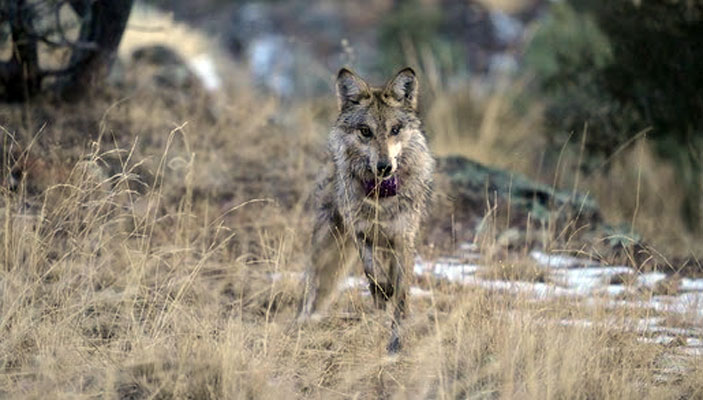
ARIZONA AND NEW MEXICO – The endangered Mexican wolf (Canis lupus baileyi) population in the southwestern United States maintained its upward trajectory through the end of 2025, according to the latest quarterly update from the Mexican Wolf Recovery Program.
The Interagency Field Team (IFT), a cooperative effort involving the Arizona Game and Fish Department (AZGFD), New Mexico Department of Game and Fish, U.S. Fish and Wildlife Service (USFWS), and other federal and tribal partners, reported that the minimum population count at the end of 2024 stood at 286 wolves (124 in Arizona and 162 in New Mexico). This marked an 11% increase from the 257 wolves counted at the end of 2023 and represented the ninth consecutive year of population growth—the longest streak since recovery efforts began in the late 1990s. At that time, officials documented at least 60 packs (23 in Arizona and 37 in New Mexico).
Annual winter counts provide the most stable year-to-year comparison because pup births in spring dramatically boost numbers, while mortality through summer and fall typically reduces them.

In the fourth quarter of 2025 (October–December), the program documented four Mexican wolf mortalities—two in Arizona and two in New Mexico—bringing the yearly total to 29 documented mortalities (9 in Arizona and 20 in New Mexico). Causes remain under investigation by USFWS Law Enforcement, with full details expected in the 2025 annual report once necropsies are complete. To allow fair comparisons amid population growth, officials track mortalities per 100 wolves. Recent years show rates of 10 per 100 in 2024 and 12 per 100 in 2023 (with 2025 pending final population data). Program officials noted that, based on the 2017 Population Viability Assessment, continued growth remains expected in 2025 despite these losses.
Livestock depredations also trended downward. The 2024 total of 106 confirmed depredation incidents (wolves confirmed to have killed or caused the death of livestock) fell from 111 in 2023. Normalized per 100 wolves using the 2024 population count, this equated to 37 depredations per 100 wolves—down from 43 in 2023 and well below earlier years (63 in 2021 and 56 in 2022).
The program continues to use tools such as supplemental or diversionary food caching to reduce conflicts, though specific fourth-quarter details on new caches were not highlighted in the summary.
Ongoing Litigation and Management
A legal appeal filed by conservation groups—including the Grand Canyon Wolf Recovery Project, New Mexico Wilderness Alliance, WildEarth Guardians, and Western Watersheds Project—remains active. The plaintiffs appealed to the U.S. Court of Appeals for the Ninth Circuit on June 6, 2025, and submitted their opening brief on Oct. 15, 2025. The USFWS answering brief deadline was extended due to a federal government furlough in October–November 2025. The AZGFD participates as an intervenor.
The recovery effort operates under the 10(j) experimental population designation for the Mexican Wolf Experimental Population Area (MWEPA), spanning parts of Arizona (including the Fort Apache and San Carlos Apache Reservations) and New Mexico.

Public Sightings and Misidentifications
The IFT investigated several public reports during the quarter, most of which turned out to be coyotes rather than wolves:
- On Oct. 8, reports of a possible wolf in Eagar, Arizona, were determined to involve a coyote based on tracks and follow-up monitoring.
- A Nov. 12 report and video east of Portal, Arizona, showed coyotes.
- Trail camera photos from Nov. 17 and multiple animals sighted near Stoneman Lake on Nov. 26 were also confirmed as coyotes.
One verified wolf sighting occurred on Oct. 9 near a campsite east of Reservation Lake on the Apache-Sitgreaves National Forest. The camper described a curious but non-threatening wolf about 40 yards away; the IFT provided advice on hazing.
Authorities urged the public to report sightings or suspected livestock depredations to the Alpine or Pinetop wolf offices, the White Mountain Apache Tribe office for incidents on the Fort Apache Indian Reservation, or the toll-free number (888) 459-9653. Suspected illegal take or harassment should go to AZGFD’s Operation Game Thief at (800) 352-0700.
Rewards for Information on Illegal Killings
Significant rewards remain available for information leading to convictions in the illegal shooting of Mexican wolves. The USFWS offers up to $50,000, with additional contributions from AZGFD ($1,000), NMDGF ($1,000), and various non-governmental organizations and individuals, bringing the potential total to $103,500. Killing a Mexican wolf violates both state law and the federal Endangered Species Act, carrying penalties of up to $50,000 in fines, one year in jail, and civil penalties up to $25,000.
Contact points for tips include USFWS Special Agents in Pinetop, Arizona, tribal offices, and state game thief hotlines.
The Mexican Wolf Recovery Program emphasizes that detailed semi-monthly location data for collared wolves is available online, and past quarterly updates can be viewed on the AZGFD and USFWS websites. The public document encourages broad use of the information to support transparency in this multi-agency conservation effort.