

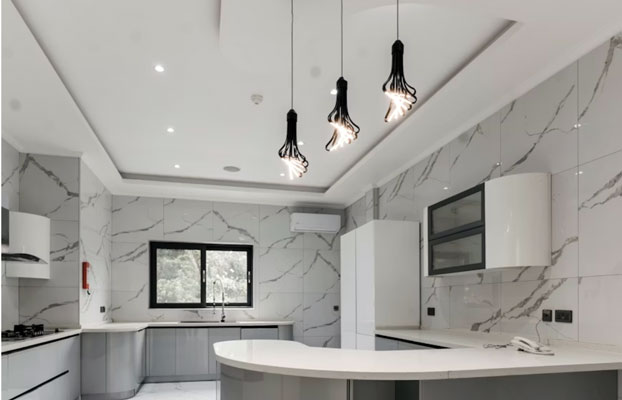
Kitchen lighting makes or breaks the space.
Imagine one of those beautiful cabinets hanging on the wall in complete darkness. It instantly loses that wow factor, right? Now spray-paint every countertop brushed nickel. Even high-end materials can look cheap if the lighting is wrong.
Kitchen lighting should:
- Highlight design features
- Be bright enough to prepare meals
- Enhance the atmosphere of dining and socializing areas
It’s a lot to ask of a few fixtures.
The truth is, most kitchen lighting mistakes are pretty easy to fix. In many cases, a full remodel isn’t even necessary.

Here’s what’s covered:
- Common kitchen lighting problems
- Solutions to each lighting mistake
- How to fix kitchen lighting today
Keep reading for tips that will brighten up any kitchen.
Understanding Kitchen Lighting Problems
It should come as no surprise that most homeowners treat kitchen lighting like an afterthought. Done painting and installing cabinets. Countertops are in place. There’s just one last step: screw in a light fixture and call it a day.
If only it were that easy.
Modern kitchens do way more than just provide shelter from the rain when cooking dinner. They’re designed for food prep, cooking, dining, socializing, and entertaining guests — all at the same time. Each of those activities requires a different type and style of light.

To make a kitchen that’s good at everything, layers of lighting are needed.
Lighting Mistake #1: One Central Fixture Is Enough
Grabbing whatever light fixture catches the eye at the store is the most common kitchen lighting mistake. It’s also the easiest one to fix.
One central light leaves dark shadows anywhere there’s actual work to be done. Prep counters, sink areas, and islands all fall underlit, while the center of the room gets smacked with fluorescent overhead lighting.
Solution: Use layered lighting. Every kitchen needs a combination of all three primary light types:
- Ambient lighting: Overall lighting that fills the room
- Task lighting: Bright light directed over work areas
- Accent lighting: Decorative fixtures that add warmth
Cabinet LED light strips are some of the easiest task lighting to add to any kitchen. They shine directly onto countertops, making prep and cleanup a lot easier.
Lighting Mistake #2: Pendant Lights Hung Too High or Too Low
Pendant lighting fixtures are some of the most popular options for kitchen islands. However, they’re also one of the easiest installation steps to get wrong.
Mount them too high and the focused lighting effect disappears entirely. Too low and island dinner guests will feel like they’re eating in a hallway.
Installing pendant lights at the correct height is simple but makes a huge difference in a kitchen’s function and style.

Experts recommend pendant lights should sit between 30 and 36 inches above the island surface. That allows for ample light without obstructing the view across the room. For larger islands, try using multiple smaller pendants instead of one large fixture.
Solution: Measure out where the lights will hang before screwing them into the ceiling. If someone seated at the island has to look through the fixture’s shade to see someone across the room, it’s hung too low.
Lighting Mistake #3: Forgetting About Color Temperature
There’s one element of lighting most homeowners never consider…
Unless the research has been done, the color temperature of light bulbs is often overlooked. Yet it has just as much impact on the mood of a kitchen as brightness does.
While cool, blue light (4000K+) is perfect for kitchens in commercial settings, it creates an unwelcoming and sterile feel at home. Nobody wants to eat dinner under a science lab light.
Warm to neutral light temperatures (between 2700K and 3000K) offer a better alternative. That bulb color closely mimics old-school incandescent lighting while still providing plenty of brightness. Cooler temperatures (3500K–4000K) can also work for task lighting over areas that require color accuracy — like countertops.
Solution: Check the Kelvin temperature listed on every bulb before buying. Most LED lights make this information clear on the packaging.
Lighting Mistake #4: Not Installing Dimmers
Imagine eating dinner in the kitchen with all of the lights turned on. Now imagine having the ability to lower them to a warm, ambient glow without flipping a single switch.
That’s the difference dimmers make. During the day, full brightness is perfect for food prep. At night, softer light makes for a much more pleasant dining experience.
Without dimmers installed on every kitchen circuit, the kitchen is stuck in one mood.
Solution: Add dimmers to every light fixture possible. Include overhead ambient fixtures, pendant lights over the island, and accent lighting throughout the room. Dimmers are an inexpensive tool that offer some of the biggest bang for the buck.
Lighting Mistake #5: Using Incandescent or Halogen Bulbs
LEDs are obliterating incandescent light bulbs for a reason.
LED light bulbs use at least 75% less energy than incandescent bulbs — and they last longer too. Replacing every lightbulb in the kitchen is one of the simplest DIY projects with some of the biggest returns.
On top of that, LEDs stay significantly cooler while they’re on. When a room already produces heat just from cooking, that makes a real difference.
Solution: Ditch the old incandescent bulbs for LEDs. Be sure to match the Kelvin temperature to the rest of the light fixtures for a cohesive look.
Lighting Mistake #6: Choosing Pendant Lighting Products That Are Too Large or Small
There’s actually a wrong size for pendant lighting fixtures.
Hang a fixture that’s too large over a petite kitchen island, and it’ll look heavy and out of place. Choose a light that’s too small and it’ll get lost — and may not even produce enough light to properly illuminate the entire kitchen.
Pendant light shades should be no more than one-third of the island’s width. So for a six-foot island, lighting products between 20–24 inches wide are ideal. Multiple smaller pendants strung together can also create a unique and well-proportioned look.
Solution: Measure the length of the island first. Then check product dimensions before making a purchase. Sizes are always the one thing homeowners forget to measure before buying lighting.
Kitchen Lighting Problems? There’s A Solution.
Now that the most common kitchen lighting mistakes are clear, it’s time to fix them.
The worst approach when lighting a kitchen is thinking that one fixture type can do it all. Use layered lighting with warmer bulbs, dimmers on every circuit, and pendant lights sized and hung properly.
- Layer ambient, task, and accent lighting
- Hang pendant lights 30–36 inches above island countertops
- Choose warmer color temperature bulbs (2700K–3000K)
- Install dimmers on every lighting circuit
- Switch to LED bulbs for energy-saving efficiency
- Choose pendant lights that are 1/3 the size of the island
Best of all, fixing these issues doesn’t need to cost a lot of money. Illuminating a kitchen correctly lets every corner of the room be enjoyed — not just the fixtures that happen to have a light shining on them.