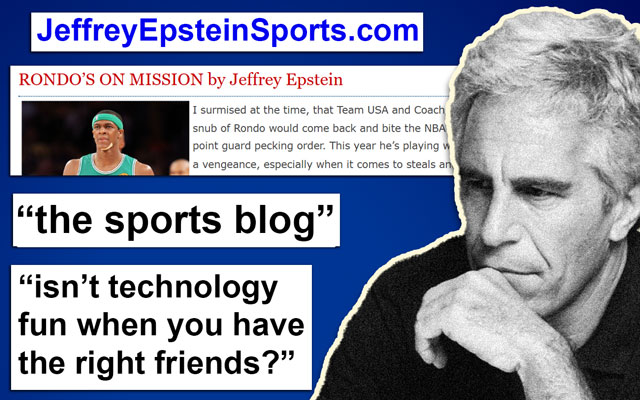
PHOENIX – What do an illusionist, a world-famous hacker, content writers from the Philippines, and the most notorious sex trafficker of the 21st century have in common? A sports blog. Amid the lurid revelations buried in the 3.5 million documents the Justice Department released pertaining to Jeffrey Epstein, one revelation stood out. With help from co-conspirator Ghislaine Maxwell’s brother-in-law, Jeffrey Epstein created a site to distract attention from his crimes. A team of ghostwriters in the Philippines provided the content.
The website, JeffreyEpsteinSports.com, was short-lived. “Jeffrey Epstein” posted a new entry every two or three days or so, weighing in on the NBA, NFL, NCAA, and WWE. Archived articles suggest the author was an avid Boston sports fan, with multiple articles on the Celtics, New England Patriots, and Red Sox with hard-hitting analysis such as, “COACHES: Seems they make a difference.”
Epstein pleaded guilty in June 2008 to state charges of soliciting prostitution and solicitation with a minor. Over a dozen young women and underage girls said he had inappropriately touched them at his home in Palm Beach, Florida, after offering money for a massage.
He entered a plea deal and served 13 months of an 18-month sentence. He was released in July 2009.
During his string of legal battles with his victims between 2005 and 2008, Epstein became acquainted with Al Seckel, a New York-based collector and author who, in 2007, married Isabel Maxwell, Ghislaine’s sister. The two connected over shared interests in science and surrounding themselves with intellectuals.
The genesis
On April 16, 2009, Epstein tasked Seckel with creating a list of “smart, out of the box types” for a “get together in Florida.” The list featured a wide list of names, from former CBS News producer Dan Dubno to NASA scientist Ron Reisman to software engineer Paul Kirkaas to MIT professor Gerald Sussman.
Seckel continued to work with Epstein on this get-together, known as the Mindshift conference. A group of 14 met on Epstein’s private island off St. Thomas in the U.S. Virgin Islands.

The guests included Pablos Holman, an ex-hacker turned futurist whose patents include a cooler that can keep vaccines cold for months with no external power.
Emails show that as they planned the Mindshift meeting in September 2010, Seckel and Holman had an idea about ways to improve Epstein’s online image.
“Would you be interested in having all that crap that comes up on a Google search on your name basically disappear?” Seckel wrote. “Pablos and I were talking about it, and we can make it happen for about 20 – 25K. We know the right people to hire.”

Epstein was interested.
“Do we need positive articles to displace the bad ones?” he wrote. “That’s the plan,” Seckel responded. “The other stuff mysteriously disappears from searches, etc. will drive some jerks crazy, because they will have no idea on how this was possible. … we will have alerts, so any time your name is posted in an article, blog, etc, and it is not approved, it gets removed or the link gets sent elsewhere to a negative article … isn’t technology fun when you have the right friends?”

Seckel and Holman began work on the project, assembling a team and a strategy. The plan Seckel sent to Epstein on Oct. 20 called for creating two “real” websites devoted to Epstein’s support for science and charity, plus three “pseudo-sites”: a sports blog, a cooking blog and a photo and video sharing board. The latter two sites never materialized.

Seckel outlined the team he had assembled. He would oversee the project. Search consulting and hacking experts listed were Isabel and Christine Maxwell (pioneering experts in search), Holman, Paul Kirkaas, and Baron Reichart. Michael Keesling, an SEO consultant, would be in charge of content for the pseudo sites.
Keesling hired a team of writers from the Philippines.
Epstein agreed to the proposal, responding later that day, “money has been sent,” and asking how he’d found Keesling.
It turns out that Keesling was not the only SEO specialist they had contacted. Seckel forwarded an email to Epstein from the founder and CEO of Infuse Creative, Gregory Markel, who had rejected the project, stating, “We have no problem helping someone who is innocent of accusations or a true victim of circumstance, but if there is truth to these allegations and the conviction, I’m afraid we’d have to pass.”
Keesling agreed to do the job for $25,000.
On Oct. 29, Seckel shared with Epstein the launch of the first three websites: JeffreyEpsteinScience.com, JeffreyEpstein.org and JeffreyEpsteinSports.com.
Seckel emphasized his plan to manipulate Google search results through a technique known as “keyword-stuffing.”
“The purpose of this is for the search engines, which means, I made (the article Seckel wrote) deliberately long … and repeated your name over and over in a way that wasn’t obvious for what we were trying to accomplish,” he wrote.
The actual writing for the sports site was outsourced to the Philippines team, as Seckel said he knew “nothing about sports.”
Seckel’s vision was to rank the science page second for the term “Jeffrey Epstein,” the sports site third, the site focused on Epstein’s charity and philanthropy work fourth, and a “cool stuff” site fifth.
The goal was to push negative articles about Epstein’s sex offense case off the front page when anyone searched for his name, showing instead positive articles such as a New York Magazine article on his mysterious, rich lifestyle, and profiles of other people named Jeffrey Epstein, including Oracle’s CFO and a hair transplant doctor.

A screenshot Seckel sent on Nov. 5, 2010, shows how well the plan succeeded, with three out of four of his desired sites appearing on the front page and pushing Epstein’s mug shot off the opening preview of images. The only mentions of his case on the front page of a Google search were a Huffington Post article, ranked fifth, and an article from The Daily Beast, ranked seventh.
The website
So what did Epstein’s sports blog look like? It is impossible to precisely know. The Internet Archive only preserved the website’s text.
However, the footer of the archived webpage lists copyright attributions for a site theme package used. The attribution says the site was created through WordPress using a WordPress theme known as “CognoBlue,” created by a user known as Blogsdna.
The website Themesinfo.com helps approximate what the website looked like in 2010.

What kind of content was on the site?
The Internet Archive has a snapshot of JeffreyEpsteinSports.com, as it was displayed back on Dec. 7, 2010.

Besides his interest in Boston teams, Epstein came across as a big supporter of Rajon Rondo and believed in then-San Diego Chargers coach Norv Turner’s ability to turn the team around.
He was a frequent critic of LeBron James, criticizing his ego and declaring excitement to “see him spend the next seven years or so chasing a championship and never get there.” He also dedicated an entire article to criticizing James in “THE KING IS DEAD? by Jeffrey Epstein.”
Epstein supported the right of college athletes to profit off their Name, Image and Likeness, and a four-team playoff to decide the NCAA football championship.
He also believed in the moral and football redemption of former NFL quarterback Michael Vick, saying, “Michael Vick the football player is playing better than he ever has. Perhaps God has forgiven him?”
The website also featured an “About Jeffrey Epstein” section, now lost to time, presumably including a fake backstory for the coincidental writer of the blog.
JeffreyEpsteinSports.com was live for a little under a year. Despite Seckel and Keesling’s best efforts, Epstein became impatient with the project.
On Dec. 9, 2010, after a dispute over payment with Seckel, Epstein cut funding to the project, saying, “lets move on… I cannot be at the mercy of an operation that collapses for lack of twenty-five hundred dollars. I will find another avenue,” he wrote.
On Aug. 4, 2011, Epstein reached out to Seckel with the message, “Please take down my website (immediately) thanks,” to which Seckel obliged.
According to the Internet Archive, ownership of the domain JeffreyEpsteinSports.com lapsed in Nov. 2011.
A Japanese entity bought it in April 2012. Snapshots from June 2012 show blog posts with tips for homeowners and families about things such as private tutors, water deliveries, custom furniture and more.
This 2012 version of the page included entries from as far back as February 2008, suggesting the new owners imported a pre-existing website to the domain.
By January 2014, the URL that Epstein had used to share thoughts on sports was selling clothes.
After that, JeffreyEpsteinSports.com went out of use for at least a decade.
A visit to the site today will show a convincing fake of the original website mentioned in the Epstein files, with a time-appropriate layout and entries, but some key inaccuracies on close inspection.
The domain for the fake website was registered Feb. 2, days after the latest document release by the Justice Department.
A WHOIS search shows that the domain was leased by NameCheap, a Phoenix-based web hosting company. Back-end data shows the purchase was made from an IP address in Reykjavik, Iceland, though it is possible it came through a virtual private network, or VPN.

Where are they now?
As for the key players in this story, Keesling still works with his own company, providing SEO and Internet marketing consulting services. He was named Alignable.com’s 2024 Local Businessperson of the Year for West Hollywood.
Epstein was arrested on July 6, 2019, for sex trafficking and committed suicide in his federal prison cell on Aug. 10, 2019. The Justice Department released over 3 million documents on Jan. 30 after Congress ordered it to do so. The files include many redactions to protect victims, though critics of the Trump administration say some of the redactions appear to be intended to protect wrongdoers.
Seckel had a falling out with Epstein and barely corresponded with him between 2013 and 2015, a period in which he moved to France with his wife, Isabel Maxwell, to care for her ill mother. Seckel died in July 2015 by suicide, the Daily Mail reported in 2022.
Holman continues to work and maintain a public presence as the Founder of Deep Future; he backs ambitious projects meant to innovate and define the future.
And finally, the Philippines team. After the latest release of the Epstein files, members of the Philippine Congress have pushed for investigations into the company, which is yet to be identified.
For more stories from Cronkite News, visit cronkitenews.azpbs.org.