

If you’ve ever Googled “how much is my injury worth,” you’ve probably seen online calculators spitting out a number in seconds.
Unfortunately, settlements are rarely that simple, which is why we spoke with a personal injury lawyer in Middletown ,who told us the only reliable way to estimate a payout is through someone who can actually assess all the factors in a case.
Lawyers typically rely on one of these approaches:
- The Multiplier Method, which multiplies your medical expenses by a factor that reflects injury severity.
- The Per Diem Method assigns a daily dollar value to your pain and suffering, then multiplies it by the number of recovery days.
This article cuts through the confusion of “how much money can I get” that comes with each method, breaking down the 5 key factors that truly determine what a personal injury settlement is worth, especially when evaluated with the guidance of an experienced personal injury attorney.
1. Severity of the Injury
Severity is the single biggest driver of settlement amounts.

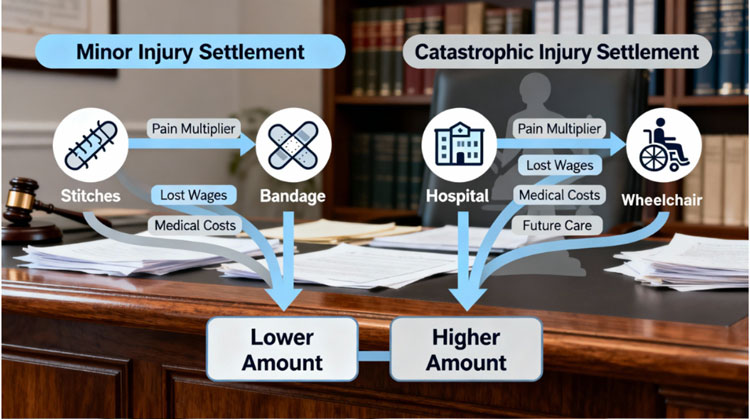
For instance, minor injuries (think someone slips in a store, cuts their forehead, needs a few stitches, and heals in a couple of weeks) usually result in settlements at a few thousand dollars.
Using the standard multiplier for pain and suffering, the non-economic damages in this specific instance might be $3,750. Throw in lost wages, and the settlement lands around $5,000–$15,000.
Now, for catastrophic, life-changing injuries, settlements can hit seven figures. A person who suffers a traumatic brain injury will have a hefty hospital bill, recovery will take years, mobility is permanently affected, and ongoing care is needed.
The multiplier then jumps to 4 or higher, so non-economic damages alone reach $500,000—and that’s without taking lost wages and future care costs into account.
2. Strength of Medical Documentation
The more detailed your medical documentation is, the higher your payout can be.
Low-end scenario: someone claims ongoing back pain after a minor car accident but only has one ER visit documented. If the insurance company has nothing to verify the injury, you’re looking at a settlement of maybe $10,000.
High-end scenario: same back injury, but this time there’s a CT scan, orthopedic notes, multiple physical therapy sessions, and a detailed treatment plan showing surgery might be needed in the future. Suddenly, the claim multiplier jumps, and non-economic damages could easily add $15,000–$50,000 on top of documented medical costs.

Note: Strong documentation also protects against arguments about pre-existing conditions. Without it, insurers can claim the injury wasn’t caused by the accident.
3. Lost Wages and Future Earning Capacity
Money you lose from missing work can dramatically shift a settlement. And it’s not just past paychecks; future earning potential matters too.
For example, an office assistant earning $20/hour who misses four weeks of work due to a moderate injury, like a sprained ankle, could lose roughly $3,200 in wages and see a settlement in the range of $8,000–$15,000.
That aligns with real-world data from the Upjohn Institute for Employment research which found that moderate injuries causing 8–30 lost workdays resulted in an average earnings loss of $3,545 over five years.
Alternatively, if a surgeon breaks a hand in a car accident and spends months off work, that could be around $37,500 of lost wages, plus nerve damage that leaves the hand weaker forever.
In this case, medical economists may calculate $40,000/year lost over the remaining 20-year career—which is $800,000 in future income alone (medical bills and ongoing therapy not included!).
By the way, even bonuses, promotions, or benefits factor into the settlement!
4. Liability and Comparative Fault
Even a severe injury won’t guarantee a top-dollar settlement if liability is unclear or if you share some blame.
A clear liability scenario would be if a driver runs a red light and hits a car. Police reports, traffic cameras, eyewitnesses—they all exist, so the fault is obvious. In this instance, settlement can hit the full policy limit even if your injuries are modest, because the insurance company knows they’ll likely lose at trial.
As opposed to that, if a pedestrian claims they were hit, but the driver insists the pedestrian stepped into traffic and there were no cameras or eyewitnesses present, the insurer might offer only 40–60% of what a clear-cut case would fetch.
Why? They’re betting they can reduce the payout or win in court.
Extra: Comparative fault adds another twist. In some states, if you’re 20% responsible, your settlement drops by 20%. 45% at fault? Big reduction. Over 50%? You might get nothing at all, depending on local laws.
5. Duration and Permanence of the Injury
If a person breaks an arm that heals completely in eight weeks and deals with some minor distress, they may be looking at a settlement of around $15,000–$25,000.
But a spinal cord injury that leaves someone paralyzed below the waist? That’s a lifetime of wheelchair use, ongoing medical care, home modifications, lost career opportunities, and permanent lifestyle changes. Settlement could easily reach $750,000–$3,000,000 or more, depending on income and long-term care needs.
Even within the same injury type, permanence changes everything.
Conclusion
Settlement amounts aren’t random. They depend on multiple factors, and every factor interacts, often compounding the difference between a few thousand dollars and millions.
Two people with similar accidents can see wildly different outcomes because no two cases are identical. That’s why online calculators or quick estimates can only give a rough ballpark—and why having an experienced personal injury lawyer on your side matters.