Stable numbers are great news after a dry year
Contributed Article/Courtesy AZGFD
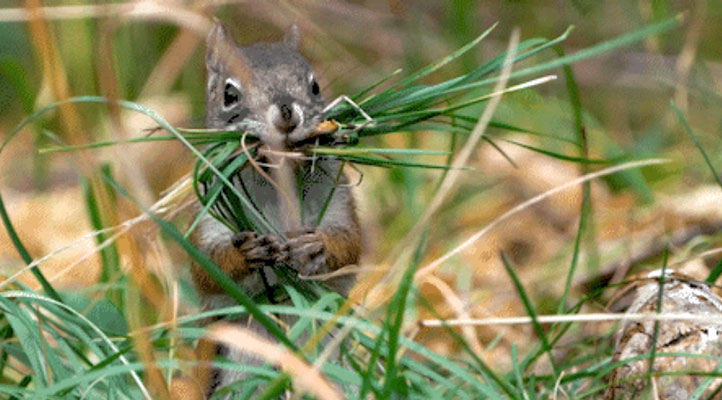
PHOENIX — The annual interagency survey of the endangered Mount Graham red squirrel in the Pinaleño Mountains of southeastern Arizona found the latest population estimate to be stable.
The survey, conducted jointly by the Arizona Game and Fish Department (AZGFD), Coronado National Forest, and the U.S. Fish and Wildlife Service, resulted in an estimate of 232 squirrels compared to last year’s count of 234. This consistency is particularly encouraging because it means that the population weathered a very dry 2025 on the mountain.
“After a rough year with little to no winter or spring precipitation, we were pleased to find the population persisting under these conditions,” said Holly Hicks, AZGFD’s small mammal project coordinator.
Annual red squirrel surveys focus on finding “middens” — areas where squirrels store their cones. This method enables biologists to track squirrels’ locations and movement patterns systematically.

“Survey plots are designed to capture the majority of red squirrel habitat in the Pinaleño Mountains, enabling new middens to be detected as they are created,” said Hicks. “Activity at these middens is then used to estimate the population size.”
The Mount Graham red squirrel population peaked at approximately 550 in the late 1990s. Typically ranging between 200 and 300 individuals, the population plummeted to approximately 35 squirrels after the 2017 Frye Fire. After years of steady growth and a banner year of 90 new squirrels counted in 2023, the population is back within its typical range.
“Seeing the population hold steady this year despite the challenging conditions is such an encouraging sign for this endangered subspecies,” said Brittany Garza, lead biologist for the Mount Graham red squirrel with the U.S. Fish and Wildlife Service.
Listed as endangered in 1987, Mount Graham red squirrels live only in the upper elevation conifer forests of the Pinaleño Mountains and feed primarily on conifer seeds. They are highly territorial and have lower reproductive rates than other red squirrels. Long-term negative impacts on the Mount Graham red squirrel population size and habitat include wildfire, insect infestations, competition with non-native Abert’s squirrels, and poor pine cone crops caused by drought.
“The U.S. Forest Service’s Safford Ranger District appreciates the support and collaboration of our partners as we work together to conserve and restore habitat for the Mount Graham red squirrel,” said Justin Green, Safford District Ranger for the Coronado National Forest. “We are encouraged by the resiliency of the squirrel’s population numbers despite a dry calendar year and are optimistic about the squirrel’s continued success.”
Continuing conservation efforts by the partnering agencies include:
- Habitat assessment
- Insect pheromone treatments to protect trees
- Conifer seed collection, storage, and planting
- Forest stand monitoring and enhancement
- Reduction of food and habitat competitors
- Captive rearing with partners at the Arizona Center for Nature Conservation and the Phoenix Zoo
- Life history and translocation/augmentation research through the University of Arizona
- Annual survey monitoring