



Column By Mike Bibb
The first manned trip to the Moon was NASA’s Apollo 11 mission, launched on July 16, 1969, carrying astronauts Neil Armstrong, Buzz Aldrin, and Michael Collins, and it achieved the first human lunar landing on July 20, 1969.
NASA
On July 20, 1969, I was in the Marine Corps, stationed at an overseas USMC air station, doing my part to “Keep the world safe for Democracy.”
Not entirely sure that deployment was completely successful, since when I returned to Main Street, USA, there were a lot of upset people, protesting what I thought was a fairly sensible endeavor.
Later, I learned there may have been circumstances and reasons for our involvement in the tussle that weren’t fully explained at the time.
After about a decade, and 50,000 dead soldiers, sailors, airmen, and Marines, we left South Vietnam.

Today, a united Vietnam is a trading partner with us. You can find some of their products in various stores around the country.
Also, on July 20, 1969, about a dozen Marines were huddled in front of a small television, awaiting the arrival of Apollo 11, the first U.S. manned spacecraft to land on the Moon.
At the time, space television wasn’t nearly as advanced as today’s. The picture was grainy and somewhat distorted.
However, the audio wasn’t bad, and we could clearly hear Neil Armstrong announce his now-famous declaration as he descended the spacecraft’s ladder: “That’s one small step for man, and one giant leap for mankind.”
Currently, NASA and the media are making a big deal about returning to the Moon in 2028—nearly 60 years after the original Moon walk.

Actually, there have been 12 Moon walks, involving 12 different people from six Apollo lunar landings between 1969 and 1972.
Why, other than using modern rockets, updated software and advanced engineering, is this newest trip — Artemis IV — extra special?
Have we noticed some kind of abnormality deserving a fresh examination by a younger group of astronauts? Are the soil and rocks noticeably different than the ones brought home in the ’60s and ’70s?
Or is the Moon being conceived as a Circle K pit stop for flight crews on their way to Mars—about 34-250 million miles farther down the road, depending on their location in their orbital journeys?
Equally puzzling, it only took a few years after President Kennedy’s encouragement to “travel to the Moon by the end of the decade,” but now, nearly six decades later, we’re going to try it again.
What am I missing?
“Mike, you’re an idiot,” my wife frequently reminds me. “You’ve never been to the Moon, so what do you know about it?”
Actually, a valid opinion I don’t necessarily disagree with.
True, I’ve never been to the Moon, or Mars, or Disney World in Orlando, Florida.
But I know they exist because I’ve read stories and have seen pictures of them.
Plus, Orlando is closer than the Moon or Mars, and it doesn’t cost hundreds of millions of dollars to fly there — and back.
I imagine the urge to return to the lunar surface is probably rooted in the age-old ambition of exploration and domination: “Get there before someone else does” mentality.
We have six U.S. flags, from the six Apollo Missions, planted on the Moon. Five are still standing. One blew down from Apollo 11’s rocket exhaust during liftoff from the Moon’s surface.
At least, that’s what we’re told. Since I haven’t personally journeyed to the Moon’s “Sea of Tranquility,” or any other landing site, to see if the Stars and Stripes are unfurled, I’ll just have to take NASA’s word for it.
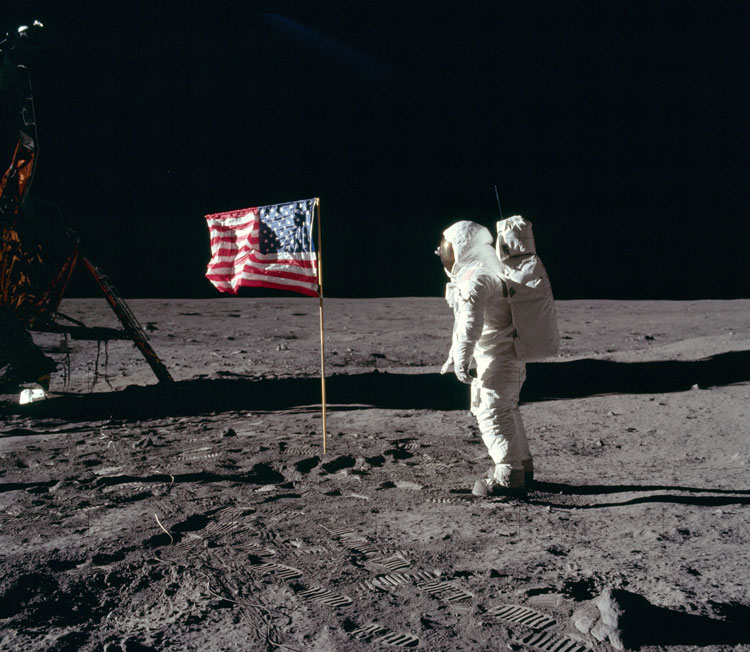
Besides, my social standing as one of the community’s “Village Idiots” — I don’t know how many of us are roaming around; we’re kind of a “keep-to-ourselves” bunch — and accept just about any tale and excuse I hear on the evening news, it shouldn’t come as a surprise when I acknowledge an early 2028 Moon trip is the greatest thing since the 1969 version.
Only this time, it’ll be enhanced with all the marvels AI can provide. Including the difficulty in determining if everything we see and hear is really from the Moon, or a computer-fabricated video telecast from a movie studio in Burbank, California?
If I see Colonel Sanders attired in a NASA space suit ambling in front of the Moon lander, while toting a red-and-white bucket of his famous 11 herbs and spices chicken, then I might suspect I’m watching another Hollywood FX reenactment of H.G. Wells’ “War of the Worlds.”
Regardless, if the announcer assures everyone he’s reporting from the Moon’s surface, and the Air Jordan-shoed jocks in the background are really undocumented NBA aliens from Earth.
FYI — Because the Moon’s gravity is 1/6th of Earth’s, the “3-Point Line” on a lunar basketball court is 143.4 ft. from the basket.
Meaning, since Stephen Curry is the highest-paid player in the NBA, earning over $62 million in salary and about $200 million in endorsements for the 2026-27 Earth season, then if he transfers to the Moon League, his contract should increase sixfold.
Not including the extra oxygen necessary to maintain his high level of play.
The opinions expressed in this editorial are those of the author.