


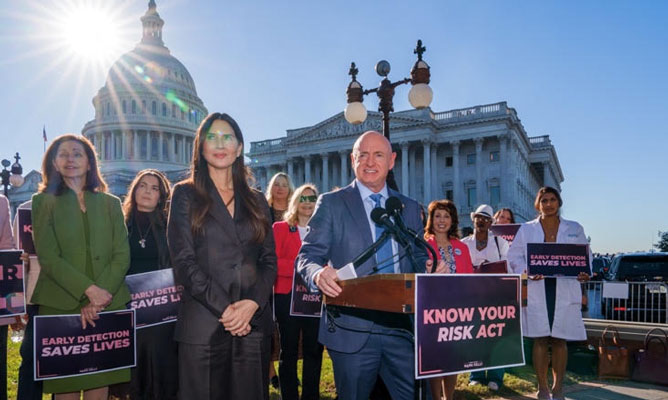
WASHINGTON, D.C. — Arizona Senator Mark Kelly and West Virginia Senator Shelley Moore Capito have introduced bipartisan, bicameral legislation to expand the routine clinical use of breast cancer risk assessment tools to help catch the disease earlier and improve survival rates.
Announced Wednesday, November 18, 2026, the Know Your Risk Act seeks to ensure more women are evaluated for individual breast cancer risk as a standard part of health care. Companion legislation is being introduced in the U.S. House of Representatives by Representatives Mariannette Miller-Meeks (R-IA-01) and Kim Schrier (D-WA-08).
The bill was developed with input from actress and breast cancer survivor Olivia Munn, who was diagnosed in 2023 after her doctor recommended the Tyrer-Cuzick Risk Assessment tool. Even though her mammogram, ultrasound, and genetic testing came back clear, the assessment helped identify her cancer early and led to potentially lifesaving treatment.
Closing the Screening Gap
Breast cancer remains one of the most common cancers affecting women in the United States, with roughly 1 in 8 women developing it over their lifetime. When detected early, the five-year relative survival rate reaches nearly 99 percent. Despite decades of scientific validation behind tools such as the Tyrer-Cuzick Risk Calculator and the Breast Cancer Risk Assessment Tool (BCRAT), studies show only about 50 percent of physicians currently use them.
“My mom and grandmother both had breast cancer; when I think about this disease, I think about them and my daughters and granddaughters. My friend Olivia Munn was able to catch her breast cancer early thanks to a risk assessment test. We know early detection saves lives. That’s why we’re teaming up on this bipartisan bill to make sure more women understand their risk, know what screening options are available to them, and have doctors who are using these tools to help them get the care they deserve,” said Sen. Kelly.
Munn emphasized that shifting more responsibility onto medical professionals can help women who may not yet be at routine mammogram age or who have dense breast tissue or other elevated risk factors.
“I know firsthand how powerful this tool can be because it led me to my breast cancer diagnosis when other standard tools missed it, which ultimately helped save my life,” Munn said. “Had it not been for that assessment, my breast cancer may not have been identified when it was. That experience is exactly why it’s important other women have access to the same opportunity.”
Key Provisions of the Legislation
According to the announcement, the Know Your Risk Act would:
- Establish a Task Force: Create an expert task force to recommend strategies for expanding access to and evaluation of evidence-based risk assessment tools, as well as improving access to medically needed care afterward.
- Expand Patient and Provider Education: Direct the National Cancer Institute to update and expand publicly available educational materials on risk assessment tools for both patients and health care providers.
- Advance Research and Accuracy: Direct the Department of Health and Human Services (HHS) and the National Institutes of Health (NIH) to study and continually improve the accuracy of risk assessment tools.
Broad Coalition Support
The legislation has drawn backing from dozens of health organizations and advocacy groups, including Susan G. Komen, the American College of Obstetricians and Gynecologists (ACOG), the Breast Cancer Research Foundation, the National Comprehensive Cancer Network (NCCN), Memorial Sloan Kettering Cancer Center, FORCE: Facing Our Risk of Cancer Empowered, My Density Matters, and the Prevent Cancer Foundation.
“Too many people are being diagnosed with breast cancer before anyone ever told them they were at risk, sometimes before they are even old enough for a first mammogram,” said Amber Guild, president and CEO of Susan G. Komen. “That is a failure we can fix. When people understand their risk early, they can begin screening sooner, advocate for the care they need, and catch this disease when it is most survivable.”
More details, including the full text of the bill and a one-page summary, were distributed alongside the announcement.