
Column By Mike Bibb
I must confess, before “Artificial Intelligence” became commonly known as “AI,” I’d always thought the AI abbreviation referred to “Always Incompetent.”
Admittedly, my conclusion was based primarily upon observations seen during the Biden Administration, liberal mainstream media, Hollywood hollow heads, perplexing scientific explanations, sports team rankings, and why anyone would want to go to Mars.
Something to talk about, I suppose, but we still haven’t figured out if the dinosaurs were wiped out by a giant meteor crashing into Mexico’s Yucatan Peninsula, a COVID-like virus, volcanoes erupting and polluting the air, too many T-Rex’s munching smaller lizards, and rising seas drowning everything, then immediately freeze-drying it.

Or, a combination of all the above.
Meanwhile, our attention has been diverted from other important matters.
For instance, why hasn’t a vaccine been discovered that reduces a human’s propensity to conquer, enslave, and kill each other? Sort of a “Dicktator’s Prophylactic.”
Why is having a bigger gun the usual remedy in maintaining global peace? Or at least, “peace” as described by the bunch holding the bigger gun.
Seeking solutions, we gaze millions of miles into the heavens, as if answers to these questions are out there — somewhere.
Consequently, we build machines and launch people and equipment to the moon and beyond — continually scanning the universe for hints and clues to the reasons for our existence and purpose.

When, in reality, I imagine answers are much closer than we realize; if only we took the time to pay attention.
Aiding in our quest, we’ve appointed national leaders, accompanied by theologians expressing their particular opinions on God’s view of things, composed train loads of law and scripture, built and destroyed empires, and huddled together to, supposedly, resolve our differences and move on in a more tolerant manner.
Then, some genius had the bright idea to cram all of this information and experience into a giant-sized computer box, accessible by possessing the proper credentials, PIN number, and official approval by the box’s appointed managers and supervisors.
Usually, it’s the same guys who constantly remind us they know what’s best for everyone.
They gave the new invention a name: Artificial Intelligence — the greatest discovery since the wheel and microwaveable Pop-Tarts.

Finally, a mechanical brain that could surpass the curiosity and creativity of the human brain.
Has the creature now exceeded the capabilities of its creator?
What could possibly go wrong?
But first, these colossal “data centers” require lots of water and electricity to keep running.
Or, so we’re told.
Knowing this makes me wonder why they would build these contraptions in the middle of semiarid states like Arizona and New Mexico.
After all, I’ve noticed there doesn’t seem to be much water around here. Which might account for the fact that these states are not known for an overabundance of H2O, particularly in recent drought years.
However, a winter visitor might ignore the obvious when camping in the Phoenix area and teeing off from one of the dozens of green golf courses.
However, Maricopa County, Arizona — often 116F in the summer and not a cloud in sight — and several counties in New Mexico have attracted these information storage facilities:

“Arizona: Hosts multiple hyperscale campuses (Meta, Google, Microsoft) and large planned projects, making it a strategic location for AI and cloud infrastructure.
New Mexico: Already has 10 operating data centers (489 MW) and 11 planned projects adding nearly 13 GW, with Meta’s Los Lunas site among the largest in the state.
In short: Both states have “big” data centers — Arizona’s are hyperscale and multi‑gigawatt in scale, while New Mexico’s include large Meta facilities and multi‑gigawatt planned projects. These are among the most significant in the U.S. and are part of the broader Mountain West digital infrastructure growth.” — AI Overview, Oct.12, 2026.
These billion-dollar structures will only become more commonplace the more information (data) is gathered and stored within them.
Adding to the predicament, forests of electrical wind generators and hundreds of acres of solar panels will not be sufficient to maintain these units. Additional power has to come from conventional sources.
FYI: Have you noticed the huge solar farm a few miles west of Willcox on I-10? The Winchester Solar Facility, which will supply power to Tucson Electric Power, is scheduled to be operational in 2027. TEP already has another smaller solar farm and electrical wind towers in the vicinity. I don’t know how many panels are in the new complex; I’d imagine it’s several thousand or more. This aluminum and glass installation is supposed to provide 80 megawatts of “environmentally friendly” electricity.
AI may be heralded as the ultimate solution to fixing our information problems, but realistically, big business and big government have simply devised a fancy “bookkeeper” to digitally keep track of virtually everything — every individual task, every financial transaction, every cell phone call and text, every mile driven, every article written, every product purchased and every campaign pledge promised.
To me, there is nothing artificial about it, in spite of the clever name tag. It’s real, and it’s here.
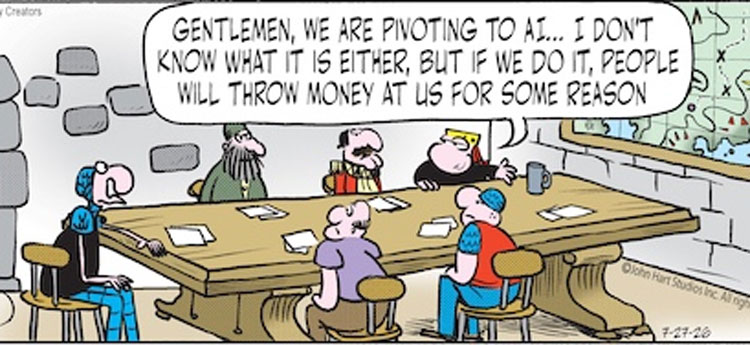
In the end, looks like the King of Id is right about AI — “People will throw money at us for some reason.”
Often, that’s all that matters!
The opinions expressed in this editorial are those of the author.