


By Max Powers
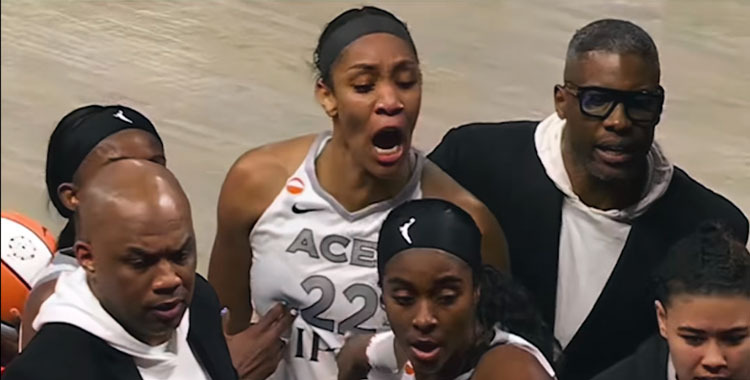
During Tuesday night’s pivotal Game 2 matchup between the Las Vegas Aces and the Indiana Fever at Gainbridge Fieldhouse, a single, tense moment away from the ball stole the spotlight from an intense playoff atmosphere.
With roughly four minutes remaining in Indiana’s 99-89 victory, Aces superstar A’ja Wilson drew a blocking foul on Indiana’s Sophie Cunningham. Following the whistle, a fan seated in the baseline courtside area pointed toward Wilson and shouted, “That foul’s on you!”
What followed was an immediate escalation: Wilson walked past the court boundaries, went two rows deep into the spectator seating area, and confronted the fan directly, repeating, “You don’t point at me!”
Arena security quickly intervened, briefly removing the fan to investigate. The Indiana Fever organization later cleared the spectator, stating:
“Following a report of a comment directed toward a player, arena security spoke with the fan involved and witnesses. Security determined there was no violation of the Fan Code of Conduct, the fan was not removed from the arena. We consider the matter closed.”
While emotions run high during elimination playoff games, Wilson’s decision to enter the stands raises serious questions regarding professional boundary standards and league enforcement.
A Look at the Rulebook
Professional sports leagues maintain strict boundaries separating the playing surface from spectator seating. Under standard professional basketball regulations, including Rule 12A, Section V of the WNBA rulebook:
- Spectator Boundary: The first row of courtside seating marks the beginning of the spectator stands.
- Automatic Ejection: Any player, coach, or trainer who deliberately enters the spectator stands to confront or interact with a fan is subject to an immediate ejection and potential league discipline.
While fan behavior in professional sports venues has faced increased scrutiny in recent years, security personnel and courtside witnesses confirmed that the fan in question did not use profanity, derogatory language, or slurs. The interaction consisted entirely of standard—if animated—spectator banter regarding an officiating call.
In postgame remarks, Wilson defended her response, arguing that a fan stepping toward or pointing at her crossed a personal boundary regardless of the words used:
“If I see a man come at me, taking steps towards me and pointing at me… I don’t give a damn what you said. I don’t give a damn how you said it. The tone—that is unacceptable. You don’t step towards me. You never just point at me.”
Balancing Passion and Professional Standards
The rapid growth of the WNBA has brought unprecedented attendance, passionate home crowds, and high-stakes playoff environments. High-intensity atmospheres naturally produce vocal interactions between fans and visiting athletes.
However, allowing players to cross court boundaries to address non-hostile fan commentary sets a dangerous precedent. Arena security teams are trained to handle rowdy or disruptive spectators so that athletes do not have to police the crowd themselves. When a player steps into the stands, it bypasses safety protocols and increases the risk of physical escalation.
As the series shifts back to Las Vegas for a deciding Game 3, the league faces a crucial responsibility: enforcing clear, consistent boundary standards for both spectators and players to keep the focus where it belongs—on the court.
And while A’ja Wilson said fans didn’t have to like her but would respect her, I lost my respect when she didn’t admit she made a mistake and instead doubled down. So no, A’ja, as a former fan of yours, I no longer respect you. And if I were at the game, I’d let you know it.
The opinions expressed in this editorial are those of the author.