

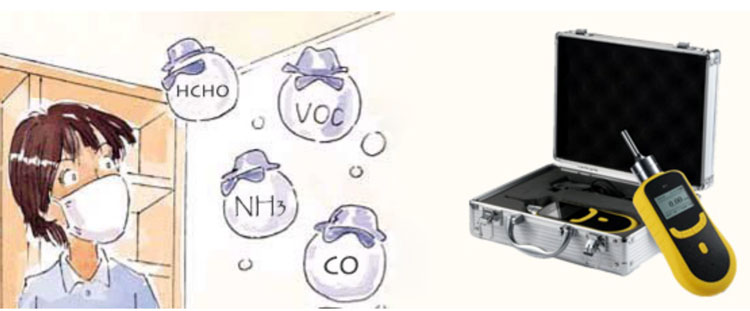
No smoke. No smell. No warning.
“Gases that affect people are the ones that nobody notices until it’s too late” stuck with me. He did not talk about a fire or chemical spill.
He was talking about a typical Tuesday, a regular inspection of a lift station, and a buildup of hydrogen sulfide gas, all of which accumulated overnight, without people knowing, and is now deadly.
It is the most common misconception about gas hazards. Fire, you can see. Smoke, you can feel in your throat. There are, however, dozens of gases that will fill a room without warning, all used in industry. When a person senses that something is wrong, they are already breathing it.

This is exactly why fixed gas detectors exist. Not as a line item on a safety audit. As the one thing on your site that’s watching the air every second of every day, in the exact spot a leak would start, long before any human walks in.
What Safety Gap Does a Fixed Gas Detector Fill?
Most gas-related accidents don’t start with a sudden explosion. They start with:
- A slow leak from a valve
- A cracked seal on a tank
- Gas building up in a confined space
The gas builds up quietly. Workers walk in. Nobody knows there’s a problem.
A fixed gas detector closes that gap. It’s permanently mounted near the risk of a valve, storage tank, compressor, or manhole and never stops watching.
When gas levels start climbing, it triggers an alarm. In many modern systems, it can also:
- Shut off a solenoid valve
- Turn on ventilation automatically
- Alert people before they reach the affected area
That’s the difference between a detector and a warning sign:

- A sign tells people to be careful.
- A detector actually catches the problem.
How Do You Choose the Right Sensor for a Fixed Gas Detector?
Here’s something a lot of buyers don’t realize: There isn’t one gas sensor for every situation. The right sensor depends on the gas you’re trying to detect.
- Catalytic sensors are suitable for combustible gases, such as methane and propane. They’re reliable and economical but require a good amount of oxygen in the air to operate and therefore are not recommended for areas where oxygen levels are low, such as sealed tanks.
- If hydrocarbon gases are present in places with low oxygen or no oxygen, such as inside a vessel purged with nitrogen, then use infrared (IR) sensors. They also last longer with continued use because they don’t undergo a chemical reaction like the chemical reactions in other materials.
- Electrochemical sensors are designed for toxic gases: carbon monoxide, hydrogen sulfide, chlorine, and ammonia. They’re very precise for a discrete gas, but one sensor typically only measures a single type of gas.
The mistake I see most often: a facility buys a general combustible gas detector and assumes it also covers toxic gas exposure. It doesn’t. No methane sensor will alert you to a build-up of carbon monoxide in a boiler room. You cannot put a 1-size-fits-all sensor in place you have to use the right sensor for the gas threat in that place.
| Sensor Type | Best For | Weak Point |
| Catalytic | Combustible gases (methane, propane) in normal-oxygen air | Fails in low-oxygen areas |
| Infrared (IR) | Hydrocarbons in sealed or low-oxygen environments | Higher upfront cost |
| Electrochemical | Toxic gases (CO, H₂S, Cl₂, NH₃) | Usually detects one gas only |
Where You Put It Matters More Than the Model You Buy
I’ve seen facilities spend good money on a high-quality detector and then mount it in the wrong spot, making the whole investment almost pointless.
Some rules that count:
- Methane/propane: These gases float higher in the air and tend to collect near the ceiling; put the detector near the ceiling.
- Carbon dioxide and hydrogen sulfide: These gases are heavier than the air and may collect near the floor or in pits, so place the detector at the lower level or inside pits.
- Avoid placing the sensor in the center of a free-flowing area where the gas may have been spreading and diluted, or in other potential leak areas in the vicinity of valves, flanges, tank seams, etc.
- Tanks, silos, manholes: If the gas is not evenly distributed in a closed area, several detectors may be required, one of which would have to be at a different height.
A detector outside the source of the leak on the wrong wall, at the wrong height, five meters away may be able to detect the gas later. But “eventually” is exactly the word you don’t want in a safety plan.
Understanding the Numbers on the Display
The display on these gas detection units may be intimidating for those new to the gas detection field. Once you understand the two main scales, it’s actually quite simple.
- Toxic gases are measured in parts per million (ppm). It gives details of the amount of that particular gas present in the air, albeit in very small quantities. For instance, being exposed to CO at greater than 200 ppm for even a few hours is hazardous.
- Combustible gases are expressed in terms of percent of LEL (Lower Explosive Limit). It doesn’t measure the amount of gas in the area, just how close the air is to being explosive. The 20% LEL reading is 20% of the way to an explosion hazard, and that is where most safety guidelines recommend evacuating people.
Scale information is not optional. It’s about getting to the right time and not getting to the wrong one.
Calibration is the most expensive mistake you can make!
If a gas detector has not been calibrated regularly, then it’s not really doing its job. It’s simply in your face, giving you false confidence.
Why calibration matters:
- Sensors drift with time: An accurate sensor installed one day may become less sensitive after a few months, particularly in dusty, humid, or corrosive environments.
- Bump tests: A bump test is done monthly by most manufacturers and exposes the sensor to a known gas concentration to ensure it is responding properly.
- Full calibration: This is usually done every 3 to 6 months depending on the environment.
- Not calibrating is risky: because it’s easy to think that the detector is working when it is not, and by the time you realize this, it may be too late.
- The math is simple. A calibration check costs a little time and test gas. A missed leak can cost a shutdown, an injury claim, or worse. There’s no version of that trade where skipping calibration comes out ahead.
One Gas Per Sensor Means You Might Need More Than One Detector
It’s a common mistake made by new home buyers. A single fixed gas detector is generally designed to detect one gas or type of gas. If there are many risks at your facility, such as combustible gas near a compressor, CO near a boiler, and H₂S near a wastewater line, it’s important to set up different purpose-built detectors, not one unit that is expected to detect all.
Let’s take a quick glance at some of the most common industrial applications:
| Environment | Main Gas Risk | Typical Sensor Type |
| Boiler rooms, parking garages | Carbon Monoxide ($CO$) | Electrochemical |
| Wastewater plants, sewage lines | Hydrogen Sulfide ($H – 2S$) | Electrochemical |
| Cold storage, breweries, fermentation rooms | Carbon Dioxide ($CO_2$) | Infrared |
| Gas compressor stations, LPG storage | Combustible gas / LEL | Catalytic |
| Chemical storage, water treatment | Chlorine ($Cl – 2$), Ammonia ($NH – 3$) | Electrochemical |
| Nitrogen-purged tanks, confined vessels | Oxygen deficiency ($O – 2$) | Electrochemical |
If your facility spans more than one of these risks, and most do, you’re not looking at one detector. You’re looking at a system, with each unit doing one job well instead of one unit doing several jobs poorly.
How Does a Fixed Gas Detector Work on a Real Site?
Picture a mid-size chemical processing plant:
- Loading dock: A chlorine sensor monitors the tank connections.
- Boiler room: A CO detector is mounted near the ceiling vent.
- Wastewater area: An H₂S sensor sits low near the lift station.
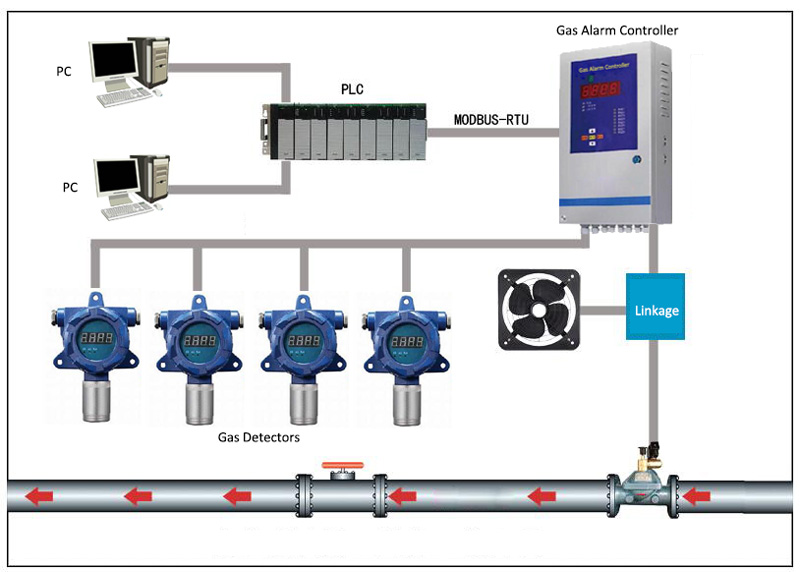
- Central control: Each detector is wired into a central control panel. If any sensor detects rising gas levels, the local alarm sounds and the alert appears on the control room screen.
Nobody in that plant is relying on smell, instinct, or luck. The air is being checked every second, exactly where a leak is most likely to start.
That’s the whole purpose of a fixed gas detection system: not to replace good safety training, but to warn workers before their senses ever would.
The Alarm Doesn’t Have to Stay on the Wall
Gas detectors used to be standalone boxes. You’d walk past one, glance at the display, and move on. That’s changed.
Most of the modern fixed gas detectors are capable of providing live output in either 4 – 20 mA, which can be directly connected to the plant’s control system.
In practice, this is
- Central monitoring: A single safety officer can monitor and control the gas level throughout the site from one screen.
- Automatic response: When the gas levels hit a certain threshold, the system can activate a relay to close a solenoid valve, start ventilation fans, or disconnect power to equipment nearby.
- Remote alerts: If a gas spike occurs, some systems will alert the maintenance team via SMS and/or app – even when no one is present.
- PLC/HMI integration: If the plant has the existing PLC/HMI, the detector can directly input into the existing system to display the gas information.
Gas detection isn’t just a sensor bolted to a wall anymore. It’s part of the same automation network running your pumps, motors, and production line.
Before You Choose a Fixed Gas Detector
Choosing a fixed gas detector isn’t about buying the cheapest unit on a spec sheet. It’s about getting three things right:
- The right sensor for the gas
- The right location for the detector
- The right calibration to keep it reliable
Get all three right, and your system can catch a gas leak before it becomes an accident. Get one wrong, and that detector on the wall may give you nothing more than a false sense of safety.
Don’t wait for the alarm to tell you what you should have checked first.
Match the detector to your actual gas risk. Detect combustible gases, CO, H₂S, ammonia, chlorine, oxygen, and so much more, and design detection where the threat is.
Select the appropriate sensor. Place it where it’s needed. But don’t wait for it to happen; know what’s in the air before it’s too late.