

EAC hosts powerful Constitution Day assembly
By Jon Johnson/Gila Herald
THATCHER — Marking the exact date 239 years after the nation’s founding document was signed, Eastern Arizona College hosted its annual Constitution Day assembly on Thursday, Sept. 17, delivering a powerful reminder of American freedoms through the eyes of an immigrant who fled war and totalitarianism.
The annual commemoration, traditionally held on a Thursday at 11 a.m. during EAC’s non-class “common hour,” took on added significance this year as the gathering fell precisely on the Sept. 17 national anniversary of the U.S. Constitution’s signing in 1787.

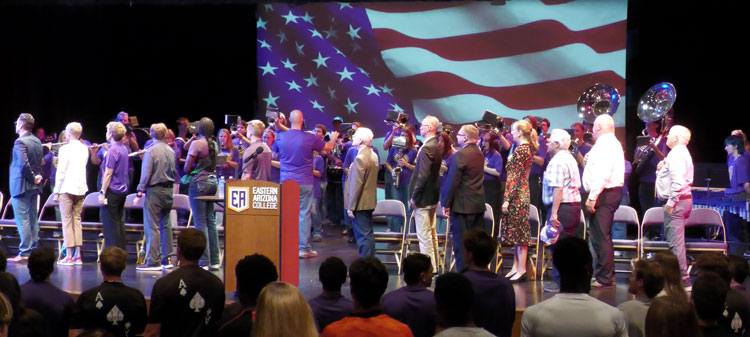
The event opened with patriotic fanfare as the EAC Band warmed up the crowd and performed the National Anthem, followed later by a rendition of “America the Beautiful” by the EAC Choir. Local leaders and dignitaries filled the stage, including Graham County Supervisor Paul David, Safford Vice-Mayor Arnold Lopez, Fiona De Young representing U.S. Rep. Juan Ciscomani, Graham County Attorney Scott Bennett, and the EAC Governing Board.
Opening the ceremony, EAC President Todd Haynie highlighted the historic date and the universal impact of the nation’s governing document.
“This is the day 239 years ago that the Constitution of the United States was signed,” Haynie said. “As we come together and commemorate this important occasion… it’s important to remember that this is the document upon which the foundational principles that we live under happen to be.”
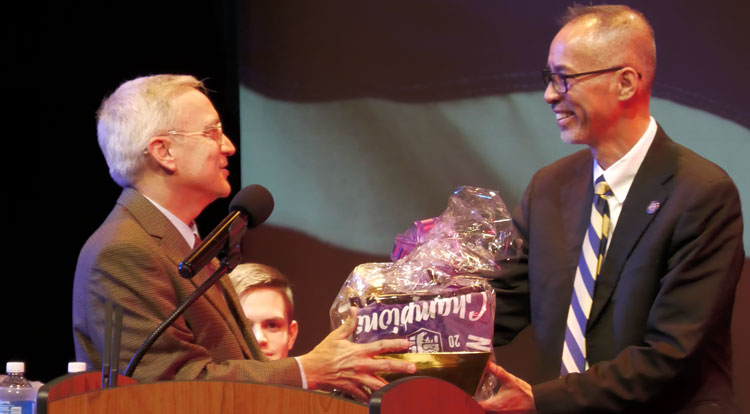
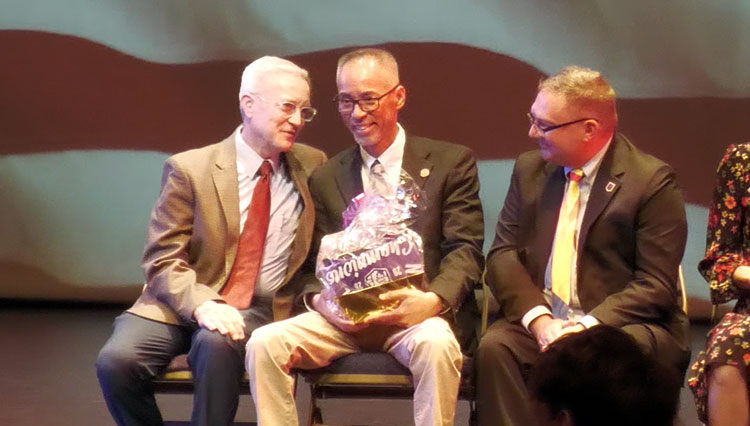
Haynie then introduced the keynote speaker, Arizona State Representative Quang Hữu Nguyễn (R-Dist. 1), noting that his perspective on freedom was forged not in a classroom, but through raw personal experience.
Born in South Vietnam during the Vietnam War, Nguyen was 12 years old when Saigon fell in April 1975. Arriving in the United States unable to speak English, Nguyen went on to learn the language, earn an aerospace engineering degree, build a successful career as an entrepreneur and artist, become a naturalized citizen in 1983, and eventually earn election to the Arizona House of Representatives, where he currently serves as Chairman of the House Judiciary Committee.
Taking the podium, Rep. Nguyen offered a candid, fiery, and deeply personal address comparing the liberties guaranteed by the U.S. Constitution to his upbringing under an oppressive war zone and his fierce anti-Communist worldview.
“Two hundred and thirty-nine years of greatness — that’s how I see the U.S. Constitution,” Nguyen told the packed crowd of students, faculty, and community members. “I didn’t know how to be an American. But just watching Americans be Americans motivated me to do so much more.”
Reflecting on his childhood in South Vietnam, Nguyen detailed his family’s generational history of conflict. His father fought for 39 years — against French occupation, Japanese invaders during World War II, and ultimately as a lieutenant colonel in the South Vietnamese army fighting Communism. Nguyen recalled growing up surrounded by violence and going to bed hungry.
“What is freedom?” Nguyen asked the audience. “To someone like me looking in, it is the ability to criticize your government, knowing that the next day you would still be alive… and not have the opposition take care of you the next day. That’s what freedom means to me.”
Nguyen delivered a scathing critique of Communism and Socialism, drawing on historical atrocities like the Cambodian killing fields under Pol Pot and Mao Zedong’s mass starvation policies.
“Don’t let people tell you Socialism is awesome,” Nguyen warned. “Communism isn’t an economic system… it’s a death machine. More than a hundred million people slaughtered in less than a hundred years. If you’re well-educated, you can’t be controlled. If you’re well-fed, you can’t be controlled. And if you’re well-armed, you definitely cannot be controlled.”
To illustrate the human toll of totalitarian rule, Nguyen shared the story of his cousin Ann, an educated pharmacist and South Vietnamese airborne soldier who was captured and sent to a “re-education” camp at the end of the war. After enduring nearly a decade of beatings and isolation, his cousin attempted a final escape the night before his scheduled release, choosing to die seeking true liberty rather than accepting freedom on his captors’ terms. He was executed in front of the camp.
“He said, ‘I want freedom on my own terms, not theirs,'” Nguyen recalled. “That’s Communism. When you see them fly the red flag with the yellow star, don’t be proud of it.”
Nguyen emphasized the First and Second Amendments as the fundamental pillars protecting American life, describing the Second Amendment as the essential shield for the First. He urged students to take personal responsibility for their civic duties, particularly by reading the Constitution and participating in elections.

“Your voting preserves the Republic,” Nguyen urged. “I am such a darn proud American. I bleed red, white, and blue every day… watch out for things, and don’t buy into the easy thing. Understand your rights, defend your rights, and keep this Republic alive.”