
Gila Herald Staff Reports
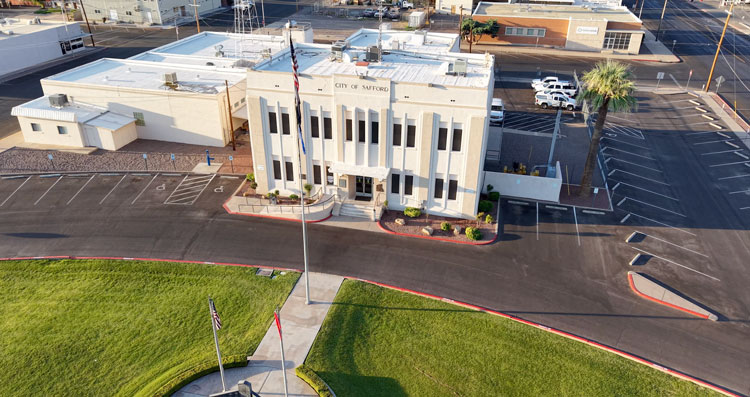
SAFFORD — Following a marathon budgeting process that stretched back to January, the Safford City Council voted 6-1 on Monday, June 8, to adopt a resolution establishing a tentative fiscal year 2026–2027 municipal budget of $132,017,625.

The vote officially sets the city’s legal expenditure ceiling for the upcoming fiscal year. Under Arizona state law, while the council can choose to trim line items and reduce the total amount over the next month, it cannot exceed this approved $132 million limit when it votes on the final budget in July. Councilmember Dusti Brantner cast the lone dissenting vote.
Safford Finance Director Troy Bingham explained that while the headline figure represents a balanced budget, it stands significantly higher than the $109 million figure previously discussed by the council. This discrepancy is due to the inclusion of mandatory state tracking categories, legal internal service funds, and critical financial safety nets.
Understanding the Numbers: Fund Breakdowns and Debt
To comply with state reporting mandates, Bingham streamlined the city’s complex ledger into three core fund categories: the General Fund, Special Revenue Funds (primarily the Highway User Revenue Fund, or HERF), and Enterprise Funds, which encompass city-run utilities, the landfill, and sanitation.
| Budget Component | Total Allocated | Key Highlights |
| General Fund | $44,695,521 | Includes Public Works administration, park development, and public safety. |
| Special Revenue (HERF) | $6,037,000 | Dedicated exclusively to street maintenance and pedestrian infrastructure. |
| Enterprise Funds | $62,477,716 | Houses city utilities, including gas, electric, water, wastewater, and sanitation. |
The budget figures also bundle operational costs together with the first year of the city’s five-year Capital Improvement Plan (CIP). For example, a $14.9 million line item for Public Works combines daily operational funds with the first year of funding for construction of a major new city park.
Bingham noted that a massive chunk of the budget—$36 million—is technically exempt from the city’s state-mandated expenditure limitations because it is funded directly by incoming grants and newly acquired debt. This includes a $13.75 million rural utility loan from the USDA for a major water project in Lebanon, $8.7 million in city-wide vehicle leasing, and various grants. Among those are a $5 million federal chunk for airport upgrades, specialized police deployment grants, and sidewalk funding through the Community Development Block Grant (CDBG) program.
From a taxpayer perspective, the council intends to keep the city’s property tax levy completely flat. Because of local construction and regional growth, the tax rate will actually slide slightly downward, though it will collect roughly $335,000—representing a minor $7,000 increase over last year’s collection. Bingham noted this marks the first time in ten years that the city has allowed the property tax rate to drop.
Budget Can Shrink, But It Cannot Grow
Bingham repeatedly emphasized that passing the tentative budget is a structural statutory requirement rather than a final stamp of approval.
“This requires us to set a maximum budget, and then from here we can set a final budget less than this, but you cannot go higher than this number,” Bingham told the council. “It is balanced right now… If we’re talking about an increase [in a specific area], we’ve got to talk about a change somewhere else.”

The presence of a $4 million utility contingency fund and additional General Fund contingencies gives the city flexibility. For instance, the city just received a three-year grant to cover years two through four of its police “Flock” camera tracking system. Because the $285,000 grant arrived after the ledger was compiled, Bingham will utilize the contingency fund to balance out the police department’s spending authority, resulting in a net-zero impact on city funds.
Council Spars Over Utilities, Fleet, and Bonuses
With the budget ceiling firmly established, council members spent the remainder of the presentation outlining specific amendments they want to vote on before finalizing the budget. The council plans to address these issues at the next regular meeting on June 22:
- Utility Rate Increases: Council members explicitly noted they are opposed to rolling out utility rate increases without a strict 60-day notice to the community, requesting that any planned utility changes be synchronized and delayed until November 1 to mark a full year since the last adjustments.
- The “Ghost Fleet” and Vehicle Replacements: A debate emerged regarding the city’s vehicle replacement schedule. Council members requested a review of the entire fleet matrix, seeking options to push vehicle replacement cycles out to extend their usefulness and save cash immediately. Additionally, the council targeted a so-called “ghost fleet”—older vehicles that were replaced but passed to other departments rather than being auctioned off—demanding they be stripped from the automatic replacement program.
- Employee Holiday Bonuses: Council requested bringing back options to fund traditional staff holiday gift cards and employee bonuses, potentially offsetting the expense by scaling back the City Council’s individual community donation program from $105,000 to $70,000.
- Golf Course Effluent Water Rates: Following recent financial turmoil at the Mt. Graham Municipal Golf Course, the council is considering a standard $2.50 rate for effluent wastewater use, but has requested an amendment to explore charging the city-owned course a discounted internal rate to mitigate its structural losses.
Timeline for Public Review
Per state law, the approved tentative budget will be advertised publicly in the local newspaper for two consecutive weeks to allow for community evaluation.
Because of the mandatory publication timeline, the absolute earliest the council can vote to enact the final budget is Monday, July 13, at 6 p.m. at the Safford Library, which will begin with an open public hearing. Bingham noted that this schedule places the first 13 days of the 2027 fiscal year in a brief legal limbo in which the city cannot enter into new contracts or encumber additional funds, but assured council members that standard payroll schedules will not be affected.