

Most bettors are chasing winners. But here is the thing: picking the right team is only half the battle. If the price you get for that team is too low, you have already lost before the game even starts. This is the core insight that separates recreational bettors from those who treat sports betting as a discipline.
The approach is called value betting. Rather than focusing on who is most likely to win, value bettors ask a sharper question: is the price on offer actually worth the risk? When bookmakers misprice an outcome, and they do, regularly, a knowledgeable bettor can take advantage before the market corrects itself.
Defining value in a betting context
Every set of odds carries an implied probability. Odds of 2.50, for example, suggest the bookmaker believes that the outcome has roughly a 40% chance of occurring. Now imagine your own research leads you to a different conclusion – say, a 50% chance. That gap between the bookmaker’s estimate and yours is where value lives.
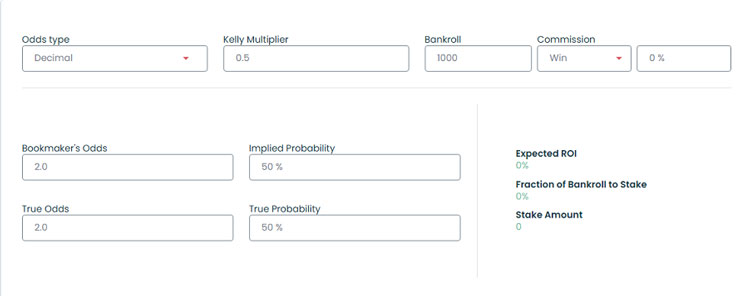
By the way, some value bet scanners already have built-in EV, no-vig, and even a quarter kelly calculator, so you’re able to make all the necessary calculations in a few clicks.
Value betting is not about certainty. No bet is ever guaranteed. It is about finding situations where the potential return is greater than the actual risk. If you can consistently identify these situations and act on them, the mathematics will work in your favor over time, even if individual bets do not.
Bookmakers employ experienced analysts, but they are working on an enormous scale. On any given day, there are hundreds of matches across dozens of sports. Keeping every line perfectly accurate is simply not possible.
Mispricing happens for several reasons. Breaking news: a key player ruled out, a manager sacked, a venue change may not be reflected instantly. Heavy public money on a popular team can distort lines away from true probability. Analysts may apply generic models that miss context-specific factors. Sometimes it is just a straightforward human error.

Any of these situations can create an opening. The bettor who spots the discrepancy first and acts quickly has an edge.
A worked example
Take a hypothetical NBA matchup between the Phoenix Suns and the Golden State Warriors. A bookmaker publishes these lines:
Phoenix Suns: 2.50 | Golden State Warriors: 1.50
The implied probabilities here are roughly 40% for the Suns and 67% for the Warriors. Now you dig deeper – current form, injury reports, travel schedules, head-to-head trends, motivation. Your assessment is that Phoenix is genuinely a 50% proposition in this game.
That 10-percentage-point difference between 40% and 50% is significant. The bookmaker is undervaluing the Suns. If your analysis holds up and you keep finding similar edges across many bets, the expected value compounds in your favor, even on the nights when Phoenix loses.
Value betting is conceptually straightforward. The execution is far harder. Odds move constantly. A line that represents genuine value at one moment may be corrected within minutes. To catch enough opportunities to make the strategy viable, you would need to monitor dozens of bookmakers across multiple sports simultaneously while also running your own probability calculations in real time.
For anyone without specialist tools, this workload quickly becomes unmanageable. The edge evaporates faster than it can be identified.
How scanning software changes the equation
Value bet scanners do the heavy lifting automatically. They pull odds from a wide network of bookmakers, calculate the implied probabilities, compare them against each other, and flag the discrepancies that might represent value – all in real time.
Instead of bouncing between websites and keeping mental notes, a bettor using scanning software sees potential opportunities consolidated in one place. Speed matters because these windows close quickly; having the information instantly means you can act before the market adjusts.
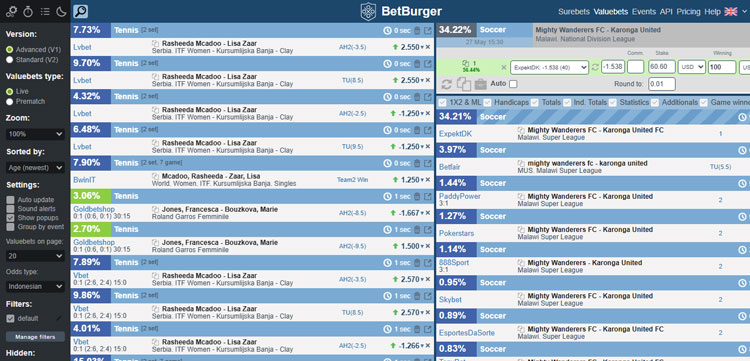
BetBurger is a dedicated value bet checker designed for bettors who want a serious workflow. It covers a broad range of bookmakers, sports, and markets, presenting value opportunities without requiring you to hunt through them manually.
The platform handles both pre-match and in-play events, so opportunities can be tracked right up to and during a game. Customization is a key feature: users can filter by sport, bookmaker, value threshold, profitability percentage, and match timing to align the feed with their specific strategy rather than drowning in irrelevant data.
Conclusion
Value betting reframes the entire question of sports wagering. The goal is not to predict outcomes perfectly – it is to identify when the price available is better than the underlying risk deserves. Do that consistently, and the mathematics will look after the long-term result.
Finding those opportunities manually is possible, but slow and error-prone.
Tools like BetBurger automate the scanning process, surface value bets across multiple bookmakers and sports, and give users the controls to match what they find to their own strategy.
With sound analysis, proper money management, and the patience to let an edge accumulate, value betting can be a genuinely sustainable approach to sports betting over the long run.