

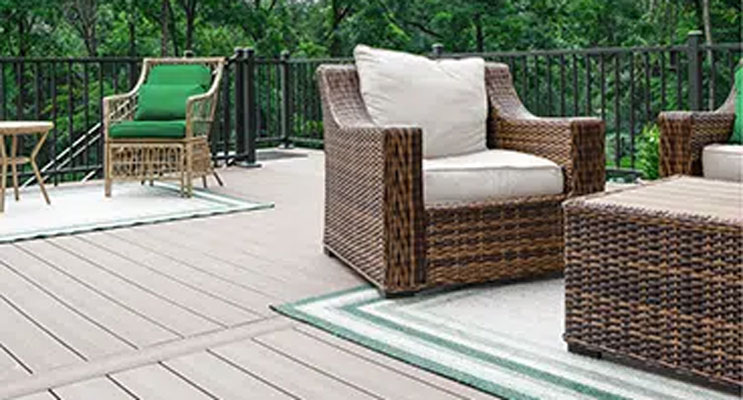
You’d think that there’s not that much to building a deck.
It’s a pretty basic structure, and since you’re building on your own property, you should call the shots on how it will look and what exactly you end up building. Maybe you’ll ask your neighbor how deep to dig the holes, but that’s about it. Easy peasy.
But as it turns out, it’s not quite so easy or peasy.

Regardless of which state you live in, it has its own rules regarding any structures you want to build, plus there’s the weather and climate to think of.
If you try to be nonchalant and build a deck somewhere in Pennsylvania, the snow will probably heave your deck 6 inches out of level. In Arizona, though, you have heat and sun to think of.
Read on, and let’s see how to build a deck (the legal way) in both states.
Rules and Regulations in Pennsylvania
If you’re in Pennsylvania and you want to build a deck, the first thing you’ll need to do is get a permit.
Permits are necessary for decks that are attached to the house or stand more than 30 inches off the ground. Pennsylvania uses the Pennsylvania Uniform Construction Code, which is a version of the International Residential Code, just tweaked to work for the state’s specific conditions.
So, the way to start this is by going to the permit office with your plan.
The plan has to show exactly where your deck will be, and make sure to have the property lines clearly drawn out. Along with this, you should also bring some basic drawings of the structure. The more that’s on there, the better – footings, beams, joints… Heck, even the type of screws and nails you plan on using.
After that, it’s time for inspections. That’s right. Not an inspection but inspections.
And let’s not forget zoning rules.
You can’t just pick a spot that you think will look good and then build a deck there. That would be too easy. Instead, you have to make sure that there’s a certain amount of distance between the deck and property lines. And to make this even more complicated, in some towns, you also need to think of the portion of the yard the deck covers and how tall it is relative to your house. And if you have an HOA, well… You know how they are. They have a lot of opinions that you have no choice but to respect.
There’s also the climate to consider. Pennsylvania gets really cold and really wet, which means the ground freezes every winter. That means that all footings MUST go below the frost line, and that’s at least 30 inches deep.
Sometimes, it can even be 42.
If you want to make your life easier, you’ll contact a reputable company that specializes in building custom decks (to your specs and liking), such as Keystone Custom Decks, to make sure the job gets done right.
Since this is a real investment, you want this to be built right, and you want it to last for generations to come.
Rules and Regulations in Arizona
Things are different here than they are in Pennsylvania.
You still need a permit in most cities and counties; that part’s the same. You’ll also need to turn in some basic plans and wait for inspections. But that’s about it as far as similarities go.
The real-world card here is the HOAs.
They’re absolutely everywhere, and they’re very interested in how your deck looks from the street. They care about the color of the boards, if the deck fits the vibe of the neighborhood… Everything.
Even if you follow every single building code to the letter, an HOA can still tell you to tear the thing down because they don’t like the style of the railing.
In Arizona, you don’t really need to dig 30 or 40 inches to get below the frost line because the ground doesn’t freeze, so that saves you a ton of work.
Still, that doesn’t mean things are peachy because they aren’t.
Some parts of the state have clay soil, and when it gets wet, the soil swells up like a sponge. Then it shrinks and cracks when it dries, and that cycle pushes your footing around all the time. Other areas have sandy soil, which is loose and doesn’t hold the weight well.
Then there’s heat and sun, which make regular lumber completely useless. It doesn’t stand a chance against Arizona’s sun because it dries out and cracks like you wouldn’t believe.
You’ll need to use either composite materials or woods treated to handle UV exposure.
Another thing you’ll want is a pergola or something else that provides shade, or the deck will be unusable for most of the year.
Conclusion
Building a deck, wherever you are, is anything but simple.
The process of putting it up isn’t rocket science, but when you think about all the permits you need and all the considerations you have to think of, it’s a lot. The smartest thing you can do is hire professionals.
A chunk of work will still fall on you, but you’ll have fewer headaches to deal with.