

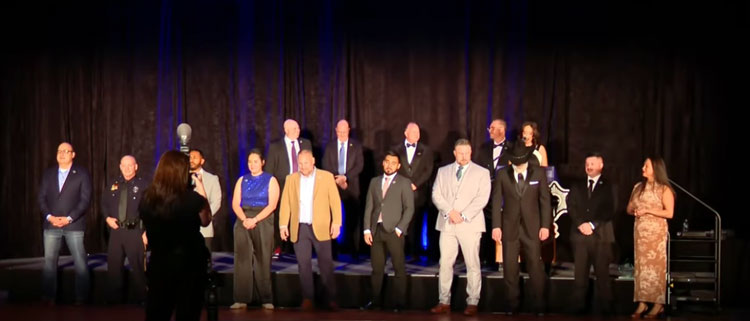
The Assist the Officer Foundation (ATO) has named Dr. Alexander “Alex” Eastman as the Dallas Police Department’s 2025 Reserve Officer of the Year, honoring his career bridging trauma care and tactical operations.
Eastman, a reserve lieutenant and longtime tactical medic/SWAT physician, received the honor at ATO’s 32nd Annual Cop’s Cop Banquet and Gala. The event recognized officers, staff, and supporters, and was attended by law enforcement leaders, elected officials, and community members, including Texas Gov. Greg Abbott, who received a separate “Back the Blue” award.
The Reserve Officer of the Year award highlights volunteer reserve officers who serve alongside full-time personnel while maintaining civilian careers. For Eastman, it publicly recognizes his impact on medical support for Dallas officers before, during, and after high-risk incidents.
In his remarks, Eastman emphasized that the recognition reflects a team effort.
“This award is about service, and I’m honored to stand with the men and women who protect Dallas every day,” he said. “I’ve always believed that showing up, training hard, and taking care of each other is what keeps officers safe and helps families get through the hardest moments.”
A physician in uniform
Eastman has served in the Department’s reserve unit since 2010 and now holds the rank of reserve lieutenant. He also serves in a department-wide medical leadership role, advising on officer safety, operational planning, and medical readiness.
While the titles vary in how they are described, the day-to-day responsibilities are straightforward: helping the department prepare for critical incidents, improving medical training, and ensuring officers have a better chance when a routine shift turns into an emergency.

This work has made Eastman a familiar presence at training sites, command posts, and in hospitals where officers and families gather after traumatic incidents.
The nomination that brought the room to its feet
A significant part of the evening’s tribute focused on retired Dallas Police Sgt. Edmundo “Ed” Lujan, who nominated Eastman and credited him with life-saving care and ongoing support after a severe line-of-duty injury in 2015.
According to remarks shared during the gala, Lujan was working off-duty security on Nov. 9, 2015, when he was struck and run over by a vehicle, suffering catastrophic injuries and facing a long, uncertain recovery.
Lujan’s son spoke to the audience about the family’s experience during his father’s recovery.
“The road back was long,” he said. “He was treated by incredible doctors led by one of our very own reserves, Dr. Alex Eastman. … His extended Blue Family was a big part of recovery.”

He also highlighted the ongoing support the family received from ATO, including regular check-ins and assistance, and described Lujan’s later involvement with the organization as a way to give back. For many, it was a reminder that tactical medicine extends beyond the initial response. It also involves surgeries, rehabilitation, family stress, and the ongoing work of recovery. expectations
Officer tactics and the threats they face have evolved. Eastman’s influence is evident in the shift toward bringing advanced trauma expertise closer to the point of injury, a concept once considered unrealistic.
Since the mid-2000s, Eastman has advocated for trauma-trained physicians to move beyond hospital settings and integrate directly with tactical teams, bringing medical expertise closer to where injuries occur.
This concept was formalized through the Dallas Police Department’s tactical medic program, which trains physicians and medics to provide advanced care in high-risk, uncontrolled environments. The goal is to improve survivability when seconds matter.
This emphasis extends to both training and deployment. The work involves repetition, adherence to standards and protocols, and scenario-based decision-making. It also requires coordination to ensure law enforcement and medical personnel operate seamlessly during high-stress situations.

Why the award matters inside the department
ATO’s Reserve Officer of the Year award is selected by a committee based on nominations from fellow officers, who are best positioned to observe a reserve officer’s impact.
In Eastman’s case, supporters highlight his consistent presence at difficult calls, his role in building scalable medical capabilities, and his ongoing support for officers and families.
Eastman has received multiple commendations, and his work is described as both operational and cultural, reinforcing that officer safety includes prevention, training, wellness, and family support, not just emergency response.
Work that extends beyond Dallas
Outside the department, Eastman is recognized nationally for his work in trauma care and law enforcement medical support. He has trained officers and medical professionals, contributed to tactical emergency casualty care discussions, and participated in efforts to improve outcomes during active threat situations.
Despite his national presence, Eastman’s work remains rooted in local relationships, including officers, families, and training teams who have seen Dallas become a model for tactical medical integration.
ATO’s mission and the “Blue Family” focus
Founded to support Dallas Police officers and first responders, ATO provides financial aid, resources, and crisis support for those affected by line-of-duty injuries and other emergencies. While the Cop’s Cop Banquet and Gala is its most visible event, ATO’s mission continues year-round, often quietly supporting officers and families in times of need.
That theme surfaced repeatedly during the tribute to Eastman: not just the role he plays in critical incidents, but the steadiness of presence — the idea that support shouldn’t end when the sirens stop.
As the evening concluded, the award highlighted the evolving needs of modern policing: officers trained for high-risk environments, systems that prioritize medical readiness, and leadership committed to building programs that improve survival and recovery.
For Alex Eastman, the recognition served as a reminder of why he chose both roles and why he continues to serve.
“Showing up,” he said, “is what keeps officers safe and helps families get through the hardest moments.”