

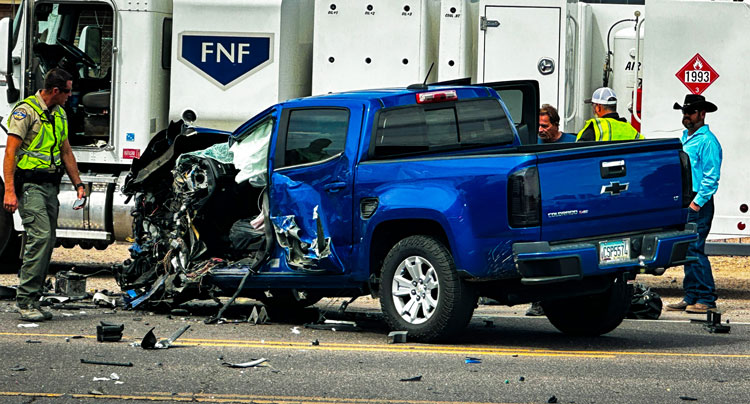
You’re driving home from work, the light turns green, you go, and BAM! Someone runs the red light and plows right into you. Now your neck is sore, the bumper is in the gutter, and there’s absolutely zero chance you’ll be able to drive the car.
Now imagine that same crash happening 1,500 miles east. The accident is identical, but the state is different, so everything changes.
There’s a version of this story where you walk away with all your medical bills covered and a check for the car that was totaled. But there’s also a version where you lose your mind fighting with insurance companies and wondering if you’ll ever see a dime.
Sounds strange, doesn’t it? And, yet, it’s true.

If you compare Arizona and Illinois, you see the rules are completely different.
Who Gets Blamed and How Much It Costs
Whose fault was it? That’s the first question after every accident, and the answer is supposed to be simple. You either caused the crash or you didn’t, right?
It’s black and white.
But legally speaking, fault isn’t always that clear. Most of the time, everyone gets part of it, and the real question you should be asking is how big is your part. That determines how much money will end up in your pocket or how much you’ll need to pay.
This is called comparative negligence, and it’s how courts and insurance companies decide who pays what when there’s more than one person at fault.
So instead of a single person being blamed for the crash, they assign percentages.

Let’s say you’re 20% at fault, which makes the other driver 80%. In most states, that means the other person’s insurance will pay for 20% of your damages, and you’re the one who has to cover the rest. This is where Arizona and Illinois part ways, though, because although they both use comparative negligence, they have totally different rules.
Arizona follows pure comparative negligence.
That means that nobody cares if you’re 10% at fault or 90%, you can still get something.
For example, say your medical bills and car repair add up to $10,000 (USD). If you’re 40% at fault, that’s how much the payout will be reduced by, so you’d walk away with $6,000. The door is never fully closed on your claim, regardless of how much you’re to blame.
Illinois is different.
They use the so-called modified comparative negligence, and there’s a hard cutoff here.

The only way for you to recover damages is if you’re not more than 50% at fault. If you’re at 50% exactly, you can still get paid, but the moment that number climbs to 50%? Nope.
You don’t get anything.
So while you’re counting your money in Arizona, in Illinois, you’re wondering when to hire a motorcycle accident lawyer or when to hire a car accident lawyer, which is fully dependent on what exactly happened in the incident and which vehicles were involved.
Insurance companies are familiar with all those rules, of course, and they tweak their tactics according to them. They’ll be more willing to negotiate in Arizona because they know you can still get some money even if you’re pretty much the person who caused the accident.
In Illinois, insurers play hardball, and if they think there’s even the slightest bit of chance they can push your percentage over that 50% line, they’ll fight like crazy.
The Insurance Gap Most Drivers Don’t See Coming
Just because you figure out who caused the crash doesn’t mean you know who will pay for it.
Most people think that, if the person was at fault, their insurance will cover everything, but the thing is that their coverage can run out way before your bills do.
Every state requires minimum liability insurance, but as you can imagine, those minimums aren’t always enough.
In Arizona, drivers need to have at least $25,000 (USD) in bodily injury coverage per person, and it’s the same in Illinois. And those 25 grand sound like a lot of money until you spend a night in the hospital and realize that one short stay can gobble up all that. And you’re stuck with the rest.
Now, this is where the states differ.
In Illinois, insurance companies have to offer uninsured and underinsured motorist coverage, and if drivers don’t want it, they have to reject it in writing. Arizona doesn’t have that requirement, and drivers can skip this coverage without signing anything (and plenty do to save money).
So you could have two crashes that are completely identical, and yet they could result in two entirely different financial futures.
Conclusion
Same crash, same busted care, but two different backgrounds and two different outcomes. It probably messes with your head a little, which is understandable. Most people drive around assuming the system is fair and, if you get hurt, someone will pay for it.
But actually, the system isn’t really your friend, and where you’re sitting when the crash happens will determine if you walk out buried in bills or not.