


Column By Mike Bibb
Why did President Truman fire General MacArthur?
Quick answer: President Truman fired General MacArthur in April 1951 due to fundamental disagreements over Korean War strategy, particularly MacArthur’s desire to bomb China, which Truman opposed. MacArthur’s public criticism of Truman’s policies and his defiance of civilian control over the military led to his dismissal. Despite MacArthur’s previous military successes, his actions and statements contradicted the administration’s policies, ultimately necessitating his removal to maintain civilian authority over the military. — eNotes, Jan. 3, 2026.
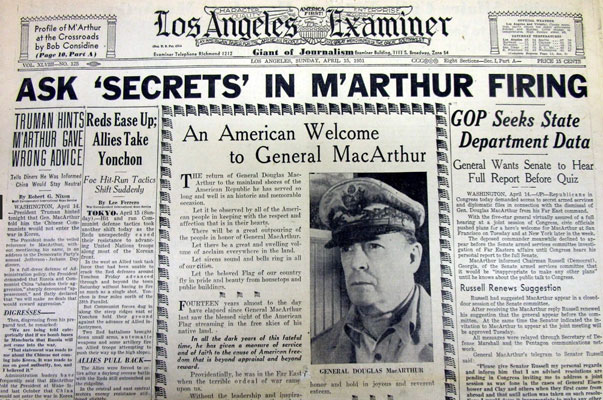
During the Korean War, President Truman fired Army General Douglas MacArthur for not adhering to Truman’s orders. Today, retired Navy Captain and U.S. Senator Mark Kelly, (AZ-D), is encouraging military personnel to disregard orders they believe are unlawful.
Seems like deja vu all over again — as former New York Yankee catcher, Lawrence Peter “Yogi” Berra once remarked.
Which brings to mind — If President Trump, who is also the Commander-in-Chief of the military, has authority to dismiss generals and admirals, can he also terminate Navy captains, Marine, Army, and Air Force colonels, or any other service member with whom he may be in disagreement?

Possibly.
Then again, I’d imagine things have changed considerably since the 1950s. The military, Congress, civil rights, the Uniform Code of Military Justice (UCMJ), and the Supreme Court have probably tangled several times over this subject in the past 75 years.
Yet, the question remains: Does the President of the United States have the lawful authority to fire any member of the Armed Forces he believes has violated his policies?
Likewise, is Mark Kelly, a retired Navy Captain, still under the jurisdiction of the Navy and subservient to the Office of the Presidency?
Of equal importance, can Mr. Kelly — via his 1st Amendment right of free speech — advocate his opinion that officers and enlisted personnel can refuse to obey a direct order if he/she believes it is not lawfully administered?
Where is the line drawn? Can anyone disobey an order anytime they wish by simply stating — in their opinion — they don’t think it’s legitimate? Therefore, are not obligated to comply.

This conundrum could open a whole can of worms. Not the least being the concept of discipline, training, and military decorum as essential elements to the successful operation of a military organization.
Article II, Section 2 of the U.S. Constitution specifically states, “The President shall be commander in chief of the Army and Navy, and the militia of the several states, when called into the actual service of the United States.”
In other words, the President is the “General of Generals.” The boss, if you prefer. When dealing with military matters, his decisions are absolute, unless he changes his mind due to circumstances, conditions, information, or influences.
This is the way our constitutional system of government was established: Civil, not military dominance.
Obviously, for a very important reason.
Societies are littered with the carcasses of previous governments that have been dominated and enforced by military regimes.
Still are.
Our Founders were historically wise and intelligent enough to realize these forms of government were fleeting. Emperors, generals, and a compliant citizenry existed for the benefit of the ruling elite, not the ruled.
The U.S. Declaration of Independence, and later our Constitution, reversed the common thinking — people mattered. They were not to be treated and taxed as mere servants and worker bees for the benefit of the wealthy and powerful.
Their lives also had meaning and purpose. Maybe not to the upper echelons of kings and government honchos, but every bit as essential.
However, to successfully maintain a government of and for the people is the fundamental principle of national security; a military apparatus in place to thwart aggression and defend the homeland. That is it’s primary responsibility
It is common knowledge that military units are not based on democratic principles. The generals, officers, and troops are not elected to their positions. They are achieved through advancement and knowledge of their particular occupation and following a prescribed code of conduct established by Congress.
The most basic concept of any military organization is its responsibility to follow orders from superior-ranking individuals. Officers and enlisted learn this principle from their very first day in boot camp: “Do what you’re told, when you’re told to do it.”
Don’t think about it, question, or analyze the order — just comply, and life will be much easier.
If this is a problem, then the military is probably not suited to your disposition.
This is why I’m having difficulty understanding Sen. Mark Kelly’s suggestion that a person in the armed forces has the right to refuse or ignore an order they don’t agree with or believe is unlawful.
I’m wondering, as I’m sure many others are, when Capt. Kelly was in the Navy. Did he ever ignore or fail to comply with an order he didn’t agree with? Did he do it more than once?
Did he ever tell a superior officer, “Gee, I don’t feel like flying this mission today. Someone might get hurt. Besides, I don’t think you’re being straight with me, sir.”
If so, was he reprimanded?
If not, why is he suggesting current service members can refuse to obey orders?
Appears a bit hypocritical.
It’s doubtful Kelly would have had a career in the Navy if he failed to follow orders — no matter his personal opinions.
That reasoning didn’t work for General MacArthur, a highly decorated World War II Army Officer. He may have been one of America’s top military generals, but he was never elected President.
Ironically, fellow Army General Dwight Eisenhower, Supreme Allied Commander in Europe during WWII, followed Truman into the White House after Truman didn’t seek reelection in 1952.
It remains to be seen if Sen. Kelly’s admonition lasts through various legal challenges — or the next election.
Or, possibly, President Trump’s termination notice:
“Dear Mark,
Thanks for your former service. You did a good job until you got a little too big for your flight suit. Unfortunately, you messed up when advising military folks that they could disobey orders.
That’s not the way things are done.
If you didn’t know it before, guess you do now.
Your friend and Commander-in-Chief,
Donald J. Trump, President of the United States.
p.s. — We can still be sociable. See ya on the back-9!”
Editor’s Note: In November 2025, Senator Mark Kelly and other Democratic lawmakers released a video advising military personnel that “Our laws are clear: You can refuse illegal orders“. Kelly argued that such orders, which violate the Constitution or law, must be refused, and that this stance is a non-controversial, foundational principle of the military justice system.
Key details regarding Kelly’s statement and its aftermath:
Justification: Kelly maintained that telling troops to follow the law is not a crime, and that under the Uniform Code of Military Justice (UCMJ), troops are permitted and required to disregard unlawful orders.
The Message: Released amidst concerns over potential military involvement in domestic affairs, the video, titled “Don’t give up the ship,” emphasized that duty is to the Constitution, not just to leaders.
Context: The statements were made in response to concerns regarding the legality of using the National Guard in U.S. cities and specific boat strikes, with Kelly suggesting some orders from the Trump administration might be illegal.
Controversy and Legal Battle: President Trump accused the lawmakers of “SEDITIOUS BEHAVIOR” punishable by death. The Department of Defense, under Secretary Pete Hegseth, initiated a review to potentially reduce Kelly’s retired rank and pension.
Legal Action: A federal judge in February 2026 temporarily blocked the Pentagon from punishing Kelly, criticizing the attempt to curb a retired service member’s free speech.