


By Alysa Horton and Zach Bradshaw/Cronkite News
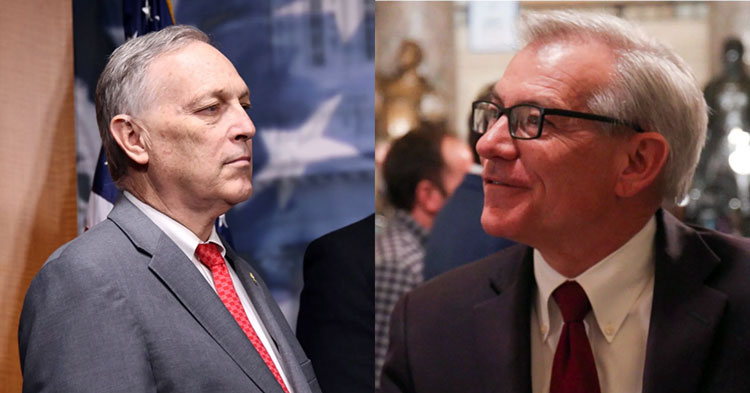
WASHINGTON – Karrin Taylor Robson’s abrupt exit from the Arizona governor’s race last week narrowed the Republican field to a pair of congressmen who offer a fairly clear choice in terms of ideology and style.
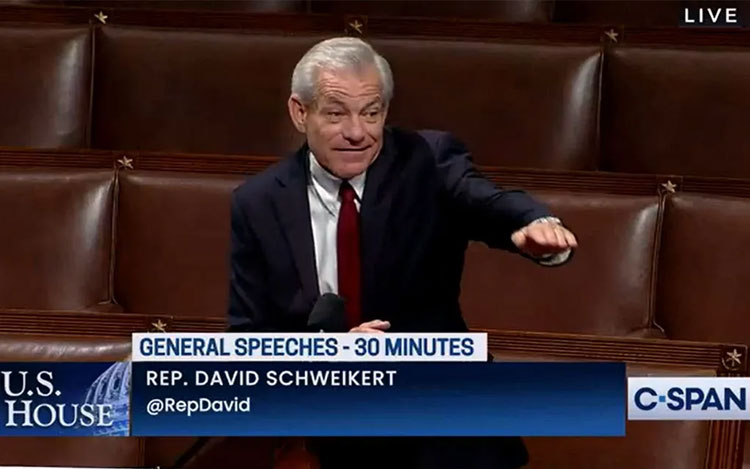
Rep. David Schweikert of Fountain Hills, elected in 2010, is a self-described “classic free-market conservative” known for railing for countless hours on the House floor against deficit spending.
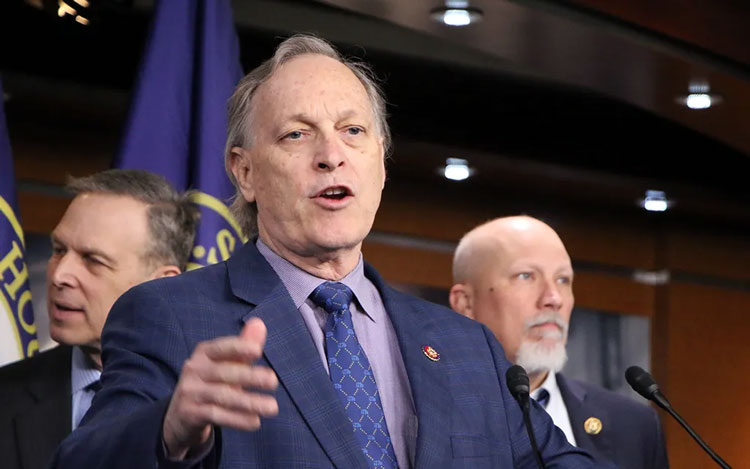
Rep. Andy Biggs of Gilbert, elected in 2016 after serving as president of the state Senate, is a MAGA warrior, former chair of the far-right House Freedom Caucus, and staunch defender of President Donald Trump.
So far, Biggs has outraised his rival more than 2-1 – $1.9 million to Schweikert’s $872,000, according to filings with Arizona’s Secretary of State’s Office.
But Schweikert joined the race in September, eight months after Biggs, and he also raised $1.7 million for his congressional account. He could use much of that in his run for governor, though not the $660,000 from political action committees, because Arizona doesn’t allow such donors in state elections.

Biggs is backed by both Trump and the influential Turning Point USA, whose political action committee has already spent nearly $460,000 to help him, according to campaign finance reports.
Trump had also endorsed Robson. So her departure likely helps Biggs consolidate support, though Schweikert could also benefit, analysts say, if her business-minded donors shift to his camp.
Biggs has been “standing shoulder to shoulder with President Trump,” and that’s very helpful in a Republican primary, said Arizona political consultant Chuck Coughlin.
Neither campaign responded to requests for comment.

Part of Schweikert’s pitch is his appeal to independents, hitting Biggs for feeding public anger rather than focusing on solutions. He has downplayed his rival’s endorsements.
“I believe often when you do the endorsement game, you give up some of your freedom to always tell the truth,” he told 12News last weekend.
The winner on July 21 is likely to face Democratic Gov. Katie Hobbs in November. The filing deadline for the primaries is March 23.
“Right now Biggs has momentum, and it’s hard to see a pathway for Schweikert’s nomination,” Don Critchlow, director of the Arizona State University Center for American Institutions, said by email.
Whoever wins the nomination will hardly be a shoo-in against Hobbs, though. He cited the power of incumbency and “general backlash toward Republicans on a national level. This can change, but right now any Republican candidate running for governor has an uphill battle.”
Largely aligned
On a host of policies, Biggs and Schweikert largely align with each other and with the president. There’s little doubt Biggs is more MAGA, though.
From 2019 to 2021, Biggs chaired the House Freedom Caucus, a group formed in early 2015 to push Republicans further to the right.

Schweikert was among the first few dozen members but left in 2023, saying he wanted to distance himself from a group with a similar name in the Arizona Legislature that is “more populist” than conservative.
As for voting with Trump, Schweikert actually outdid his rival in 2025 despite Biggs snagging the endorsement. He scored 100% compared to 96% for Biggs in a VoteHub analysis of 282 votes on which Trump had stated a clear position.
In 2022, Trump endorsed Schweikert for reelection when Democrats were targeting his district, calling him “a tireless advocate” for Arizona and a “Principled Conservative.”
In the governor’s race, the president had issued an unusual double endorsement, starting with Robson. Four months later, in April, he added Biggs.
In 2020, both Biggs and Schweikert defied Trump by joining with Democrats on a vote intended to force the president to get congressional approval before going to war with Iran.
Just 11 House Republicans supported the measure, which would have revoked a 2002 law authorizing presidents to use the military in a way Biggs called “a “blank check to deploy troops in the Middle East against almost any enemy.”
That departure was especially rare for Biggs, who has gone out of his way to tie himself to Trump. He calls his agenda the “America First Contract,” echoing Trump’s “America First” slogan.
When Trump refused to concede the 2020 election, Biggs was one of his most outspoken advocates. Even after a GOP-led audit of votes in Maricopa County affirmed President Joe Biden’s victory in Arizona, Biggs insisted at a congressional hearing that “we don’t know” who won.
On Jan. 6, 2021, 139 House Republicans voted to overturn the election, including Biggs and Schweikert.
Both voted to reject Biden’s win in Pennsylvania. Schweikert voted to certify the Biden victory in Arizona, though during his recent 12News interview, he refused to acknowledge that Trump lost the state.
In 2019, Biggs led a failed effort to censure Rep. Adam Schiff of California, now a senator, who led the first impeachment inquiry against Trump.
He blamed the impeachment effort on a conspiracy by “the deep state, or swamp.”
“The fanatics who hated Donald Trump during the 2016 presidential campaign are continuing to undermine him using those entrenched in government to perpetuate their coup against this president,” Biggs wrote in a Fox News essay.
In 2024, he helped lead the successful effort to impeach Biden’s Homeland Security Secretary, Alejandro Mayorkas, though the effort died in the Democratic Senate without a trial.
Last March, Biggs tried to persuade the House to remove a federal judge who had blocked deportations of alleged Venezuelan gang members to El Salvador.
Biggs’ congressional website features a 30-minute documentary titled “Alien Invasion” about illegal border crossings under Biden.
Schweikert has criticized Immigration and Customs Enforcement’s conduct in Minneapolis, calling the killing of two U.S. citizens “absolutely unacceptable.”
Vying for the most conservative
Schweikert has no major endorsements in the primary.
Apart from Trump himself, Biggs has gotten a boost from Turning Point USA, a leading organization in Trump’s Make America Great Again movement.
Turning Point calls him “the only person we trust to work with the White House on day one.”
“Go Biggs or go home is where we are at,” Erika Kirk, Turning Point’s CEO and the widow of founder Charlie Kirk, told a Phoenix crowd of about 30,000 in December.
Two of the other four Arizona Republicans in Congress also support Biggs: Reps. Paul Gosar of Bullhead City and Eli Crane of Oro Valley, both fellow members of the House Freedom Caucus.
In 2023, Biggs and Crane were among the eight conservatives who voted with Democrats to oust GOP Speaker Kevin McCarthy, throwing the House into turmoil for weeks.
Crane, in an interview with Cronkite News before Robson dropped out, called Biggs “one of the most conservative members of the House.”
“He’s poised to be one of the best governors,” he said.
Conservative advocacy groups give high marks to both Biggs and Schweikert.
The American Conservative Union, which organizes the Conservative Political Action Conference, gives Biggs a lifetime rating of 97% and Schweikert 95%. Biggs has voted the wrong way just three times, in the ACU’s view, while Schweikert strayed 14 times during a longer congressional career.
Ratings from progressive groups mirror those scores.
The League of Conservation Voters, for instance, gives Biggs a 3% lifetime score, with credit for eight votes it views as pro-environment. Schweikert’s score is 5%, with 24 votes the group liked.
Turning Point Action gives Biggs a 98% lifetime score, far higher than Schweikert’s 84%. For comparison, the highest score for any Arizona Democrat was 28%, which went to Rep. Greg Stanton of Phoenix.
Among the recent votes for which TPA penalized Schweikert: votes to increase the supply of housing, extend trade preferences for dozens of African nations, and approve the annual defense budget.
Biggs was one of just 17 House Republicans to oppose that defense bill, and two other major appropriations bills.
Schweikert supported each of those bills, putting him in line with party leadership and the majority of House Republicans.
Appeal to the base
Biggs and Schweikert’s views on a host of issues aren’t far apart.
On abortion, for instance, Planned Parenthood gives them both a zero. Both have supported legislation to restrict access and block the use of federal funds by groups that provide abortions.
Both oppose the Affordable Care Act, also known as Obamacare, though Biggs has emphasized a demand for repealing the law while Schweikert advocates for “reforms that improve affordability and provide flexibility.”
Both consider themselves fiscal hawks. But for Schweikert, the deficit is a signature issue. Biggs has also described the federal debt, now nearly $39 trillion, as a national security threat.
Both opposed the massive Biden-era infrastructure bill and backed Trump’s significant 2017 tax cuts and last summer’s One Big Beautiful Bill. All of those measures added to the federal debt, according to nonpartisan analysts.
Both candidates have faced ethical questions.
In 2022, a former Trump aide told the House committee that investigated the Jan. 6 attack on the Capitol that Biggs, among others, had sought a pardon from Trump for his role in the “stop the steal” riot. Biggs rejected the assertion.
In 2020, the House Ethics Committee found that Schweikert committed 11 campaign finance violations, including misusing official funds, failing to report over $140,000 in contributions, and pressuring staff to perform campaign work.
The bipartisan committee fined him $50,000. In 2022, Schweikert agreed to pay $125,000 in fines to the Federal Election Commission.
Schweikert is no moderate, but his fiscal conservatism and looser alignment with Trump could help him appeal to independents, analysts say.
Unlike Biggs, he has won elections in a competitive district. In 2024, Schweikert eked out an eighth term with 51.9%. Biggs received 60.4% in a safe red district.
“If you come from a 16-point Republican district, you don’t actually have to pay attention to the third of Arizona voters that are independent. I do,” Schweikert told 12News last weekend.
Coughlin agrees that Schweikert would have an easier time in a general election. But the primary electorate will be dominated by “a hardcore MAGA base,” he said.
“I still struggle to try and define what Schweikert’s lane is,” he said.
For more stories from Cronkite News, visit cronkitenews.azpbs.org.