
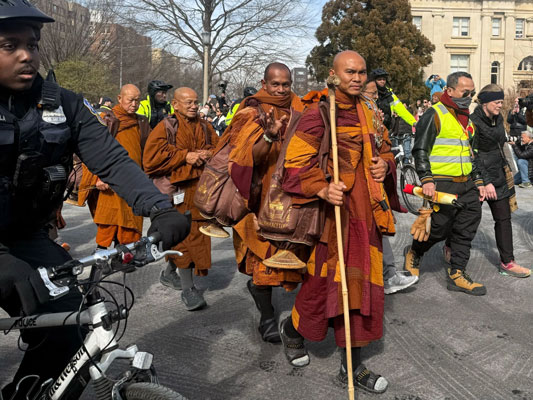
WASHINGTON – After a 2,300-mile “Walk for Peace,” a group of Buddhist monks arrived Tuesday at their final destination, drawing thousands of excited residents, students, and tourists.
“We are not walking from Fort Worth, Texas, to Washington, D.C., to bring you any peace,” the group’s spiritual leader, Bhikkhu Pannakara, told the throng outside the Washington National Cathedral, “but to raise the awareness of peace so that you can unlock that box and free it, let peace bloom and flourish among all of us, throughout this nation and the world.”
He led the thousands gathered before him on a chilly winter afternoon in a breathing meditation. And he counseled them to spend far less time on their phones.
For those in the crowd, the moment was deeply moving.
“I love that so many people participated. … It’s just incredible,” said Chris Albutz, 68, a retired teacher from Fredericksburg, Va.

Nineteen monks started the pilgrimage in Fort Worth. During the 108-day trek, they battled ice, snow, and harsh winds across eight states before finally crossing the Potomac River from Arlington, Va.
They entered the capital during rush hour. Police on bicycles and motorcycles escorted them through the snowy streets of D.C., temporarily blocking cars as the monks passed.
About three weeks into the walk, a car struck one of the monks as they walked through a small city east of Houston. Phra Ajarn Maha Dam Phommasan, a senior monk at a Georgia monastery, ended up losing a leg. He joined the group on Tuesday in a wheelchair.
The monks – and their dog, Aloka, the “Peace Dog” – averaged 20 to 23 miles per day, drawing millions of fans online who followed their progress on a Live Map.
The dog, whose name means light, underwent surgery on his leg in January but rejoined the group for the final stretch.
He sat on a blanket at Pannakara’s feet at American University’s Bender Arena, the first stop in the city.
Along the route, people held flowers or waved hand-drawn posters of praise.
Beverly Keane, 77, a tourist from Washington state, arrived at the arena hours earlier.
“Our country, we’re lost, and I believe the message that we’re lost because we’re living a ‘multitasking life.’ We’re so tuned into technology that we really lost the human aspect of ourselves,” she said.
Pannakara, who came up with the idea for the walk, hit that theme hard at AU. He warned students and others against getting overly attached to technology because “our mind can only focus on one thing at a time.”
“Live with this present moment, here and now,” he said. “That is your job. That is your duty – bringing that mind back to this present moment with each and every breath going in and out. If you could do that, you will have a peaceful day.”

Sarah Belson, 56, an American University education professor from Phoenix, said AU has “always been really welcoming of lots of different backgrounds.”
“We’re a home to civil disobedience and civil unrest in a really structured way,” she said, adding that her students were “happy to see somebody doing something. The action part of it is really compelling.”
Belson said that her school, like others, “needed a little mindfulness and peacefulness.”
Daisy Pulido, a 19-year-old first-year student from Fort Worth, kept up with the monks on social media as they made their way across the country.
“I’ve seen them all over, on every platform,” said Pulido, who is studying international studies and finance. “I wanted to go see it myself. … It’s a once in a lifetime opportunity.
After the hour-long event at the arena, some attendees raced outside to watch the monks continue their journey. Many followed them on their mile-and-a-half walk to the Washington National Cathedral for their next appearance.
The gothic-style Episcopal cathedral has hosted funerals and memorial services for 21 presidents since construction began in 1907, plus vice presidents, Supreme Court justices, and the first man to walk on the moon.
For those on hand on Tuesday, the monks’ arrival was also historic.
“I am so grateful for the mission and the purpose of these monks. For me, this time of peace, for everyone, is very, very needed,” said Albutz.
After their appearance at AU, the crowd went to the Washington National Cathedral, where the monks continued their walk and words of wisdom to thousands more guests.
Yong Clark, 53, a professional flutist from Oakton, Va., was among the thousands at the cathedral. He said the monks’ journey was a reminder that “there are peaceful people around the world.”
It was “great to see them come out of the woodwork and to support each other, regardless of color, creed, ethnicity,” he added.
The Fort Worth monks were joined by dozens of other monks at the cathedral.
Pannakara said he never imagined how many people would be drawn to the movement.
Kenneth Hudson, a 56-year-old business owner from Atlanta, said he first saw the monks in Snellville, Ga., where he received a prayer bracelet from one of them.
“I’ve been following the Buddhist philosophy ever since,” Hudson said. “Everything that they try to instill in each one of us is just peace, serenity, joy, and happiness.”
On Wednesday, the monks will speak at the Lincoln Memorial.
On Thursday, they will start their journey back to Fort Worth – by bus.
For more stories from Cronkite News, visit cronkitenews.azpbs.org.