
Staff Reports
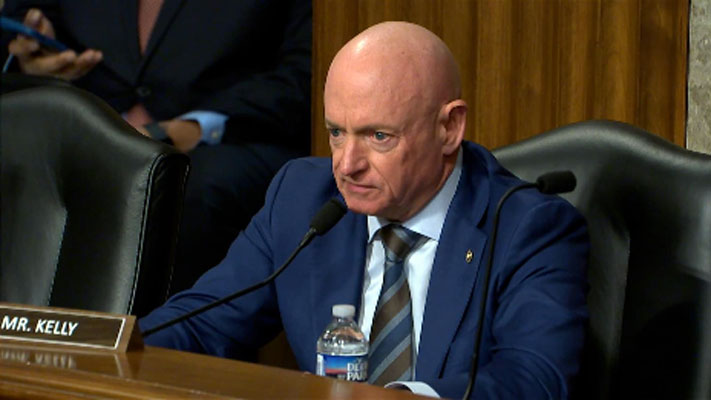
WASHINGTON D.C. – As the world marks the expiration of the New START treaty – the last remaining major nuclear arms control agreement between the United States and Russia – Arizona Sen. Mark Kelly is urging caution against policies that could ignite a new era of unchecked nuclear proliferation. During a recent Senate Armed Services Committee hearing, the Navy combat veteran highlighted the risks of pursuing expansive missile defense systems, warning they could undermine global stability and burden future generations with a more dangerous world.
The New START treaty, formally known as the Treaty on Measures for the Further Reduction and Limitation of Strategic Offensive Arms, was signed in 2010 and entered into force in 2011. It capped the number of deployed strategic nuclear warheads at 1,550 for each side and limited deployed intercontinental ballistic missiles (ICBMs), submarine-launched ballistic missiles (SLBMs), and heavy bombers equipped for nuclear armaments to 700. The treaty also allowed for mutual inspections and data exchanges to verify compliance, fostering transparency and reducing the risk of miscalculation between the two nuclear superpowers. Its expiration on Feb. 5, 2026, comes amid heightened tensions, with Russia suspending its participation in 2023 and no immediate prospects for renewal or a successor agreement.
This development echoes the perils of the Cold War, a decades-long standoff between the United States and the Soviet Union that began in the late 1940s and lasted until the early 1990s. Characterized by ideological rivalry, proxy wars, and a massive nuclear arms race, the Cold War saw both sides amass thousands of warheads, pushing humanity to the brink of annihilation during crises like the 1962 Cuban Missile Crisis. Arms control efforts, starting with treaties like the 1972 Anti-Ballistic Missile Treaty, aimed to curb this escalation, but the lapse of New START now threatens to unravel decades of progress in limiting nuclear arsenals.

At this week’s Senate hearing, Kelly pressed expert witnesses about how to maintain strategic stability in a post-New START world. He expressed deep concerns over the administration’s push for the “Golden Dome” concept – a proposed homeland missile defense system scaled to counter full-scale nuclear attacks from Russia and China, potentially costing hundreds of billions or even $1 trillion.
“That challenge is getting more complex as New START approaches expiration,” Kelly said. “At the same time, this administration is trying to throw billions or hundreds of billions eventually, at this Golden Dome concept, a homeland missile defense supposedly scaled to counter full salvoes of nuclear ballistic missiles from both Russia and China. Physics favors the offense. Intercepting ballistic missiles with decoys present, at hypersonic speeds, and mid-course or terminal phase is extremely hard. Countermeasures are cheap. Tests are scripted, and real adversaries adapt. A defender must stop everything. The attacker only needs a few to get through. In my view, missile defense can undermine mutual deterrence, and I think a shield can be a false sense of security.”
Kelly’s exchange with retired Adm. Charles A. Richard, former commander of U.S. Strategic Command, underscored the debate. When Kelly questioned whether such defenses could handle full ICBM salvos, Richard affirmed, “I do. Absolutely, because the goal is not to—you’re not going to intercept every single weapon going in, but you will intercept enough of them that one will drive your opponent to have to consider a much larger attack than they might otherwise have. There’s a deterrent value in that alone.”

Kelly countered by noting the low cost of decoys, to which Richard replied, “I would agree decoys are pretty cheap. I would agree that there are ways to discriminate through that. I also think directed energy is pretty cheap. And so, I think there is a technological competition not unlike other ones we’ve had in our history that we can win.”
Turning to Ambassador Rose E. Gottemoeller, a former U.S. negotiator on arms control, Kelly asked if the Golden Dome approach was destabilizing. Gottemoeller emphasized a need for limited, integrated defenses against opportunistic attacks, stating, “I support what we agreed and recommended in the Strategic Posture Commission report. That is, limited missile defenses against conventional and nuclear threats to the United States integrated air and missile defense… We need to take a comprehensive look at this, including the very long experience the Russians have with countermeasures of all kinds, and figure out what will buy us the most effectiveness in countering limited, opportunistic attacks on our critical targets.”
Kelly wrapped up his remarks with a stark warning about the long-term consequences: “I am very concerned that we could throw $1 trillion at a problem that ultimately, we will find is unsolvable, that we will not be able to get a four-nines kind of reliability out of it. And we just wind up encouraging our adversaries to build more ballistic missiles, more warheads. And then this problem ultimately grows out of control. I mean, we’ve seen this before. We’ve got the numbers down. And I really worry about the future for our kids and our grandkids living in a world where we have multiple countries with potentially thousands and thousands of nuclear weapons.”
Kelly’s intervention comes at a critical juncture, as experts warn that without arms control, Russia and China could expand their arsenals, prompting a similar response from the U.S. The senator, drawing on his military background, advocates targeted investments, such as the existing 44 interceptors at Fort Greely, Alaska, designed to counter rogue-nation threats, rather than an expansive system that could spark an arms race.
As the dust settles on New START’s expiration, Kelly’s call for prudence resonates amid growing calls for renewed diplomacy. Without a new framework, the specter of the Cold War’s nuclear brinkmanship looms larger than ever.